




You snapped at someone you love over something small. Again. And you have no idea why. A moment ago, things felt fine. Now your heart is racing, your words came out sharp, and the guilt is already piling up. This is not a character flaw.
So what does it mean to be emotionally unstable? It means your nervous system struggles to regulate, predict, or return to a calm state after stress. It is not about being dramatic or weak. This article covers the real signs, causes, daily impact, treatment options, and honest self-help strategies, including what you should not do.
What Does It Mean to Be Emotionally Unstable? (The Honest Definition)
what does it mean to be emotionally unstable: Being emotionally unstable means having ongoing difficulty managing your emotional regulation. Your feelings come fast, hit hard, and take longer than normal to settle back down. This is not the same as having a bad day or going through a rough week.
It is not a drama. It is not a weakness. It is not being “too sensitive.” Research shows it is a pattern of responses that the nervous system learned often long before you had the words to describe it.
Normal mood changes are short and tied to clear triggers. Emotional instability is different. The reaction feels out of proportion. Recovery takes hours or even days. Patterns repeat despite wanting them to stop.
Myth: Being emotionally unstable means you are dangerous or beyond help.
Fact: Most people with mental health issues like this live full, connected lives with the right support.
10 Signs You May Be Emotionally Unstable
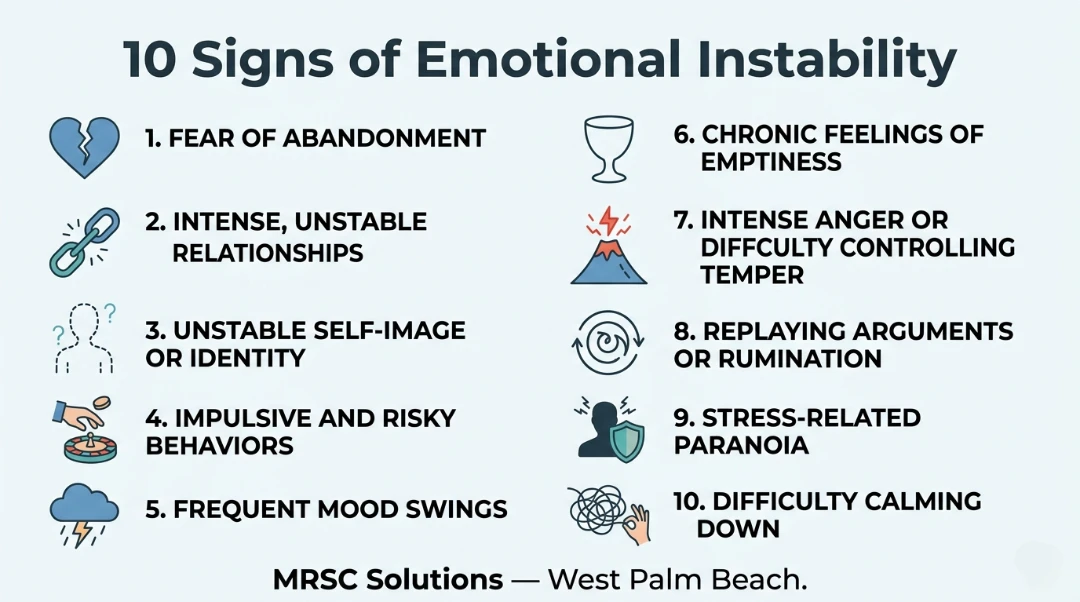
These common signs show up in everyday moments. See how many feel familiar what does it mean to be emotionally unstable. This is what it looks like when someone is spiralling inside their own emotional patterns.
1. Rapid, Unpredictable Mood Swings
You felt fine at breakfast. By lunch, everything felt unbearable. Mood swings this fast are a key signal.
2. Emotional Reactions That Feel Too Big
A small criticism at work triggers a full wave of shame or rage. Your intense emotions do not match the size of the situation.
3. Difficulty Calming Down Once Triggered
Even after the argument ends, your body stays in fight mode for hours. This is emotional dysregulation in action.
4. Impulsive Behavior You Later Regret
You quit, spent, said, or texted something in a moment of emotion. Impulsive behavior often follows emotional flooding.
5. Fear of Rejection or Abandonment
A friend takes hours to reply and you assume the worst. Even minor situations feel like proof someone is leaving. This connects strongly to relationship difficulties.
6. Unstable Relationships
Close bonds go from warm to cold fast. Borderline personality disorder (BPD) and emotionally unstable personality disorder both list this as a defining feature.
7. Hard Time Keeping Plans or Promises
Your intentions are real. But when emotions shift, following through collapses.
8. Feeling Empty or Numb Between Episodes
Between bursts of extreme mood there is a flat, hollow feeling. Like nothing matters.
9. Replaying Arguments Obsessively
You lie awake replaying what was said, editing your responses, feeling the hurt fresh every time. This is one of the quiet signs of a mentally unstable person most people do not talk about.
10. Difficulty Empathizing When Overwhelmed
When you are flooded with your own pain, there is almost no bandwidth left to hold space for others. This damages relationships over time.
What Causes Emotional Instability? (It Is Not Your Fault)
Understanding why you are disturbs emotionally matters. There is almost always a root cause, usually more than one.
- Genetics and family history if a parent struggled with mental illnesses, you are more likely to as well.
- Childhood trauma or neglect early experiences teach the nervous system that emotions are unsafe or unpredictable.
- Underlying mental health conditions bipolar disorder, ADHD, PTSD, anxiety and depression all involve emotional dysregulation.
- Chronic stress and burnout sustained pressure shrinks your capacity to cope.
- Hormonal changes puberty, postpartum periods, and menopause all shift emotional thresholds significantly.
- Substance use short-term relief worsens long-term trouble managing emotions.
- Physical health conditions neurological or autoimmune conditions affect brain chemistry and mood.
A trauma lens helps here. Emotional instability is often a nervous system adaptation not a personal failure. The body learned to stay alert because staying alert once meant survival.
Is Emotional Instability a Mental Health Disorder?
Emotional instability is a symptom, not a standalone diagnosis. It is not in the DSM as its own condition. But it runs through many mental health disorder categories.
Conditions it is closely tied to:
- Borderline Personality Disorder (BPD) marked by unstable emotions, identity, and relationships.
- Emotionally Unstable Personality Disorder (EUPD) the European diagnostic name for BPD. Same condition, different label.
- Bipolar Disorder involves cycling between high and low extreme mood states.
- ADHD emotional flooding is a recognized but underreported feature.
- PTSD triggers activate survival responses that feel like emotional explosions.
- Anxiety and Depression both interfere with baseline emotional regulation.
Important: do not define emotionally unstable for yourself using an article or quiz. A trained professional can assess what is actually driving your patterns. Self-diagnosing is not a substitute for that.
How Emotional Instability Affects Your Daily Life
Relationships
Conflict cycles build quickly. Relationship difficulties pile up. Partners, friends, and family feel confused or hurt. Fear of abandonment creates the exact push-pull that damages the bonds you most want to keep.
Work and School
Poor focus, impulsive behavior, and interpersonal friction make professional life hard. Deadlines feel overwhelming. Feedback feels catastrophic.
Self-Image
Shame becomes chronic. People ask themselves “why am I so emotionally unstable” and then turn the answer into proof they are broken. They are not.
Physical Health
Disrupted sleep, stress-related symptoms, and immune dysfunction follow unmanaged emotional chaos. The mind and body are not separate systems.
Emotional Instability vs. Mood Swings: What Is the Real Difference?
|
Factor |
Normal Mood Swings | Emotional Instability |
| Frequency | Occasional |
Frequent, unpredictable |
|
Intensity |
Proportional to trigger | Often feels too big |
| Recovery time | Minutes to hours |
Hours to days |
|
Trigger clarity |
Usually clear | Often unclear or minor |
| Daily impact | Low |
Significant |
Can You Be Emotionally Unstable Without Knowing It?
Yes. Many people normalize their patterns because that is all they have ever known. If you grew up in a chaotic or emotionally inconsistent environment, your baseline is already set differently.
Signs others may notice before you do: pulling away after minor conflict, apologizing constantly then repeating the same behavior, or describing yourself as an “emotional wreck meaning” like it is just your personality.
Ask Yourself These Questions
- Do I often feel like my reactions are too big but cannot seem to stop them?
- Do I replay arguments for days after they end?
- Do people in my life say I am hard to predict emotionally?
- Do I often feel empty or numb when I am not in a crisis?
- Have I hurt relationships because of how I handled emotions?
If several of these hit close, that is worth paying attention to.
How to Deal With Emotional Instability: What Actually Helps
Professional Treatment
Dialectical Behavior Therapy (DBT) is the gold standard for managing emotional instability. It teaches specific skills for tolerating distress, regulating intense emotions, and improving relationships.
Cognitive Behavioral Therapy (CBT) helps identify and shift thought patterns that fuel emotional spirals.
Trauma-focused therapies including EMDR and somatic therapy address the root nervous system patterns beneath the surface.
Medication, when appropriate, can stabilize the neurological baseline. Mood stabilizers and antidepressants are sometimes part of a broader plan alongside therapy.
At MRSC Solutions, our licensed clinicians specialize in Depression Treatment West Palm Beach and Anxiety Treatment West Palm Beach. Whether you are struggling with undiagnosed depression symptoms, workplace burnout, or patterns that have gone unexplained for years we build treatment plans around your actual life.
Self-Help Strategies
- Mindfulness and grounding techniques the 5-4-3-2-1 method (name 5 things you see, 4 you hear, etc.) interrupts emotional flooding in real time.
- Building a consistent daily routine predictability calms a nervous system wired for chaos.
- Prioritize sleep, nutrition, and exercise; these are emotional regulation tools, not optional extras.
- Journal and track emotional patterns over time, you will see your triggers clearly.
- Identifying known triggers early avoidance is not always possible, but awareness gives you a head start.
What NOT to Do
- Do not white-knuckle it alone. Willpower is not a treatment plan.
- Do not use substances to regulate emotions. Short-term numbing worsens long-term dysregulation.
- Do not dismiss it as “just stress.” Chronic patterns need real attention, not minimization.
When to Seek Professional Help
It is time to talk to someone when:
- Your emotional patterns are affecting work or school
- You are struggling to maintain close relationships
- You feel like an “emotional wreck” more often than not
- You are using substances, food, or avoidance to cope
- You have thoughts of harming yourself or others
- You feel hopeless that anything will change
Therapy is not a last resort. It is the most direct route to change. When choosing a therapist, look for someone trained in dialectical behavior therapy DBT or trauma-informed care especially if you suspect your patterns started young.
Conclusion
What does it mean to be emotionally unstable? Emotional instability is a signal, not a sentence. It tells you something about what your nervous system learned and what it still needs. Healing is possible. Many people move from being an emotional wreck to living with real stability, through the right support and honest work. If this resonated with you, consider speaking with a mental health professional. You can start by simply acknowledging what you have been carrying. If you are in West Palm Beach and ready for that first step, contact us MRSC Solutions is here to help.
FAQs
What does it mean to be emotionally unstable?
It means having ongoing difficulty with emotional regulation, emotions that come fast, feel intense, and take much longer than normal to settle. It is not a character flaw. It is a pattern the nervous system developed.
Is emotional instability the same as BPD?
Not exactly. Borderline personality disorder BPD and emotionally unstable personality disorder (EUPD) are closely related diagnoses. But emotional instability also appears in bipolar disorder, ADHD, PTSD, anxiety, and depression. A professional diagnosis tells you what is actually driving it.
Can emotional instability be cured?
It can be treated and significantly reduced. Research shows that therapies like DBT produce lasting improvements in emotional regulation. Many people go from crisis-level instability to stable, functional lives.
What triggers emotional instability?
Common triggers include conflict, perceived rejection, stress overload, sleep deprivation, and unresolved trauma. Over time, tracking patterns helps you seek professional guidance specific to your triggers.
Is being emotionally unstable a choice?
No. Emotional dysregulation is rooted in neurology, trauma history, and mental health conditions none of which are chosen. The choice comes in what you do next.