





Teen mental health news has taken center stage in 2026. Rates of teen anxiety and depression statistics are climbing, and parents, schools, and doctors are all asking the same question: what is really going on with our youth? The answers are not simple, but the data is clear.
This article covers the latest teen mental health statistics 2026, explains the biggest risk factors, and gives you real, science-backed steps to help. Whether you are a parent, teacher, or teen yourself, this guide is written for you.
The State of Youth Mental Health in 2026

The youth mental health crisis statistics 2026 paint a serious picture. Studies released this year show that nearly 1 in 5 adolescents in the United States meets the criteria for a mental health condition. Rates of teen mental health statistics 2025 2026 trends show a steady rise since 2019, with a sharp acceleration post-pandemic.
According to current youth mental health statistics 2026, anxiety disorders are now the most common diagnosis among teens aged 13 to 17. The teen mental health crisis is not a trend. It is a public health emergency that requires the attention of every adult in a young person’s life.
Key findings from the latest teen mental health statistics 2026 include:
- 42% of high school students report feeling persistently sad or hopeless
- Girls are twice as likely as boys to report persistent anxiety and severe depression signs
- Emergency room visits for self-harm among teens aged 12 to 17 increased by 31% between 2020 and 2025
- Only 1 in 3 teens with a diagnosable condition receives any professional treatment
These numbers matter. But behind every statistic is a real teenager who deserves real support.
What Is Driving the Adolescent Mental Health Crisis?
Academic Pressure and School Stress
Survey data from the American Psychological Association shows that 83% of teenagers name school and grades as a top source of stress. The pressure to perform, get into college, and keep up with peers starts earlier than most adults realize. This persistent anxiety tied to academic pressure is now one of the biggest triggers for teen anxiety and depression trends across the country.
The Social Media Factor
The social media impact on teen mental health is one of the most researched topics in modern mental health science. The U.S. Surgeon General issued a formal advisory warning that teens who spend more than three hours daily on social media face double the risk of anxiety and depression. The average teen now spends around 3.5 hours per day on these platforms.
How is social media affecting teenagers in concrete ways? Research shows it drives body dissatisfaction, social comparison, and low self-esteem especially in adolescent girls. Nearly 46% of teens aged 13 to 17 say social media makes them feel worse about their own bodies. More than a third of adolescent girls report feeling addicted to these platforms.
The connection between social media and declining youth mental health is now accepted by the American Psychological Association, the CDC, and the World Health Organization. Parents who want to understand how is social media affecting teenagers in their own home should look at both screen time and the type of content their child consumes.
Loneliness and Social Disconnection
61% of young adults in the United States say they experience loneliness severe enough to interfere with daily activities. After years of pandemic disruption, many children and adolescents never fully rebuilt the social connections they lost. Group settings that once felt normal now feel overwhelming for a growing number of teens.
Teen Mental Health Trends 2026: What Is New This Year
Teen mental health trends 2026: show several patterns that differ from prior years:
Anxiety is now the leading presenting problem: Depression still ranks high, but anxiety including social anxiety, test anxiety, and generalized worry is the most common reason teens seek school counseling programs in 2026.
Boys are underdiagnosed and under-supported: While teen girls show higher rates of reported distress, boys are significantly less likely to seek help. Teen behavior analytics services 2026 from SAMHSA show boys are far more likely to act out behaviorally rather than report internal symptoms which means their adolescent mental health crisis often goes unnoticed longer.
Vaping and substance use are linked to mental health decline: CDC data from 2025 shows a direct link between teen vaping and elevated anxiety and depression rates. Adolescents who vape daily are 2.4x more likely to report youth depression symptoms than non-users.
Rural and lower-income teens face the biggest access gaps: Youth mental health support services remain concentrated in urban areas. Rural teens with suicidal thoughts or severe depression signs often wait months for an appointment. Telehealth has reduced this gap but has not closed it.
Early Warning Signs You Should Never Ignore
Many parents miss early signs because they mistake them for “normal teen behavior.” These are the red flags that signal a teen may need professional help:
Persistent anxiety that does not go away after a stressor passes, sleep disturbance lasting more than two weeks, withdrawal from friends and activities, mood swings affecting life at school or home, and expressions of hopelessness or worthlessness.
If a teen talks about not wanting to be here, or shows suicidal thoughts in any form, this is a crisis. Do not wait. Seek help immediately.
Understanding common problems teenagers face requires looking at these risks together. Sleep, screen time, substance use, and social pressure do not operate separately. They reinforce each other.
School Mental Health Programs and Government Response
School mental health programs are expanding in 2026, but not fast enough. The U.S. Department of Education allocated $280 million in 2025 grants for school-based mental health services. Yet the National Association of School Psychologists estimates there is still only one school psychologist for every 1,127 students far above the recommended ratio of 1:500.
School counseling programs are handling caseloads they were not designed for. Counselors who once focused primarily on academic planning now spend the majority of their time on crisis response and referral management.
Several state-level school mental health programs & policies updates in 2026 include:
- California mandating mental health days for students
- New York expanding school-based therapy access
- Florida requiring mental health education in grades 6–12
WHO’s 2025 report on Government / WHO / CDC mental health reports recommended that all countries integrate mental health into primary school curricula by 2030. The report cited evidence that early education about mental health awareness for teens significantly reduces stigma and improves help-seeking behavior.
Therapy vs Psychiatric Care: What Families Need to Know
Many parents do not know the difference between a psychiatrist vs psychologist or when each is needed.
A psychologist provides therapy and psychological testing but typically cannot prescribe medication. A psychiatrist is a medical doctor who can prescribe medication and often specializes in complex or treatment-resistant cases.
For most teens experiencing anxiety or mild-to-moderate depression, therapy, especially cognitive behavioral therapy (CBT) is the recommended first step. Therapy vs psychiatric care becomes relevant when symptoms are severe, when there is a family history of serious mental illness, or when a teen has not responded to therapy alone.
Digital mental health apps for teens like Calm, Woebot, and Headspace have shown modest benefits as supplements to therapy. They are not replacements for clinical care. Teens experiencing persistent anxiety or suicidal thoughts need human clinical support, not just an app.
Teen Behavior Analytics Services 2026: A New Tool for Schools and Clinicians
Teen behavior analytics services 2026 represent an emerging area of youth mental health support. These are software tools and programs that use behavioral data attendance patterns, academic performance dips, social withdrawal indicators to flag teens who may need support before they reach a crisis point.
Early pilots in school districts across Florida, Texas, and Colorado have shown that these tools can identify at-risk students up to six months earlier than traditional referral systems. Critics raise valid privacy concerns that continue to shape how these tools are deployed.
Used ethically and transparently, teen behavior analytics services 2026 may become one of the most important prevention tools available to schools not to surveil, but to support.
Youth Mental Health Support Services: Where to Find Real Help
Youth mental health support services exist at several levels:
School-based: Many schools now offer on-site counseling, crisis teams, and referral networks. This is often the first point of contact for teens.
Community mental health centers: These serve lower-income families and often operate on sliding fee scales. Wait times vary widely.
Private clinical practices: Offer the most individualized care. Telehealth has expanded access significantly since 2022.
Crisis lines: The 988 Suicide and Crisis Lifeline (U.S.) provides immediate support for teens in acute distress.
At MRSC Solutions, our Anxiety Treatment West Palm Beach services are specifically designed to address teen and young adult anxiety using evidence-based approaches. If your teen is showing signs of persistent anxiety, severe depression signs, or mood swings affecting life, our clinical team can help you find the right level of care from therapy to medication management.
What the Research Says About Prevention
Teen suicide prevention is most effective when it starts early and involves multiple layers of support. The Youth mental health crisis trends research consistently identifies three prevention factors that work:
- Connectedness: feeling like someone cares reduces suicide risk significantly
- Access to care: reducing barriers to treatment saves lives
- Reducing access to lethal means a proven strategy in public health suicide prevention
Mental health activities for teens that build emotional regulation skills are also protective. Structured physical activity, creative expression, mindfulness, and the box breathing technique all have evidence behind them. The key is consistency and early adoption, not waiting until a teen is in crisis.
The Global Picture: Youth Mental Health Crisis Trends Worldwide
The youth mental health crisis trends are not limited to the United States. WHO data shows:
- Globally, 1 in 7 adolescents ages 10–19 experiences a mental health condition
- Depression and anxiety account for 40% of adolescent disease burden in middle-income countries
- Suicide is the fourth leading cause of death among 15–29 year olds globally (WHO, 2024)
- Less than 2% of global mental health budgets are directed toward youth services in many low-income countries
The global adolescent mental health crisis requires coordinated policy, funding, and cultural shifts in how societies view teen emotional wellbeing. Countries with integrated school-based mental health support, reduced stigma campaigns, and accessible care show measurably better outcomes.
Extra Reading: Why Does Anxiety Cause Chest Pain?
What Parents Can Do Right Now: Practical Steps That Work
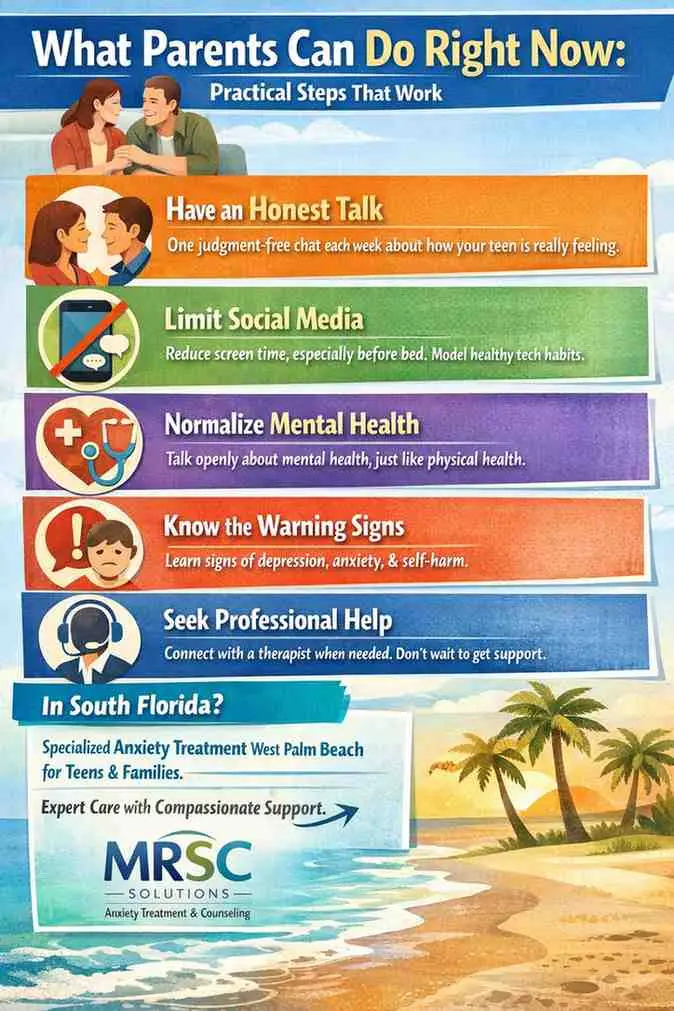
You do not need to be a therapist to help your teen. You need to be present. The latest teen mental health news consistently shows that parental connection is one of the most powerful protective factors available.
Practical steps you can take today:
- Have one honest, judgment-free conversation per week with your teen about how they are really feeling.
- Limit social media use, especially before bed, and model healthy technology habits yourself.
- Normalize mental health conversations the same way you talk about physical health.
- Learn the warning signs of depression, anxiety, and self-harm so you can act early.
- Connect your teen with professional support when needed. Waiting rarely helps.
If your family is based in South Florida, We offer specialized Anxiety Treatment West Palm Beach that is specifically designed for teens and their families. The team at MRSC Solutions combines clinical expertise with compassionate care, making it easier for teens to open up and start healing.
How MRSC Solutions Supports Teen and Family Mental Health
At MRSC Solutions, we understand that managing anxiety and navigating the teen mental health crisis requires more than a generic approach. Our team specializes in Anxiety Treatment West Palm Beach, offering evidence-based care tailored to adolescents and their families.
We work with teens experiencing persistent anxiety, sleep disturbance, anxiety symptoms, and related challenges. Our clinicians are trained in cognitive behavioral therapy, trauma-informed care, and family systems therapy.
If you are unsure when to see a psychiatrist or whether your teen needs more than what a school counselor can offer, we can help you find the right path. Seeking professional support through MRSC Solutions means getting a real assessment, a personalized plan, and consistent follow-through.
Conclusion
Teen mental health news in 2026 is urgent, but not hopeless. The data shows a youth mental health crisis that demands serious attention. The science also shows that early action, consistent habits, and professional support make a real difference.
Deep breathing, physical activity, consistent sleep schedules, and a balanced diet are not small things. They are the foundation of mental resilience. And when those tools are not enough, MRSC Solutions and qualified professionals are here to help. If your teen is struggling, do not wait. Contact us Solutions today and take the first step toward real recovery.
FAQs
What percentage of teens struggle with mental health in 2026?
In 2026, about 30% to 40% of teenagers report ongoing mental health struggles. Roughly 1 in 3 teens experience symptoms like anxiety, sadness, or emotional distress, showing that mental health challenges are now common among adolescents.
What are the top mental health issues affecting teenagers today?
The most common mental health issues in teens today are anxiety, depression, behavioral problems, and suicidal thoughts. Anxiety and depression lead the list, often linked to stress, social pressure, and lifestyle changes.
Has teen self-harm increased over the last 5 years?
Yes, teen self-harm has increased noticeably over the past five years. Reports show a rise in self-harm behaviors and suicide-related thoughts, especially after 2020, making it a serious concern for parents and healthcare providers.
Why are teen boys experiencing a mental health crisis?
Teen boys are facing a crisis due to emotional suppression, social isolation, and low help-seeking behavior. Many boys avoid sharing feelings or seeking therapy, which can lead to worsening mental health outcomes over time.
What are the leading health risks for adolescents in 2026?
The leading risks include mental health disorders, suicide, substance use, and excessive screen time. Mental health conditions are now among the top causes of illness and disability in adolescents worldwide.
How does loneliness affect teen mental health statistics?
Loneliness significantly increases the risk of depression, anxiety, and suicidal thoughts in teens. Studies show that socially isolated teens are more likely to report poor mental health and emotional distress.
What do 2026 trends say about youth mental health vs. 2024?
Compared to 2024, mental health rates in 2026 remain high but slightly more stable. While awareness and support have improved, overall stress and anxiety levels are still above pre-pandemic levels.
What is the youth mental health crisis and what causes it?
The youth mental health crisis refers to the rapid increase in anxiety, depression, and emotional struggles among teens. It is caused by factors like social media pressure, academic stress, reduced social connection, and limited access to care.
Are teen anxiety rates still rising in 2026?
Teen anxiety rates remain high in 2026, with many adolescents reporting frequent worry and stress. While the sharp rise has slowed, anxiety levels are still higher than before 2020.
Where can I find the latest adolescent mental health news?
You can find the latest updates from trusted sources like the World Health Organization, Centers for Disease Control and Prevention, UNICEF, and National Institute of Mental Health. These organizations provide current data, research, and expert insights.