
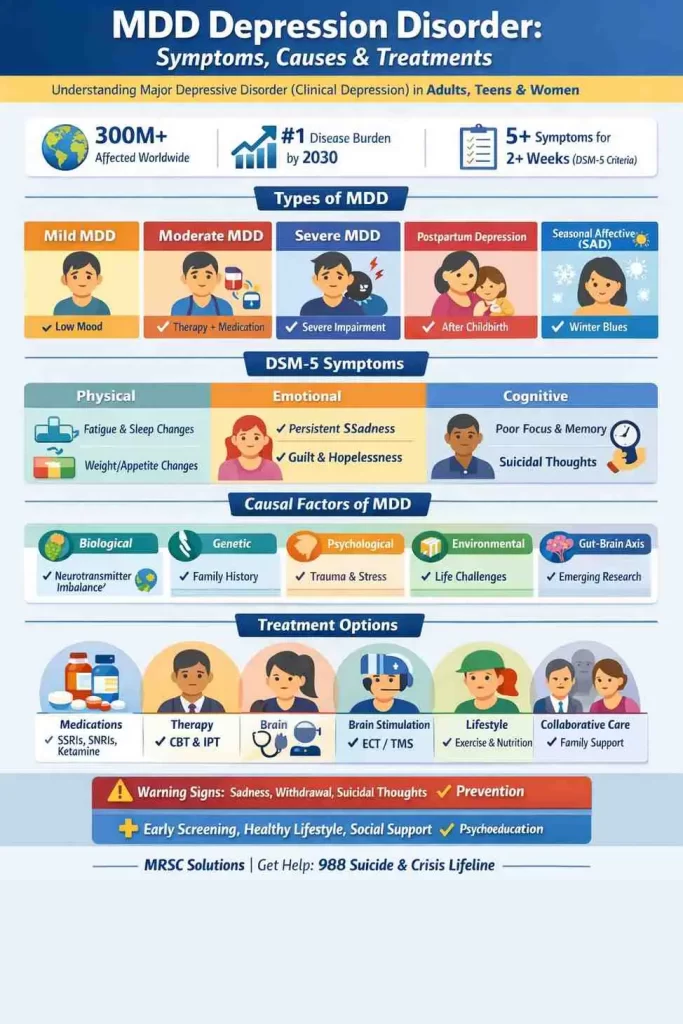
MDD Depression Disorder affects more than 300 million people worldwide, making it one of the leading causes of disability. It goes beyond sadness. It is a medical condition that changes how a person thinks, feels, and functions every single day. The World Health Organization projects that by 2030, clinical depression disorder will become the number one cause of disease burden globally.
Many people confuse normal sadness with MDD Depression Disorder. The difference is clear. MDD lasts longer, hits harder, and does not go away on its own. If you or someone you love is struggling, this guide by MRSC Solutions covers everything you need to know.
What Is MDD Depression Disorder?
MDD stands for Major Depressive Disorder. It is a mood disorder classification recognized by the American Psychiatric Association in the DSM-5 diagnostic criteria. To receive a diagnosis, a person must show at least five specific symptoms lasting two weeks or more.
The term clinical depression disorder is used by doctors to separate MDD from mild or situational sadness. It is not a sign of weakness or a character flaw. It is a real brain illness with measurable biological changes.
Types of MDD Depression Disorder
Not all cases of MDD look the same. Knowing the type helps doctors choose the right treatment plan faster.
Mild MDD
Mild MDD involves fewer symptoms and less impact on daily life. People can still function but feel a constant low mood or loss of enjoyment. Early treatment at this stage gives the best outcomes.
Moderate MDD
Moderate MDD causes clear problems at work, school, or in relationships. Symptoms are more frequent and harder to manage. Most people at this stage need both therapy and medication.
Severe MDD (With or Without Psychosis)
Severe depression disorder makes daily functioning nearly impossible. Some people experience psychosis, including hallucinations or delusions. This form requires immediate psychiatric evaluation and close medical supervision.
Postpartum Depression (MDD Subtype)
Postpartum MDD affects new mothers within four weeks of childbirth. Hormonal shifts, sleep deprivation, and life changes all contribute. Family involvement in mental and emotional health is critical here. Fathers and partners should watch for warning signs and offer consistent support.
Seasonal Affective Disorder (SAD)
SAD is a recurring depressive episode that follows seasonal patterns, most often in winter. Reduced sunlight affects serotonin and melatonin levels. Light therapy is a first-line treatment for this subtype.
Treatment-Resistant MDD
When a person does not respond to two or more antidepressants, it is classified as treatment-resistant MDD. Newer options like ketamine infusions and deep TMS are showing strong results for this group.
Major Depressive Disorder Symptoms (DSM-5 Criteria)
The DSM-5 diagnostic criteria list nine core symptoms of Major Depressive Disorder symptoms. A diagnosis requires at least five of these to be present nearly every day for two weeks, and at least one must be in a depressed mood or loss of interest.
| Pro Tip: You need 5 of 9 symptoms for at least 2 weeks for MDD diagnosis. Symptoms must cause real distress and affect daily life. |
Physical Symptoms
- Constant fatigue or loss of energy
- Changes in sleep (insomnia or sleeping too much)
- Changes in appetite or significant weight change
- Slowed movements or restlessness noticed by others
Emotional Symptoms
The emotional side of depressive mood and anhedonia is often the most painful. Anhedonia means losing interest in things you once enjoyed.
- Persistent feelings of sadness or emptiness
- Loss of pleasure in hobbies, relationships, or daily activities
- Feelings of worthlessness or excessive guilt
- Hopelessness about the future
Cognitive Symptoms
- Difficulty concentrating or making decisions
- Memory problems
- Recurrent thoughts of death or suicide
If someone is having suicidal thoughts, seek help immediately. Call 988 (Suicide and Crisis Lifeline) in the US.
MDD Symptoms in Women vs Men
Women with MDD are more likely to experience anxiety, guilt, and sleep problems. Men often show irritability, aggression, and risky behavior instead of sadness. This difference is a big reason why teen mental health news consistently reports that boys are underdiagnosed. Recognizing these gender differences leads to earlier treatment.
MDD Symptoms in Children and Teenagers
In teens, MDD often looks like irritability, school refusal, and social withdrawal rather than sadness. Physical complaints like stomachaches are common. Teen mental health awareness has grown in recent years, helping parents and schools catch symptoms earlier.
What Causes MDD Depression Disorder?
MDD does not have one single cause. It develops from a combination of biological, genetic, psychological, and environmental factors.
Biological Causes
A neurotransmitter imbalance in the brain is one of the most studied causes. Serotonin, dopamine, and norepinephrine are key brain chemicals that regulate mood. When these are out of balance, depressive symptoms emerge.
The HPA axis (hypothalamic-pituitary-adrenal axis) also plays a role. Chronic stress over-activates this system, flooding the brain with cortisol. Over time, this disrupts mood regulation and sleep.
Emerging research from 2024 highlights the gut-brain axis as a new frontier. The gut microbiome communicates directly with the brain via the vagus nerve. Poor gut health has been linked to higher rates of depression, and probiotic interventions are now being studied as supportive treatments.
Genetic and Hereditary Factors
MDD runs in families. Having a first-degree relative with MDD raises your personal risk by 2 to 3 times. Specific gene variants affect how the brain processes serotonin and stress hormones. However, genes are not destiny. Environment and lifestyle also play major roles.
Psychological Causes
Childhood trauma, abuse, neglect, and loss are strongly linked to adult MDD. Early negative experiences shape how the brain responds to stress. People with low self-esteem or chronic anxiety are also at higher risk. Learning how to survive living with a narcissist? or an emotionally abusive partner is an often-overlooked psychological trigger for recurrent depressive episodes.
Social and Environmental Triggers
Job loss, divorce, financial stress, isolation, and major life transitions can trigger a first or recurrent depressive episode. People often ask what happens when someone is spiralling. The answer: small stressors pile up until the person loses the ability to cope. Early intervention at that moment makes a real difference.
Risk Factors
| Risk Factor | Details |
| Age | Adults 18-45 most affected; onset common in late teens |
| Gender | Women are 2x more likely to develop MDD than men |
| Family History | First-degree relatives carry 2-3x higher risk |
| Chronic Illness | Diabetes, heart disease, and cancer raise MDD risk |
| Substance Use | Alcohol and drug use can trigger depressive episodes |
| Life Trauma | Abuse, loss, financial stress, or divorce are triggers |
How Is MDD Depression Disorder Diagnosed?
Diagnosis starts with a psychiatric evaluation by a licensed mental health professional or primary care doctor. There is no blood test for MDD. Diagnosis is based on symptoms, duration, and their impact on daily life.
DSM-5 Diagnostic Criteria Checklist
- Depressed mood most of the day, nearly every day
- Markedly reduced interest or pleasure in activities
- Significant weight change or appetite disturbance
- Insomnia or hypersomnia
- Psychomotor agitation or slowing
- Fatigue or loss of energy
- Feelings of worthlessness or excessive guilt
- Difficulty concentrating or making decisions
- Recurrent thoughts of death or suicidal ideation
Common Screening Tools
Doctors use standardized tools to measure severity. The PHQ-9 (Patient Health Questionnaire) is the most widely used. The Hamilton Depression Rating Scale is common in clinical research. The Beck Depression Inventory helps track symptoms over time. What is neuropsychiatric testing? It is a deeper evaluation that measures memory, attention, and mood using standardized cognitive tests. It is used when MDD overlaps with other brain-related conditions.
MDD vs Bipolar Disorder
Both conditions involve depressive episodes, but bipolar disorder also includes manic or hypomanic phases. This distinction matters greatly because some antidepressants can trigger mania in bipolar patients. A full psychiatric evaluation is essential before starting treatment.
MDD vs Normal Sadness
Normal sadness is usually tied to a specific event and fades with time. MDD is persistent, often without a clear cause, and disrupts the ability to work, sleep, or maintain relationships. Impaired daily functioning is the clearest sign that something beyond normal sadness is happening.
MDD Depression Disorder Treatment Options
The good news is that Major Depressive Disorder treatment works. About 80-90% of people respond to some form of treatment. The key is finding the right approach for each individual.
1. Medications (Pharmacotherapy)
Selective Serotonin Reuptake Inhibitors (SSRIs) are the first-line medication for most people with MDD. Common SSRIs include sertraline, fluoxetine, and escitalopram. They work by increasing serotonin availability in the brain.
SNRIs like venlafaxine target both serotonin and norepinephrine and are especially useful when anxiety accompanies depression. TCAs and MAOIs are older classes used when newer medications do not work.
Ketamine and esketamine (FDA-approved nasal spray) are now used for treatment-resistant MDD. They can reduce suicidal ideation within hours, unlike traditional antidepressants that take weeks. Lumateperone, updated by the FDA in 2025, is showing promise for MDD with mixed features.
2. Psychotherapy
Cognitive Behavioral Therapy (CBT) is the most researched and effective therapy for MDD. It teaches people to identify and change negative thought patterns. Most CBT programs run for 12 to 20 sessions.
Interpersonal Therapy (IPT) focuses on improving relationships and communication. DBT (Dialectical Behavior Therapy) is used for severe depression with emotional dysregulation. Group therapy for anxiety and depression is also gaining popularity as a cost-effective and socially supportive option. Shared experiences in group settings help reduce isolation.
3. Brain Stimulation Therapies
Electroconvulsive Therapy (ECT) remains the most effective treatment for severe, treatment-resistant MDD. Modern ECT is safe and conducted under anesthesia.
Transcranial Magnetic Stimulation (TMS) was FDA-approved in 2008 and requires no anesthesia. Deep TMS was FDA-cleared for teenagers in 2025, marking a major milestone for teen mental health treatment. These therapies are particularly important for people who cannot tolerate medications.
4. Lifestyle Changes
Exercise has meta-analytic support showing it matches the effectiveness of antidepressants for mild to moderate MDD. Aim for 30 minutes of moderate activity at least three days per week. Sleep hygiene, a balanced diet, reduced alcohol intake, and daily mindfulness practice all support recovery.
The gut-brain axis research supports eating fiber-rich foods and fermented foods to improve mood. Reducing ultra-processed food intake has been linked to fewer depressive symptoms in large population studies.
5. Collaborative Care and Family Involvement
Family involvement in mental and emotional health significantly improves treatment outcomes. When family members understand the condition, they provide better support and help reduce relapse. An interprofessional team of a psychiatrist, therapist, primary care doctor, and a supportive family creates the strongest recovery environment.
MDD Depression Disorder in Different Groups
MDD in Women
Women are twice as likely to develop MDD compared to men. Hormonal changes during puberty, menstruation, pregnancy, and menopause all affect mood regulation. Women are more likely to have comorbid anxiety and eating disorders alongside MDD.
MDD in Men
Men often mask depression through overworking, substance use, or aggression. Societal pressure to appear strongly delays their help-seeking by years. Recognizing male depression early requires looking beyond classic sadness to irritability and physical complaints.
MDD in Children and Adolescents
Childhood MDD is often misdiagnosed as behavioral problems. Academic decline, social withdrawal, and somatic complaints are key warning signs. Early treatment significantly reduces the risk of recurrent depressive episodes in adulthood.
MDD in the Elderly
Depression in older adults is frequently missed because it mimics dementia or is assumed to be a normal part of aging. It is not. Untreated MDD in the elderly accelerates cognitive decline and increases mortality risk.
MDD During Pregnancy and Postpartum
Perinatal MDD is one of the most common pregnancy complications. Left untreated, it harms both the mother and the developing child. Safe medication options exist during pregnancy, and the decision to treat must weigh risks on both sides.
Health Risks if MDD Is Left Untreated
Untreated severe depression disorder carries serious physical and mental health consequences.
- Suicide risk: MDD is the leading psychiatric condition linked to suicide. Close monitoring is essential during early treatment phases.
- Cardiovascular disease: Depression doubles the risk of heart attack and stroke.
- Dementia risk: Research shows that treating depression early reduces Alzheimer’s risk by up to 51%. Recurrent depressive episodes without treatment accelerate brain aging.
- Diabetes: MDD and type 2 diabetes share a bidirectional relationship.
- Impaired daily functioning: People with untreated MDD lose an average of 27 productive days per year.
- Shorter life expectancy: Chronic untreated depression is linked to a 10-year reduction in lifespan.
Can MDD Depression Disorder Be Prevented?
Full prevention is not always possible. But the risk can be reduced significantly with the right habits and early action.
- Early screening: Annual depression screening for adults at risk is recommended by the US Preventive Services Task Force.
- Psychoeducation: Teaching people to recognize warning signs leads to faster help-seeking.
- Lifestyle habits: Regular exercise, quality sleep, and a strong social network all buffer against depression.
- Social support: Isolation is one of the strongest predictors of MDD onset. Staying connected matters.
- When someone is spiralling: Reach out early. Waiting for a crisis makes treatment harder and recovery longer.
Final Thoughts
MDD Depression Disorder is one of the most treatable mental health conditions when caught early and managed well. Understanding your symptoms is the first step. Getting a proper MDD diagnosis criteria evaluation from a qualified professional is the next.
At MRSC Solutions, we connect people with experienced mental health providers who specialize in depression treatment in West Palm Beach and surrounding areas. Our team understands that every person’s journey with MDD is different.
You do not have to navigate this alone. Reach out to a licensed provider, call the 988 Suicide and Crisis Lifeline, or contact a trusted person in your life today. Help is available, and recovery is possible.
If this article helped you, share it with someone who might need it.
Frequently Asked Questions
What is the difference between MDD and depression?
Depression is a broad term. MDD is a specific, diagnosable form of depression based on strict DSM-5 criteria. Not all sadness or low mood qualifies as MDD.
Is MDD a serious mental illness?
Yes. MDD is classified as a serious mental illness. It causes significant functional impairment and, without treatment, can become life-threatening.
Can MDD be cured permanently?
Many people achieve full remission with proper treatment. However, MDD can recur. Ongoing maintenance therapy reduces the risk of future episodes significantly.
How long does MDD last?
An untreated episode typically lasts 6 to 12 months. With treatment, recovery can begin within 4 to 8 weeks. Persistent depressive episode, a related condition, can last for years if untreated.
What triggers MDD episodes?
Common triggers include major life stressors, relationship loss, chronic illness, hormonal changes, and substance use. Some episodes occur without an identifiable trigger.
Is MDD genetic?
Genetics play a role but do not determine outcome. Having a family history raises risk, but lifestyle and environment are equally important factors.
What is the best medication for MDD?
Selective Serotonin Reuptake Inhibitors (SSRIs) are the first choice for most patients due to their effectiveness and manageable side effect profile. The right medication depends on individual response, health history, and any co-occurring conditions.