





EMDR therapy helps millions of people recover from trauma every year. The World Health Organization endorses it. Hundreds of clinical trials back it up. Yet, the debate has never fully stopped. Why Is EMDR So Controversial? The honest answer is: the results are real, but the explanation behind how it works is not. That gap between proven outcomes and unclear science is what keeps researchers, clinicians, and patients divided.
At MRSC Solutions, we believe you deserve all the facts, not just the ones that support one side. This article covers what the science actually shows, where the real limitations of EMDR lie, and who should think carefully before starting treatment.
What Is EMDR Therapy?
EMDR therapy stands for Eye Movement Desensitization and Reprocessing. Francine Shapiro developed it in 1987 after noticing that certain eye movements seemed to reduce the emotional weight of distressing thoughts.
The therapy works through bilateral stimulation guided eye movements, hand taps, or alternating sounds while a person recalls a traumatic memory. The goal is to help the brain reprocess that memory so it no longer triggers intense emotional pain.
The Core Controversy: Do the Eye Movements Actually Matter?
This is where most of the debate lives. Critics of EMDR do not deny that patients improve. They question whether the eye movements are doing anything at all.
Multiple studies have tested EMDR with and without the bilateral eye movement component. Some found no significant difference in outcomes. This raises a legitimate concern: if removing the signature feature of the therapy does not change results, then what is actually helping people? Critics argue the real benefit may come from structured trauma exposure and cognitive reprocessing, not the eye movements themselves.
That is a real scientific problem, not a minor one. The EMDR evidence-based treatment claims rest partly on this mechanism. If the mechanism is wrong, the theory behind the therapy is incomplete. This is the core of the EMDR therapy effectiveness debate, and it is why psychological treatment skepticism around EMDR will not go away anytime soon.
The Placebo Effect Problem
One major reason Why Is EMDR So Controversial relates to the placebo effect. Some researchers argue that a portion of improvement comes from patient expectancy. People believe EMDR will work, and that belief changes their symptoms.
This does not make EMDR useless. The placebo effect is real and measurable. But it complicates claims about what EMDR is uniquely doing. Skeptics are not saying patients do not improve. They are saying we cannot be sure the eye movements are responsible for that improvement.
Related: EMDR therapists near me
The 8 Phases of EMDR
The full EMDR protocol covers these stages:
| Phase | Name | What Happens |
| 1 | History Taking | Therapist maps the patient’s trauma history |
| 2 | Preparation | Patient learns coping skills for distress |
| 3 | Assessment | Target memory and negative beliefs identified |
| 4 | Desensitization | Bilateral stimulation begins during memory recall |
| 5 | Installation | Positive beliefs are reinforced |
| 6 | Body Scan | Physical tension related to trauma is addressed |
| 7 | Closure | Session ends safely, patient stabilized |
| 8 | Re-evaluation | Progress checked at next session |
Who Does EMDR Treat?
Effective treatment with EMDR has been documented for a range of mental health conditions including post traumatic stress disorder, PTSD, anxiety disorders, phobias, grief, OCD, and MDD depression disorder. It is also sometimes used alongside group therapy for anxiety programs and traditional talk therapy.
Why EMDR Was Born Controversial: The Origin Problem
Most therapies grow out of lab research. EMDR grew out of a walk in a park. That origin story never left.
Francine Shapiro’s 1987 Discovery
Shapiro published her landmark study in 1989. Critics immediately flagged serious problems: small sample size, no independent blinding, and the fact that she personally ran the therapy and scored the outcomes. In science, that kind of researcher involvement creates EMDR criticism that is hard to shake.
The Trademarking Controversy
Shapiro trademarked EMDR and required therapists to complete certified training which cost money before using the name. Researchers called this a conflict of interest. It created a commercial ecosystem around the therapy before rigorous evidence based trials were completed. That tension between science and commerce is still part of the EMDR controversy today.
Related: Dangers of emdr therapy
7 Specific Reasons Why Is EMDR So Controversial
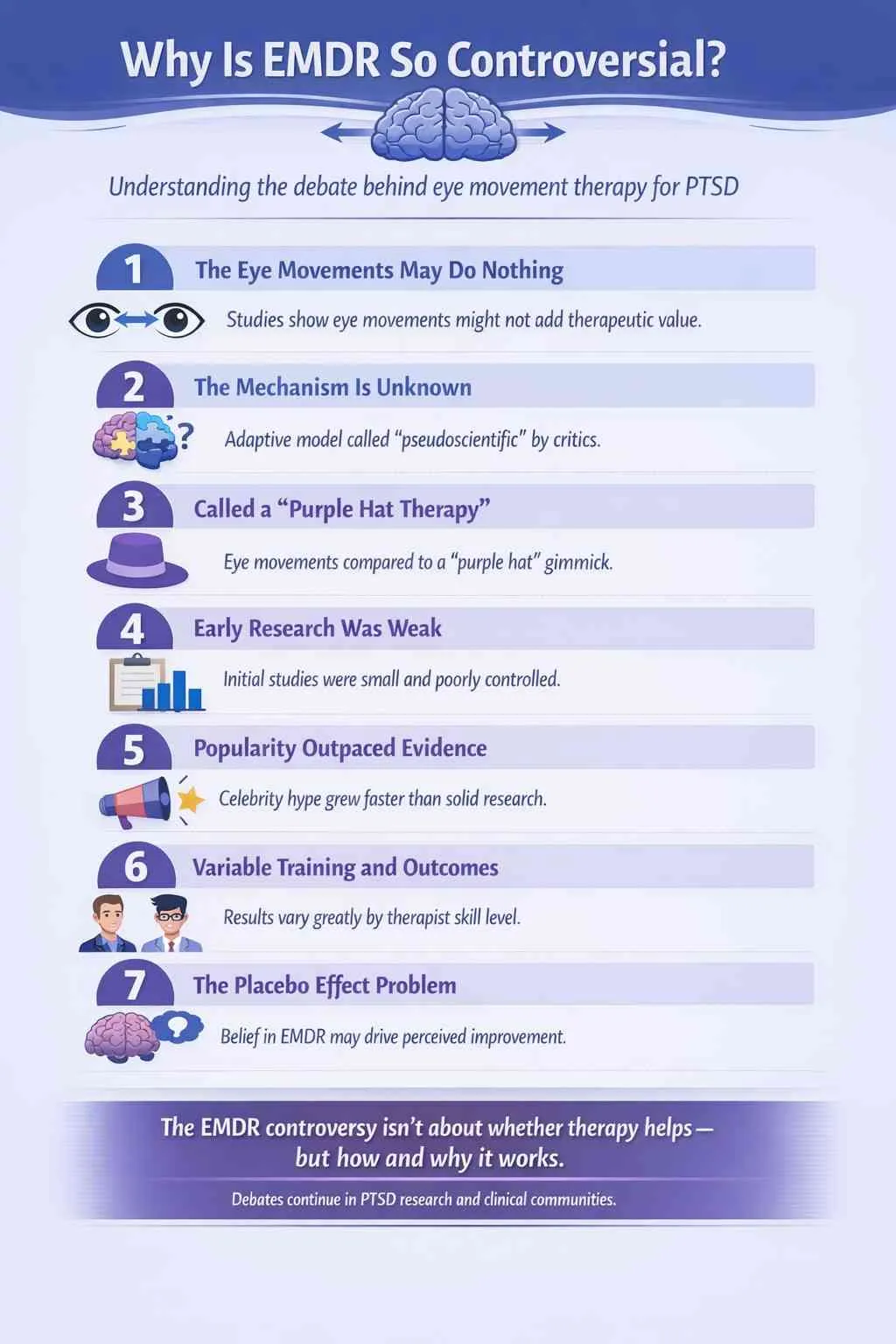
1. The Eye Movements May Do Nothing
This is the core of the EMDR effectiveness debate. Multiple dismantling studies including a widely cited 2001 meta-analysis by Davidson and Parker compared full EMDR against EMDR without eye movements. The results showed no meaningful difference. If the defining ingredient adds nothing, the whole theoretical model becomes suspect.
2. The Mechanism Is Unknown
The official explanation is called Adaptive Information Processing, a model proposing that trauma memories are stored incorrectly and that bilateral stimulation helps the brain reprocess them. The problem: this model is largely unfalsifiable. Science needs testable explanations. Unfalsifiable claims are the hallmark of pseudoscience, and that is why EMDR pseudoscience versus evidence based PTSD research debates keep resurfacing in academic journals.
3. Critics Call It a “Purple Hat Therapy”
Psychologist Scott Lilienfeld coined this term. Imagine a therapist who wears a purple hat during CBT sessions and claims the hat is why patients improve. The hat is not the active ingredient the exposure therapy is. Critics argue that eye movement necessity in EMDR effectiveness controversy is exactly this scenario: the bilateral stimulation is the purple hat, and the actual therapeutic gains come from guided trauma exposure that any structured therapy would produce.
4. Early Research Was Methodologically Weak
The early studies were not blinded, had small samples, and often used outcome measures designed by EMDR proponents. This is not a minor criticism. Is EMDR evidence based in the way CBT or Prolonged Exposure (PE) therapy is? The answer is: not quite, and that gap in research quality is a legitimate scientific concern, not just skeptic noise.
5. Commercial Promotion Outpaced Scientific Evidence
EMDR spread rapidly through mental health professionals before rigorous trials were complete. Celebrity endorsements and compelling patient stories drove adoption. Popularity and effectiveness are different things. When therapy becomes popular before evidence is solid, EMDR criticism from the research community intensifies.
6. Variability in Training and Outcomes
The quality of EMDR training standards and therapist skepticism debate reflects a real problem: EMDR outcomes vary heavily based on therapist skill and training depth. Two patients with similar trauma histories can have vastly different results depending on who delivers the therapy. This inconsistency weakens the case for the bilateral stimulation protocol as the active agent and raises questions about standardization in mental health treatment.
7. The Placebo Effect Problem
Some researchers argue that a large share of EMDR improvement comes from the expectancy effect patients believe it will work, and belief alone changes outcomes. This does not make EMDR useless, but it does complicate claims about cerebral EMDR therapy as a unique neurological treatment. The EMDR controversy mechanism debate PTSD therapy is ultimately a debate about whether we are treating brains or beliefs.
Related: Can emdr make things worse
Why Do Critics Call EMDR Pseudoscience?
The strongest criticism of EMDR is that nobody fully understands how it works. For most therapies, mechanism matters. If you cannot explain the biological or psychological reason something works, some scientists will not trust it.
Researchers like Scott Lilienfeld, Jeffery Lohr, and Richard McNally published papers arguing that the eye movement component of EMDR lacks a proven mechanism. Their position is that calling EMDR a unique therapy is not justified when the active ingredient cannot be isolated.
The core concern is this: when researchers removed the eye movements from EMDR and used only the memory processing element, outcomes were often similar. That raised the uncomfortable question: is the eye movement part just a distraction or a placebo?
EMDR pseudoscience claims often point to this gap. The label emdr quackery gets used when critics feel the therapy is being sold with more certainty than the evidence allows. This is a fair concern to raise. It is also not the whole picture.
Both the WHO and the APA classify EMDR as an evidence-based treatment for PTSD. The UK’s NICE guidelines include it. These are not organizations that endorse treatments casually. That endorsement matters and it pushes back directly against is emdr pseudoscience framing.
EMDR vs. CBT vs. Prolonged Exposure: Which Is Better?
Here is a direct comparison of the major trauma therapies:
| Therapy | Sessions | Evidence Strength | Best For | Main Debate |
| EMDR | 6-12 | Strong (PTSD) | Trauma with limited verbalization | Mechanism unknown |
| CBT / CPT | 12-16 | Very Strong | PTSD, anxiety, depression | Requires homework compliance |
| Prolonged Exposure | 8-15 | Very Strong | PTSD, phobias | High dropout rates |
| Traditional Talk | Variable | Moderate | General MH support | Lacks structure for trauma |
When EMDR Makes Sense Over Other Options
A patient may be a good candidate for EMDR over traditional talk therapy or CBT when they struggle to verbalize their trauma, when previous CBT has failed, or when the goal is faster symptom reduction. Some mental health professionals also use group therapy for anxiety alongside EMDR to address related symptoms during mental health treatment. Those considering PTSD Treatment West Palm Beach options through MRSC Solutions can discuss whether EMDR fits their specific history during an initial consultation.
Is EMDR a Scam or Is It Legitimate?

When people search is emdr a scam or ask if emdr is fake, they are often reacting to specific experiences. A therapist who was poorly trained. A treatment that cost a lot and did not help. Marketing language that promised more than EMDR can deliver.
Those concerns are valid. They do not mean the therapy itself is fraudulent.
The emdr scam narrative often links to the certification model. Francine Shapiro held the trademark for EMDR for years. Training and certification through EMDRIA (the EMDR International Association) can be expensive. Critics argue this creates a barrier that limits access and can attract underqualified practitioners looking to market a premium-sounding therapy.
Saying emdr is a scam conflates two different problems. The first is legitimate scientific uncertainty about mechanism. The second is individual therapist quality and marketing ethics. A bad therapist who misuses any technique, including CBT or mindfulness, creates a bad outcome. That does not make the technique a scam.
Is emdr a hoax? No. It is a real therapy with real randomized controlled trial support. Is emdr legitimate? Yes, when delivered by a properly trained therapist for the right conditions. Is emdr real? The evidence says it is.
So Why Do WHO, APA, and VA Still Recommend EMDR?
Because EMDR works. Not perfectly, not with a proven mechanism, but it works. That is the honest answer.
What the Meta-Analyses Actually Say
Multiple meta-analyses from 2020 to 2024 confirm that EMDR produces outcomes equivalent to Cognitive Processing Therapy (CPT) and Prolonged Exposure therapy for treating PTSD. A 2024 systematic review found EMDR patients showed significant reductions in PTSD symptom severity compared to waitlist controls. The World Health Organization includes it in its clinical guidelines for trauma care specifically because of this clinical evidence.
EMDR for PTSD: The Strongest Case
For post traumatic stress disorder PTSD specifically, EMDR has the strongest evidence base. Flashback frequency, nightmare severity, and emotional reactivity all show measurable reductions across multiple independent trials. This is why mental health professionals at institutions like the VA organizations that are not in the business of promoting any particular therapy continue to offer effective therapy through EMDR programs.
Is EMDR Debunked? Separating Fact from Social Media Noise
Emdr debunked headlines tend to overstate the case. No major scientific review has concluded that EMDR does not work for trauma. What reviews have concluded is that the mechanism is unclear and that some claims made by EMDR advocates go beyond what evidence supports.
Why is there a controversy with emdr? Much of it comes from the gap between clinical results and scientific explanation. Patients improve. But the reason why is still debated. That uncertainty gets amplified online and produces the scam, fake, and debunked narratives.
Is emdr therapy real? Yes. Is it the right therapy for everyone? No. Is it worth researching for trauma? Absolutely. The controversy is real, but so is the evidence for its use in PTSD treatment.
Should You Try EMDR? A Practical Decision Guide
EMDR May Be Right for You If
- You have a specific trauma or post traumatic stress disorder PTSD diagnosis
- You struggle to talk about the trauma directly
- Previous therapy helped only partially
- You want a structured, time-limited mental health treatment
- You are working with mental health professionals who are EMDRIA certified
EMDR May NOT Be Right If
- You are experiencing active psychosis
- Severe dissociation makes memory recall unsafe without additional stabilization
- You need when to see a psychiatrist level assessment before starting trauma work
- You are in acute crisis stabilize first through mental health professionals, then consider EMDR
How to Find a Qualified EMDR Therapist
Look for EMDRIA certification the EMDR International Association sets training and supervision standards. A certified therapist has completed approved training, logged supervised practice hours, and passed competency review. When evaluating PTSD Treatment options, ask any provider directly about their EMDRIA certification status before committing to emdr sessions. We can connect you with credentialed practitioners suited to your specific range of mental health needs.
Conclusion
Why Is EMDR So Controversial comes down to one honest gap: outcomes are proven, mechanisms are not. The therapy works for many people with PTSD and trauma. The eye movement component may or may not be essential. The research continues, and the professional debate is legitimate. Understanding the real limitations of EMDR, the risks when it is done poorly, and who it serves best puts you in a position to make an informed choice. If you are ready to explore trauma treatment with a team that gives you the full picture, Contact us today and ask about our PTSD Treatment West Palm Beach program.
Frequently Asked Questions
Is EMDR therapy legitimate?
Yes. EMDR is recognized by organizations such as the WHO and APA as an evidence-based treatment for PTSD. While debates remain about how it works, its effectiveness is widely supported.
Why do some therapists not recommend EMDR?
Some clinicians prefer therapies like Cognitive Processing Therapy (CPT) or Prolonged Exposure (PE), which have clearer theoretical mechanisms. Others cite variability in training quality and therapist experience.
Does EMDR really work for trauma?
Yes. Research, including multiple meta-analyses, shows EMDR can significantly reduce PTSD symptoms. Its effectiveness may vary depending on the individual and clinical context.
Is EMDR just exposure therapy in disguise?
EMDR includes exposure elements but also incorporates structured phases, bilateral stimulation, and cognitive restructuring. Whether these additions improve outcomes beyond exposure alone is still debated.
Can EMDR make symptoms worse before improving?
Yes, some individuals experience temporary distress during early phases. Proper preparation and guidance from a trained therapist help manage this safely.
Is EMDR considered pseudoscience?
No. Although some aspects, like eye movements are debated, EMDR is still classified as an evidence-based therapy due to consistent positive clinical outcomes.
What are the main criticisms of EMDR?
Criticisms include unclear mechanisms, variability in therapist training, and comparable results to other trauma therapies. However, outcome effectiveness is generally well supported.