
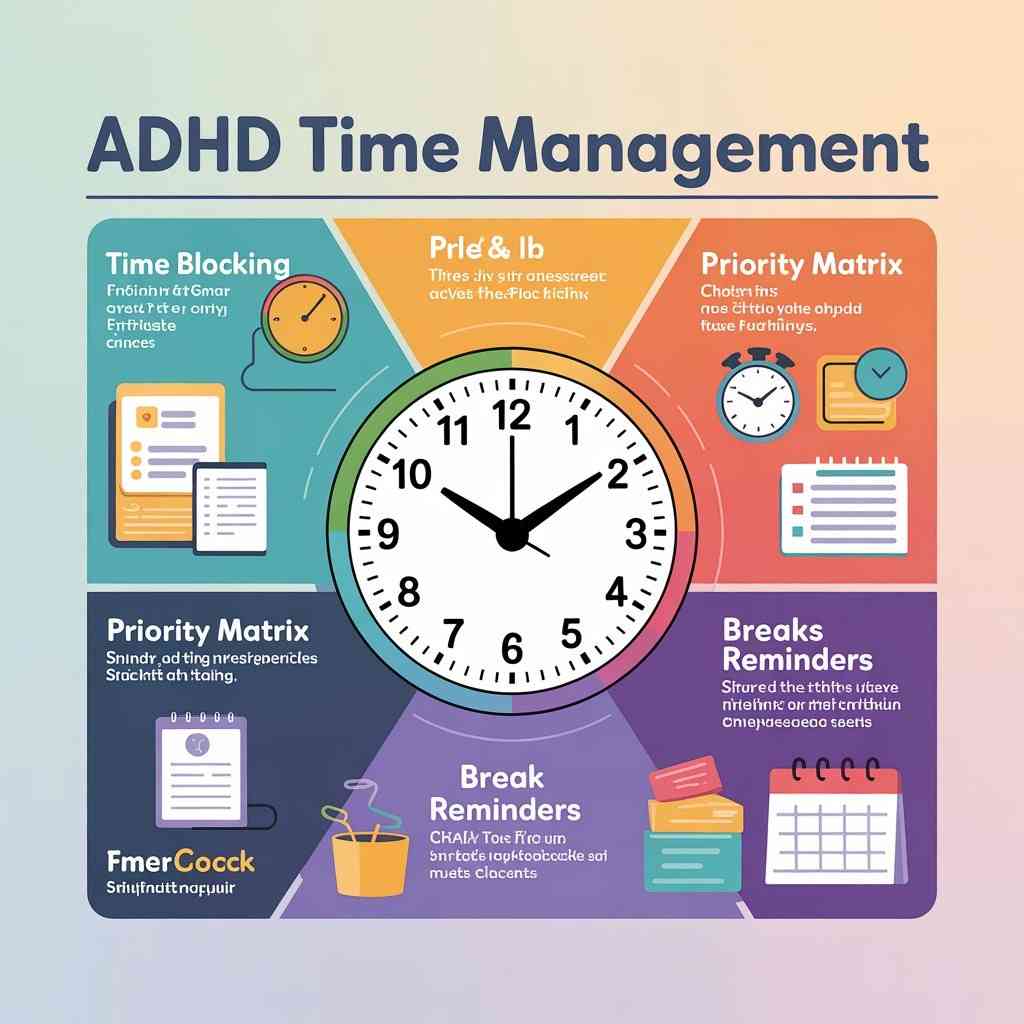




Time does not work the same way for everyone. If you have attention deficit hyperactivity disorder ADHD, the clock feels invisible. You miss deadlines, lose track of hours, and feel like the day just disappears. You are not lazy. Your brain is wired differently.
This guide breaks down exactly how to time manage with ADHD using methods backed by research. We cover why ADHD makes time so hard, what helps, and when to get professional support from a clinic like MRSC Solutions.
Why ADHD Makes Time Management So Hard
People with ADHD experience something called time blindness. It is not just forgetfulness. It is a neurological gap between now and later. Your brain treats “in an hour” and “next week” as the same vague thing.
This happens because attention deficit hyperactivity disorder ADHD affects the prefrontal cortex. That part of the brain handles planning, self-control, and sensing time. When it does not work efficiently, tasks pile up, deadlines vanish, and you feel stuck.
ADHD and depression often show up together, and that makes time management worse. When you miss deadlines repeatedly, shame and low motivation follow. That cycle looks a lot like depression. In fact, understanding depression vs ADHD is important because they share overlapping symptoms but need different treatment paths.
Related: ADHD Paralysis
How to Time Manage With ADHD: 8 Strategies That Work
1. Make Time Visible
Your brain does not feel time passing. Make it physical and visible instead.
Use a large analog clock in your workspace. Use a visual timer on your desk. When you can see time moving, your brain registers it. Digital clocks show a number. Analog clocks show time as a shape that shrinks.
Apps like Time Timer use a visual red disc that shrinks as minutes pass. This works well for people with ADHD because it makes abstract time concrete.
2. Use Time Blocking, Not To-Do Lists
To-do lists are endless. They have no structure and no time attached.
Time blocking assigns specific hours to specific tasks. You write: “Write report from 10:00 AM to 11:30 AM.” That is an appointment with yourself. Breaking your day into blocks makes it harder to hyperfocus on one task and lose the rest of the day.
When learning how to time manage with ADHD, this one shift makes the biggest difference. Research published in journals covering treating ADHD shows that structure and external cues improve daily functioning more than willpower alone.
3. Set Deadlines Out Loud
An internal promise is easy to break. A verbal one is harder to ignore.
Tell someone your deadline. Say: “I will send that email by noon.” This creates social accountability. For people with ADHD, external pressure often activates the brain in ways that internal motivation cannot.
Write your “by when” time next to every task. Not “clean the kitchen” but “clean the kitchen by 7 PM.” This small change is well-supported by behavioral research in cognitive behavioral therapy CBT, which uses structured goal-setting to build time habits.
4. Use the When/Then Method
Reward systems work well for ADHD brains. The when/then method is simple and effective.
“When I finish this report, then I watch one episode.” This is not procrastination. It is motivational structure. It gives your brain something to move toward.
Stimulant medications help many people with ADHD sustain focus. But medication alone is not enough. Pairing it with behavioral strategies like when/then creates lasting change. Your doctor can help you balance stimulant medications with lifestyle tools.
5. Break Tasks Into Micro-Steps
A task like “write a proposal” is too big. Your brain sees it as one giant wall.
Break it down: open document, write the headline, write three bullet points. Each micro-step takes less than five minutes. This reduces ADHD paralysis and gets momentum going.
Setting a two-minute rule helps too. If something takes under two minutes, do it now. That includes replying to a quick message or putting a dish away.
6. Reduce Decision Fatigue With Routines
Symptoms of ADHD include difficulty making decisions when tired or overwhelmed. The more choices you face each day, the harder it gets to manage time.
Build morning and evening routines that run on autopilot. Lay out your clothes the night before. Eat the same breakfast. Start work at the same time. These rituals reduce the number of decisions you make and free up mental space for actual work.
Routines also help when anxiety and depression are present alongside ADHD. A predictable structure lowers the background stress that makes depressive symptoms worse.
7. Limit Hyperfocus Traps
Hyperfocus is a double-edged skill. You can spend three hours on something you enjoy and not notice time passing.
Set phone alarms to interrupt hyperfocus sessions. Label them clearly: “Stop and check your task list.” Use browser extensions that block distraction sites during work blocks. Tell people around you when you are in a focus window so they do not interrupt, but also set a hard stop time.
If hyperfocus is affecting your work, relationships, or mental health, that is worth discussing with a professional. MRSC Solutions offers structured support that includes both therapy and, when appropriate, referrals to help you determine when to see a psychiatrist for ADHD-related concerns.
8. Build a Weekly Review Habit
Every Sunday, spend 20 minutes reviewing your week. What did you finish? What fell apart? What needs to move to next week?
This is not about shame. It is about adjusting your system. Time management with ADHD is not a one-time fix. It is an ongoing practice.
A weekly review also helps you spot patterns. Maybe you always crash on Wednesday afternoons. Maybe mornings are your clearest time. Knowing this lets you schedule harder tasks when your brain is sharpest.
Extra Reading: spiraling meaning
Science-Backed Time Management Strategies for ADHD
Use Time Blocking (But the ADHD Way)
Standard time blocking for ADHD does not mean filling every hour. It means creating manageable chunks of 15 to 30 minutes with breaks built in. Include transition time between tasks. ADHD brains need white space to reset, not back-to-back demands.
A person with ADHD who schedules 25 minutes of work, then 5 minutes off, will outperform someone who blocks three hours of uninterrupted work time every single time. This is one of the most effective time management techniques for ADHD.
Externalize Time (Make Time Visible)
Because time blindness distorts internal time perception, external tools become essential. Visual timers, countdown clocks, and set reminders and alarms give the brain an external anchor. Apps like Time Timer or simple kitchen timers work better than phone notifications for many people with ADHD.
Alarms to help you stay on task must be specific. Instead of an alarm that says “work,” set one that says “close browser and open report.” Specificity reduces decision fatigue at the moment the alarm fires.
Break Tasks Into “Tiny Wins”
Completing tasks feels rewarding to any brain. But for ADHD brains, that reward needs to come faster. Breaking one task into five smaller steps means five opportunities for a dopamine hit instead of one long wait.
This chunking method, paired with a small reward system, is one of the most effective time management strategies for ADHD. After finishing a chunk, take two minutes to do something you enjoy. This trains the brain to associate task completion with a positive outcome.
Build an ADHD-Friendly Daily Routine
An ADHD-friendly routine is flexible, not fixed. Rigid schedules break under the unpredictability of ADHD. Instead, build an energy-based schedule. If your focus peaks in the morning, protect that time for deep work. Use afternoons for emails, calls, or lighter tasks.
Anchor your day with three fixed points: wake time, a midday check-in, and a wind-down ritual. Everything between those anchors can shift. This structure gives enough framework to stay on track without the pressure of a minute-by-minute plan.
Extra Reading: Group Therapy for Anxiety
Use the “Start Before You’re Ready” Method
ADHD Time Management: often breaks down at the starting line. The “start before you’re ready” method means committing to just five minutes of a task without expecting to finish it. This is the five-minute rule, and it works because momentum is easier to maintain than it is to create.
This is also an anti-perfectionism strategy. For those who also deal with traits like high functioning OCD, the pressure to start perfectly can prevent starting at all. Five minutes removes that pressure.
Practical Tools for ADHD Time Management
Here are tools that support the strategies above, organized by the problem they solve.
For time visibility: analog clocks, the Time Timer app, Google Calendar with color-coded blocks.
For task structure: Notion, Todoist with due times, simple paper planners with hourly slots.
For accountability: body-doubling apps like Focusmate, text-based check-ins with a trusted friend.
For reducing distraction: Freedom app, phone placed face-down, noise-canceling headphones.
Real-Life Example: A Day With ADHD Time Blocking
A remote worker with ADHD might structure their day like this:
8:00 to 8:15 — Morning anchor: review three priorities for the day. 8:15 to 8:45 — Deep work block one (email or top-priority task). 8:45 to 9:00 — Break. Walk, stretch, or sit quietly. 9:00 to 9:30 — Deep work block two. 12:00 — Midday check-in: what was done, what needs adjusting. 1:00 to 3:00 — Lighter tasks: calls, admin, responding to messages. 3:00 — Wind-down: write three things done today, set tomorrow’s top task.
Notice the buffer time. Notice the short blocks. Notice the reset periods. This is not a rigid schedule. It is a structure that bends rather than breaks. This kind of framework is what most competitor articles completely miss when discussing how to time manage with ADHD.
Common Mistakes People With ADHD Make
Overplanning is the most common trap. Writing a 12-item to-do list creates paralysis, not productivity. Keep daily tasks to three, with a short buffer list.
Ignoring energy levels leads to scheduling deep work during mental low points, which never works. Rigid schedules that cannot flex around bad ADHD days collapse entirely by Tuesday. No buffer time means one unexpected event ruins the entire plan.
Social media worsens these patterns significantly. The impact of social media on teenagers and adults with ADHD is documented: constant notifications fragment focus and make completing tasks even harder. Set app limits during work blocks.
When Time Management Problems Need Professional Help
If these strategies feel helpful but the core problem persists, that is a sign that professional evaluation may be needed. Signs include constant inability to meet deadlines, chronic disorganization despite consistent effort, and emotional distress tied to struggles with time.
MRSC Solutions offers ADHD Testing West Palm Beach for adults who want a clear diagnosis and understanding of how their brain works. A formal evaluation identifies the specific ways attention deficit hyperactivity disorder presents for you individually, which makes treatment far more targeted.
For those already diagnosed, ADHD Treatment West Palm Beach includes evidence-based support to help you build real systems that work. Medication, behavioral therapy, and coaching together create outcomes that tips alone cannot. Contact us to take the first real step toward structured, sustainable daily function.
FAQs
Why is time management hard with ADHD?
Because ADHD affects executive functions like planning, prioritizing, and time perception, making it neurologically harder to manage time, not just a matter of effort.
What is time blindness?
ADHD time blindness is the inability to feel time passing accurately. It causes people to underestimate or completely miss how much time has gone by.
How do adults with ADHD stay organized?
External tools, visual systems, short task blocks, and consistent anchors throughout the day are the most effective methods for adults with ADHD to stay organized.
What is the best daily routine for ADHD?
A flexible, energy-based routine with three fixed daily anchors, short work blocks, and built-in breaks works best. Rigid routines tend to fail.
Can medication improve time management?
Yes. Medication can improve focus and reduce impulsivity, which directly supports ADHD Time Management. It works best alongside behavioral strategies.