
So, why is EMDR so controversial? The short answer: EMDR therapy clearly helps many people with post traumatic stress disorder PTSD but whether the eye movement desensitization and reprocessing EMDR therapy mechanism is real science or a clever placebo remains fiercely debated. That gap between results and explanation is exactly what divides the mental health world.
Major health organizations including the World Health Organization endorse it. Some researchers call it borderline pseudoscience. Both sides have data. In this article MRSC Solutions gives you the full picture with no bias, no sales pitch so you can decide for yourself.
Quick Answer
EMDR controversy centers on one core problem: the therapy produces real results for trauma, but dismantling studies consistently show that removing the bilateral stimulation (eye movements) changes nothing. If the most distinctive ingredient does nothing on its own, critics ask: are we treating trauma or performing an elaborate ritual that works for other reasons?
What Is EMDR Therapy? A Simple Breakdown
EMDR stands for eye movement desensitization and reprocessing EMDR therapy. Psychologist Francine Shapiro developed it in 1987 after a personal observation during a walk. She noticed that moving her eyes rapidly seemed to reduce the intensity of distressing thoughts.
During EMDR sessions, a patient recalls a traumatic memory while tracking the therapist’s moving finger or taps, or alternating sounds with their eyes. The goal is to process traumatic memories so they lose their emotional charge. This is part of the healing process across a structured 8-phase protocol.
The 8 Phases of EMDR
The full EMDR protocol covers these stages:
| Phase | Name | What Happens |
| 1 | History Taking | Therapist maps the patient’s trauma history |
| 2 | Preparation | Patient learns coping skills for distress |
| 3 | Assessment | Target memory and negative beliefs identified |
| 4 | Desensitization | Bilateral stimulation begins during memory recall |
| 5 | Installation | Positive beliefs are reinforced |
| 6 | Body Scan | Physical tension related to trauma is addressed |
| 7 | Closure | Session ends safely, patient stabilized |
| 8 | Re-evaluation | Progress checked at next session |
Who Does EMDR Treat?
Effective treatment with EMDR has been documented for a range of mental health conditions including post traumatic stress disorder, PTSD, anxiety disorders, phobias, grief, OCD, and MDD depression disorder. It is also sometimes used alongside group therapy for anxiety programs and traditional talk therapy.
Why EMDR Was Born Controversial: The Origin Problem
Most therapies grow out of lab research. EMDR grew out of a walk in a park. That origin story never left.
Francine Shapiro’s 1987 Discovery
Shapiro published her landmark study in 1989. Critics immediately flagged serious problems: small sample size, no independent blinding, and the fact that she personally ran the therapy and scored the outcomes. In science, that kind of researcher involvement creates EMDR criticism that is hard to shake.
The Trademarking Controversy
Shapiro trademarked EMDR and required therapists to complete certified training which cost money before using the name. Researchers called this a conflict of interest. It created a commercial ecosystem around the therapy before rigorous evidence based trials were completed. That tension between science and commerce is still part of the EMDR controversy today.
7 Specific Reasons Why Is EMDR So Controversial
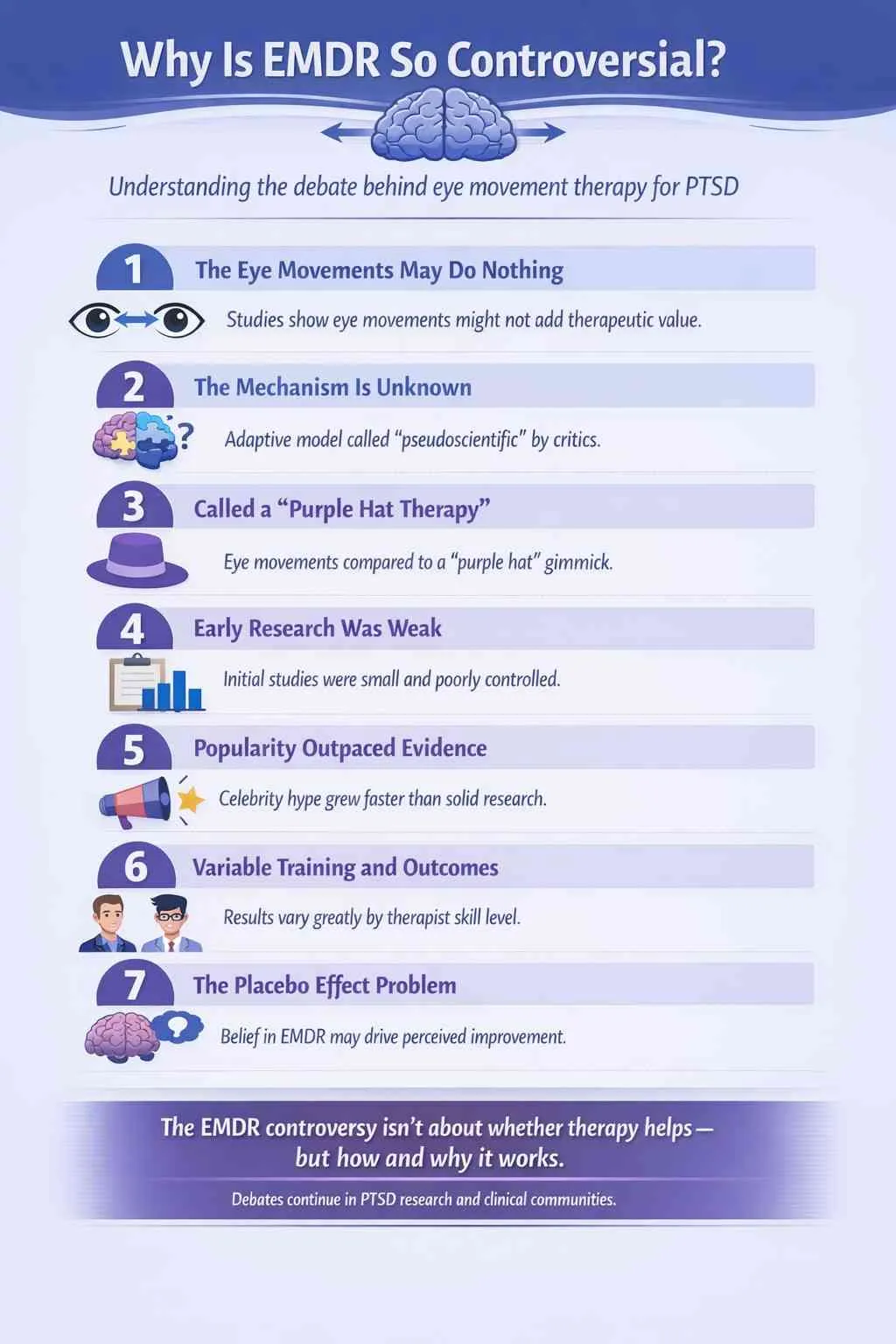
1. The Eye Movements May Do Nothing
This is the core of the EMDR effectiveness debate. Multiple dismantling studies including a widely cited 2001 meta-analysis by Davidson and Parker compared full EMDR against EMDR without eye movements. The results showed no meaningful difference. If the defining ingredient adds nothing, the whole theoretical model becomes suspect.
2. The Mechanism Is Unknown
The official explanation is called Adaptive Information Processing, a model proposing that trauma memories are stored incorrectly and that bilateral stimulation helps the brain reprocess them. The problem: this model is largely unfalsifiable. Science needs testable explanations. Unfalsifiable claims are the hallmark of pseudoscience, and that is why EMDR pseudoscience versus evidence based PTSD research debates keep resurfacing in academic journals.
3. Critics Call It a “Purple Hat Therapy”
Psychologist Scott Lilienfeld coined this term. Imagine a therapist who wears a purple hat during CBT sessions and claims the hat is why patients improve. The hat is not the active ingredient the exposure therapy is. Critics argue that eye movement necessity in EMDR effectiveness controversy is exactly this scenario: the bilateral stimulation is the purple hat, and the actual therapeutic gains come from guided trauma exposure that any structured therapy would produce.
4. Early Research Was Methodologically Weak
The early studies were not blinded, had small samples, and often used outcome measures designed by EMDR proponents. This is not a minor criticism. Is EMDR evidence based in the way CBT or Prolonged Exposure (PE) therapy is? The answer is: not quite, and that gap in research quality is a legitimate scientific concern, not just skeptic noise.
5. Commercial Promotion Outpaced Scientific Evidence
EMDR spread rapidly through mental health professionals before rigorous trials were complete. Celebrity endorsements and compelling patient stories drove adoption. Popularity and effectiveness are different things. When therapy becomes popular before evidence is solid, EMDR criticism from the research community intensifies.
6. Variability in Training and Outcomes
The quality of EMDR training standards and therapist skepticism debate reflects a real problem: EMDR outcomes vary heavily based on therapist skill and training depth. Two patients with similar trauma histories can have vastly different results depending on who delivers the therapy. This inconsistency weakens the case for the bilateral stimulation protocol as the active agent and raises questions about standardization in mental health treatment.
7. The Placebo Effect Problem
Some researchers argue that a large share of EMDR improvement comes from the expectancy effect patients believe it will work, and belief alone changes outcomes. This does not make EMDR useless, but it does complicate claims about cerebral EMDR therapy as a unique neurological treatment. The EMDR controversy mechanism debate PTSD therapy is ultimately a debate about whether we are treating brains or beliefs.
So Why Do WHO, APA, and VA Still Recommend EMDR?
Because EMDR works. Not perfectly, not with a proven mechanism, but it works. That is the honest answer.
What the Meta-Analyses Actually Say
Multiple meta-analyses from 2020 to 2024 confirm that EMDR produces outcomes equivalent to Cognitive Processing Therapy (CPT) and Prolonged Exposure therapy for treating PTSD. A 2024 systematic review found EMDR patients showed significant reductions in PTSD symptom severity compared to waitlist controls. The World Health Organization includes it in its clinical guidelines for trauma care specifically because of this clinical evidence.
EMDR for PTSD: The Strongest Case
For post traumatic stress disorder PTSD specifically, EMDR has the strongest evidence base. Flashback frequency, nightmare severity, and emotional reactivity all show measurable reductions across multiple independent trials. This is why mental health professionals at institutions like the VA organizations that are not in the business of promoting any particular therapy continue to offer effective therapy through EMDR programs.
EMDR vs. CBT vs. Prolonged Exposure: Which Is Better?
Here is a direct comparison of the major trauma therapies:
| Therapy | Sessions | Evidence Strength | Best For | Main Debate |
| EMDR | 6-12 | Strong (PTSD) | Trauma with limited verbalization | Mechanism unknown |
| CBT / CPT | 12-16 | Very Strong | PTSD, anxiety, depression | Requires homework compliance |
| Prolonged Exposure | 8-15 | Very Strong | PTSD, phobias | High dropout rates |
| Traditional Talk | Variable | Moderate | General MH support | Lacks structure for trauma |
When EMDR Makes Sense Over Other Options
A patient may be a good candidate for EMDR over traditional talk therapy or CBT when they struggle to verbalize their trauma, when previous CBT has failed, or when the goal is faster symptom reduction. Some mental health professionals also use group therapy for anxiety alongside EMDR to address related symptoms during mental health treatment. Those considering PTSD Treatment West Palm Beach options through MRSC Solutions can discuss whether EMDR fits their specific history during an initial consultation.
Is EMDR a Scam, Pseudoscience, or Placebo?
The Honest Answer
EMDR is not a scam. It is not fake. But is EMDR evidence based in the strictest scientific sense? Partially. The outcomes are real. The mechanism explanation is not well-supported. That middle-ground answer frustrates people who want a clean yes or no but it is the most accurate thing anyone can say based on current research.
What Working Memory Theory Says
The most scientifically accepted alternative explanation involves working memory taxation. When patients track moving objects with their eyes while recalling a trauma, their working memory gets split. A taxed working memory cannot maintain the full emotional intensity of the traumatic image. The memory becomes less vivid and therefore less distressing. This explains EMDR effectiveness debate results without requiring any special neurological reprocessing mechanism.
The REM Sleep Theory
A secondary theory proposes that bilateral stimulation mimics the eye movement patterns during REM sleep, the sleep stage when the brain consolidates and processes emotional memories. If EMDR replicates this process while awake, it may accelerate memory processing naturally. This is speculative, but it is scientifically plausible in a way that Adaptive Information Processing theory is not.
Should You Try EMDR? A Practical Decision Guide
EMDR May Be Right for You If
- You have a specific trauma or post traumatic stress disorder PTSD diagnosis
- You struggle to talk about the trauma directly
- Previous therapy helped only partially
- You want a structured, time-limited mental health treatment
- You are working with mental health professionals who are EMDRIA certified
EMDR May NOT Be Right If
- You are experiencing active psychosis
- Severe dissociation makes memory recall unsafe without additional stabilization
- You need when to see a psychiatrist level assessment before starting trauma work
- You are in acute crisis stabilize first through mental health professionals, then consider EMDR
How to Find a Qualified EMDR Therapist
Look for EMDRIA certification the EMDR International Association sets training and supervision standards. A certified therapist has completed approved training, logged supervised practice hours, and passed competency review. When evaluating PTSD Treatment options, ask any provider directly about their EMDRIA certification status before committing to emdr sessions. We can connect you with credentialed practitioners suited to your specific range of mental health needs.
Ready to Explore Your Options?
The EMDR effectiveness debate should not stop you from getting help. Whether you are looking into PTSD Treatment West Palm Beach, evaluating EMR sessions for the first time, or simply trying to understand your mental health treatment options, the team at MRSC Solutions is here to help. We connect patients with credentialed, experienced mental health professionals who offer effective therapy tailored to your history and goals.
Contact us today to schedule a no-pressure consultation. You deserve answers and an effective treatment plan built around you, not around a trending therapy name.
Frequently Asked Questions
Is EMDR therapy legitimate?
Yes. It is endorsed by major health organizations including the WHO, APA, and VA. The legitimacy of outcomes is not in serious dispute; the debate is about mechanisms.
Why do some therapists not recommend EMDR?
Some mental health professionals prefer therapies with clearer mechanistic evidence, like CPT or PE. Others worry about the EMDR training standards and therapist skepticism debate specifically, that inconsistent training quality leads to inconsistent patient outcomes.
Can EMDR make trauma worse?
Rarely, but it can be destabilizing when used without adequate preparation phases, or when a patient is not yet stable enough for trauma processing. This is why the 8-phase protocol specifically front-loads stabilization before any memory work begins. Proper mental health treatment sequencing matters.
Does EMDR really work for trauma?
Multiple independent meta-analyses say yes. For treat PTSD specifically, EMDR produces clinically meaningful reductions in symptoms. Whether it works better than alternatives depends on the patient which is why when someone is spiralling, the right therapist will assess all options before recommending a path.
Is EMDR just exposure therapy in disguise?
Partly. The exposure component is likely the primary active ingredient. But EMDR adds structure, pacing, and positive beliefs installation that some patients find more tolerable than standard Prolonged Exposure. The question of whether eye movement desensitization and reprocessing EMDR therapy adds anything beyond that structure is unresolved.