




PTSD is not just stress. It is a real mental health condition that can shatter daily routines, relationships, and your sense of safety. About 20% of adults will face it at some point in their lives. If you are reading this, you are not alone and what you feel is completely valid.
This guide gives you science-backed ptsd coping skills that therapists actually recommend. You will learn grounding tools for panic moments, long-term habits for recovery, and how to build a plan that fits your life. Let us get started.
What Is PTSD and How Does It Affect Daily Life?
Post-traumatic stress disorder PTSD is a diagnosable condition listed in the DSM-5. It develops after exposure to a deeply threatening or disturbing traumatic event. Unlike normal shock or grief, PTSD does not fade on its own for many people.
The difference between regular stress and PTSD is how long symptoms last and how much they disrupt your life. Normal stress usually eases within weeks. With PTSD, symptoms of ptsd can persist for months or years without the right help.
Common PTSD Symptom Categories
| Symptom Category | What It Looks Like |
| Re-experiencing | Flashbacks, nightmares, intrusive memories |
| Avoidance | Staying away from people, places, or reminders of trauma |
| Hyperarousal | Startling easily, difficulty sleeping, always on guard |
| Negative Cognition | Guilt, shame, numbness, trouble concentrating |
Understanding PTSD Triggers
Triggers are sensory cues that pull your brain back to a traumatic moment. They can be smells, sounds, sights, or even body sensations. Understanding your triggers is the first step in managing PTSD because when you know what sets you off, you gain some control.
When a trigger fires, your brain’s fear center (the amygdala) takes over. This is called an amygdala hijack. Your body does not know you are safe right now. It reacts as if the threat is happening again. This is not a weakness. It is a survival response gone into overdrive.
Tip: Keep a personal trigger journal. Write down what you noticed before each episode, the time, place, sound, and emotion. Over time, patterns appear and you can prepare responses.
Immediate PTSD Coping Skills for In-the-Moment Relief
These are your emergency tools. Use them the moment you feel overwhelmed, triggered, or disconnected from the present.
Grounding Techniques to Manage Flashbacks
Grounding pulls your attention back to the present moment. The most researched method is the 5-4-3-2-1 technique:
- Notice 5 things you can see
- Touch 4 things around you
- Listen for 3 sounds
- Find 2 things you can smell
- Identify 1 thing you can taste
This activates your parasympathetic nervous system, the part that calms your body down. It shifts your nervous system out of fight-or-flight mode quickly.
Box Breathing and Deep Breathing
Breathing is one of the most powerful relaxation techniques for PTSD. Box breathing works like this:
- Inhale for 4 seconds
- Hold for 4 seconds
- Exhale for 4 seconds
- Hold for 4 seconds
This method lowers cortisol and slows your heart rate fast. The 4-7-8 breathing method is another strong option. Inhale for 4 counts, hold for 7, exhale for 8. Military personnel use combat breathing during high-stress situations for the same reason.
Sensory Anchoring
Carry a grounding object. A smooth stone, a textured bracelet, or something familiar from a safe memory. When a trigger hits, hold it and focus on its texture and weight. Strong scents like lavender or peppermint can also break dissociation fast. Repeating a grounding phrase such as “I am safe. It is now [current year]. I am in [location]” reinforces reality.
Cold Water Grounding
Splashing cold water on your face activates the diving reflex, which slows your heart rate within seconds. Holding ice cubes also works and has been studied as a grounding method for people dealing with PTSD and intense emotional states.
Long-Term PTSD Coping Strategies for Daily Life
These habits build real recovery over time. They are not quick fixes but consistent practice rewires your brain.
Physical Exercise
Exercise reduces hyperarousal by burning off the stress hormones your body keeps releasing. It also boosts endorphins and supports better sleep. Aim for 20 to 30 minutes most days. Walking, swimming, and strength training are all effective.
Trauma-informed yoga deserves special mention. This practice is specifically designed for survivors. It focuses on choice, body awareness, and breathing rather than performance. Research published by the Trauma Center shows it reduces PTSD symptom severity significantly. This is an angle most competitors completely ignore.
Mindfulness and Meditation
Mindfulness-Based Stress Reduction (MBSR) is one of the most studied approaches for managing ptsd without medication. It teaches you to observe thoughts without being swept away by them. A body scan meditation, where you slowly notice each part of your body from toes to head, is especially helpful for survivors who feel disconnected from their bodies.
Start with just two minutes. Use apps like Headspace, Calm, or the VA-developed PTSD Coach app. Loving-kindness meditation is particularly useful for people who carry guilt or shame, which are common in survivors of abuse and combat.
Journaling and Expressive Writing
The Pennebaker method of expressive writing has strong research support. You write about your deepest thoughts and feelings around a trauma for 15 to 20 minutes, four days in a row. Studies show it reduces PTSD symptoms, visits to doctors, and even physical illness.
Trauma journaling questions to try:
- What am I feeling in my body right now?
- What does safety feel like for me?
- What would I tell a friend going through exactly what I went through?
- What has changed in me since this happened, for better and for worse?
- What do I need most today?
- Write a letter to your past self before the traumatic event happened.
- What would life look like in one year if healing was actually happening?
Sleep Hygiene for PTSD
PTSD-related difficulty sleeping is one of the most draining symptoms. Nightmares and hypervigilance make rest nearly impossible. Image Rehearsal Therapy (IRT) is a technique where you write down a recurring nightmare and then rewrite the ending with a better outcome. You rehearse the new version during the day. Clinical trials show it reduces nightmare frequency significantly.
Also avoid alcohol and caffeine, especially after 2 PM. Alcohol may feel like it helps you fall asleep but it fragments sleep and worsens nightmares. Caffeine spikes your already elevated cortisol levels, which worsen the hyperarousal that keeps PTSD alive.
Nutrition and the Gut-Brain Connection
Your gut and brain are directly connected through the vagus nerve. Chronic stress and anxiety from PTSD disrupts gut bacteria, which in turn worsens mood and anxiety. Anti-inflammatory foods such as omega-3 rich fish, leafy greens, berries, and fermented foods support brain health. Reducing processed sugar and alcohol protects both your gut and your nervous system.
Cognitive Strategies for Trauma Responses
PTSD distorts thought patterns. Survivors often carry beliefs like “It was my fault,” or “I am never safe.” These are not facts. They are trauma responses. Cognitive restructuring is the process of catching these thoughts and questioning them.
The STOP skill is a practical daily tool:
- Stop what you are doing
- Take a breath
- Observe your thoughts and feelings without judging them
- Proceed with intention
Positive self-talk scripts also help. Replace “I am broken” with “I survived something very hard.” Replace “I am in danger” with “I am safe in this moment.” This is not denial. It is reality testing, separating your past trauma from your present environment. Reducing self-blame is central to this work, especially for people who have been through sexual assault or childhood abuse.
Building Interpersonal Support for PTSD
Isolation makes PTSD significantly worse. When you withdraw, your body’s HPA axis (the stress response system) stays in overdrive with no social regulation. Human connection is genuinely healing at a physiological level.
Communicating your PTSD to loved ones can feel hard. A simple script: “I have PTSD. Sometimes I get triggered and need space or grounding. It is not about you. Here is what helps me most.” This reduces confusion and builds a stronger support system.
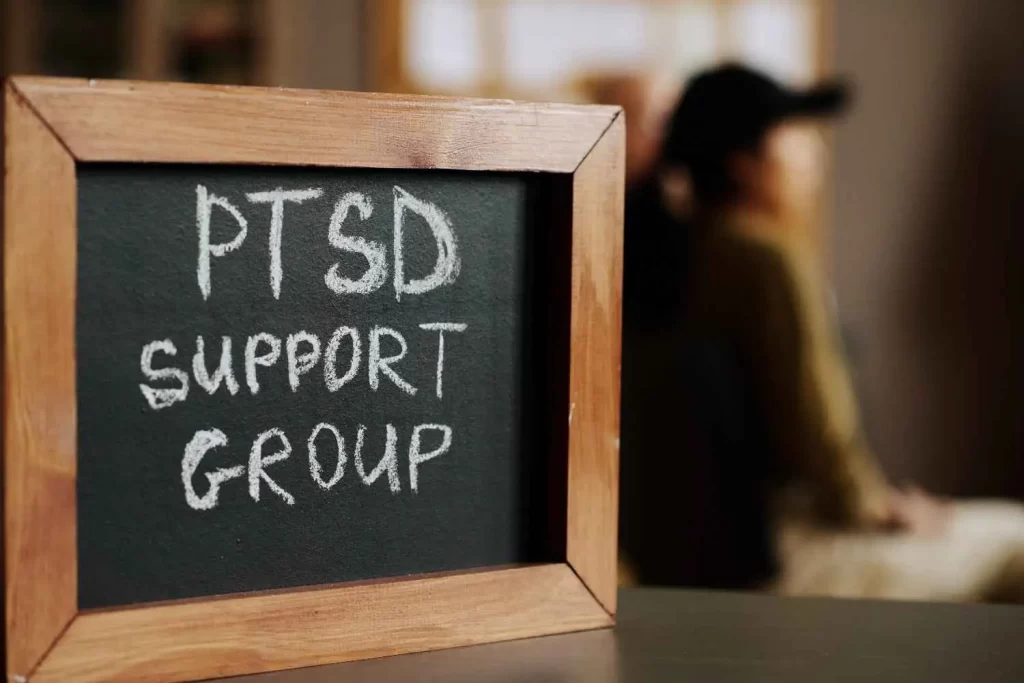
PTSD support groups, both online and in-person, offer something individual therapy cannot: the recognition that others truly understand. NAMI, the VA, and RAINN all offer peer support programs. Veterans, assault survivors, and first responders each have communities built specifically for them.
Professional Therapy Options for PTSD
Sometimes coping skills for ptsd are not enough on their own. When traumatic experiences are severe or complex, professional treatment is essential. Here is what the evidence supports:
| Therapy | Best For | How It Works |
| CBT (Cognitive Behavioral Therapy) | Negative thought patterns | Restructures trauma-based beliefs |
| CPT (Cognitive Processing Therapy) | Guilt and shame | Works through “stuck points” |
| Prolonged Exposure (PE) | Avoidance behaviors | Gradual, safe confrontation of fears |
| EMDR | Complex or childhood trauma | Eye movement reprocessing |
| DBT | Emotional dysregulation | Distress tolerance and emotion regulation |
| Somatic Therapy | Body-stored trauma | Physical release of trauma held in muscles |
Why Is EMDR So Controversial? EMDR (Eye Movement Desensitization and Reprocessing) has strong clinical evidence behind it, yet it often raises eyebrows. The controversy is mostly about mechanism, not effectiveness. Researchers debate whether the eye movements themselves matter or whether the exposure process is the active ingredient. Either way, both the WHO and the APA recommend it as a first-line treatment.
If you are wondering When to See a Psychiatrist rather than a therapist, the answer is when symptoms are severe enough to need medication evaluation. Psychiatrists can prescribe SSRIs like sertraline and paroxetine, which are FDA-approved for PTSD. A therapist and a psychiatrist can work together as part of your care team.
People with MDD Depression Disorder alongside PTSD (known as comorbid MDD) often benefit from group therapy for anxiety and trauma combined, which addresses both conditions simultaneously.
PTSD Coping Skills by Trigger Type
This is one of the biggest gaps in competitor content. Different trigger situations need different responses.
During a Flashback
- Say out loud: “I am having a flashback. I am in [location]. The year is [year]. I am safe.”
- Plant your feet firmly on the floor
- Use the 5-4-3-2-1 grounding method
- Call a trusted person if alone
During a Panic Attack in Public
If you are wondering when someone is spiralling, key signs are rapid breathing, racing heart, feeling disconnected from your surroundings, and a sense of impending doom. In public, these discrete tools help without drawing attention:sxh
- Press your feet firmly into the ground and notice the pressure
- Breathe out slowly for twice as long as you breathe in
- Squeeze your thumb and forefinger together and focus on that sensation
- Look for five blue objects in the room
PTSD at Night and Nightmares
Before bed: lower lights 30 minutes early, avoid screens, do a 5-minute body scan, and keep a notepad nearby. After a nightmare: turn on a soft light, do box breathing for 3 minutes, write one sentence about what made you feel unsafe, then write one sentence about what is safe right now. This resets your nervous system before you return to sleep.
Anniversary Reactions
Calendar dates connected to trauma, such as accident anniversaries or the birthday of someone lost, often cause worsened symptoms. Plan ahead. Schedule something meaningful and gentle for that day. Tell one trusted person it is a hard day. Reduce obligations. Use coping strategies proactively rather than waiting to feel overwhelmed.
Build Your Personal PTSD Coping Plan
Having a written plan reduces the chaos when daily life gets hard. Here is a five-step framework:
- Step 1: Write down your top 3 known triggers
- Step 2: Choose 2 immediate coping skills you will use in a crisis (example: 5-4-3-2-1 and box breathing)
- Step 3: Choose 2 daily long-term habits (example: morning walk + evening journaling)
- Step 4: Name your support person and confirm they know your plan
- Step 5: Write your crisis plan: who you call if skills are not enough (988 Lifeline, a therapist, a trusted friend)
Keep this plan somewhere visible. Review it monthly. Healing is not linear but having a structure helps you return to yourself faster after a hard day.
PTSD Treatment in West Palm Beach: MRSC Solutions
If you are based in Florida and looking for professional support, MRSC Solutions offers specialized PTSD Treatment West Palm Beach services. Their team works with trauma survivors using evidence-based approaches including CBT, EMDR, and somatic therapies. Whether you are just beginning to seek treatment or are looking for more intensive care, their clinicians understand the full complexity of post traumatic stress disorder PTSD and tailor treatment to your specific history and goals.
Conclusion
Recovery from PTSD is real. It takes time, consistency, and often professional support, but thousands of people move through it every year. You are not your trauma and it does not have to control your future. Start with one skill from this guide and build from there. Progress, not perfection, is the goal.
If you are ready for professional support, contact us for evidence-based PTSD Treatment West Palm Beach tailored to your needs. And if you are in immediate crisis, call or text 988, the Suicide and Crisis Lifeline, which supports mental health emergencies around the clock.
Frequently Asked Questions
What are the best coping skills for PTSD?
The most effective ptsd coping skills combine immediate tools like grounding and breathing with long-term habits like exercise, journaling, and therapy. The 5-4-3-2-1 technique, box breathing, and trauma-informed yoga are consistently supported by research.
How do I calm down during a PTSD episode?
Use sensory grounding immediately. Splash cold water on your face, press your feet to the floor, and name five things you can see. These steps activate the parasympathetic nervous system and help bring you back to the present moment.
Can PTSD go away without therapy?
Some people do experience symptom reduction through self-help and strong social support. However, for moderate to severe PTSD, professional therapy is strongly recommended. The longer PTSD goes untreated, the more it reshapes neural pathways and disrupts daily life.
What should you avoid doing with PTSD?
Avoid alcohol and recreational substances, which worsen hyperarousal and disrupt sleep. Avoid isolation, which keeps the nervous system dysregulated. Avoid avoiding: the longer you stay away from triggers, the stronger they become. Gradual, safe exposure with professional support is more effective long-term.
How long before coping skills start making a difference?
Immediate skills like breathing and grounding work within minutes. Long-term habits like exercise and journaling typically show measurable impact within three to six weeks of consistent practice. Therapy timelines vary but most people see meaningful change within 12 to 16 sessions.
Are there coping skills specifically for complex PTSD (C-PTSD)?
Coping mechanisms for PTSD for complex or C-PTSD often need more emphasis on internal safety, emotional regulation, and reparenting inner states. DBT skills, somatic therapy, and parts-based work (like Internal Family Systems) tend to be especially helpful when trauma started in childhood or was prolonged.
What is the 5-4-3-2-1 grounding technique for PTSD?
It is a sensory awareness exercise that interrupts a flashback or panic response. You actively engage all five senses, naming 5 things you see, 4 you can touch, 3 you can hear, 2 you can smell, and 1 you can taste. It forces the brain to engage the prefrontal cortex rather than stay locked in the amygdala’s fear response. It is one of the most recommended grounding techniques to manage flashbacks used by therapists worldwide.