depression treatment
Can You Drink on Antidepressants? Lexapro, Zoloft, Wellbutrin and More

The invitations are starting to arrive: the office party, Friendsgiving, a wedding in December, New Year's Eve. And you have a question you may feel awkward asking: you are taking an antidepressant, so can you have a drink? You have probably heard every answer. A friend says one glass of wine is fine. The pharmacy sticker says avoid alcohol. Someone online swears they blacked out after two beers on Lexapro. Here is a clear, evidence-based look at antidepressants and alcohol, medication by medication, so you can make a safe plan with your prescriber before the season starts.
The short answer: the FDA labels for most antidepressants advise against drinking alcohol, and some, like Wellbutrin (bupropion), Cymbalta (duloxetine) and the MAOIs, carry specific warnings. Alcohol can increase drowsiness and impairment, worsen depression and anxiety, disrupt sleep and undo the progress your medication is making. Whether an occasional drink is acceptable for you depends on your medication, your dose, how long you have been taking it, your health and your history with alcohol, so it is a decision to make with your prescriber, not one to guess at a party.
Key takeaways
- Most antidepressant labels say to avoid alcohol. Lexapro, Zoloft and Prozac labels all say plainly: do not drink alcohol.
- Alcohol is a depressant. The National Institute on Alcohol Abuse and Alcoholism (NIAAA) lists increased feelings of depression or hopelessness as a risk with all antidepressants.
- Wellbutrin can lower your alcohol tolerance, and stopping heavy drinking suddenly while on it raises the risk of seizures.
- Skipping a dose to drink does not work: most antidepressants take days to leave your body, and skipping can cause withdrawal symptoms.
- The first four to six weeks of treatment are the most important time to avoid alcohol.
Can You Drink Alcohol on Antidepressants?
The official answer for most antidepressants is no, or only with caution. The FDA labels for Lexapro, Zoloft, Prozac, Effexor and Remeron advise not drinking alcohol, while labels for Wellbutrin and Cymbalta warn against heavy drinking or say alcohol should be minimized. Your prescriber can tell you what is safe for your specific medication and situation.
It helps to understand why the advice is so firm, because the reasons are not always what people expect. For several common antidepressants, controlled studies did not find that the medication made alcohol's effects on thinking and coordination worse. The Lexapro label, for example, states that Lexapro did not potentiate the cognitive and motor effects of alcohol in a clinical trial, yet the same label says the combination is not advised in people with depression and tells patients not to drink.
That is the key point: the biggest risk is usually not a dramatic reaction in the moment. It is what alcohol does to the condition you are treating. Alcohol is a depressant, it disrupts sleep, it lowers inhibitions, and it can make depression and anxiety harder to treat. A medication that is slowly lifting your mood is working against a substance that pushes it back down.
What Each Antidepressant Label Says About Alcohol
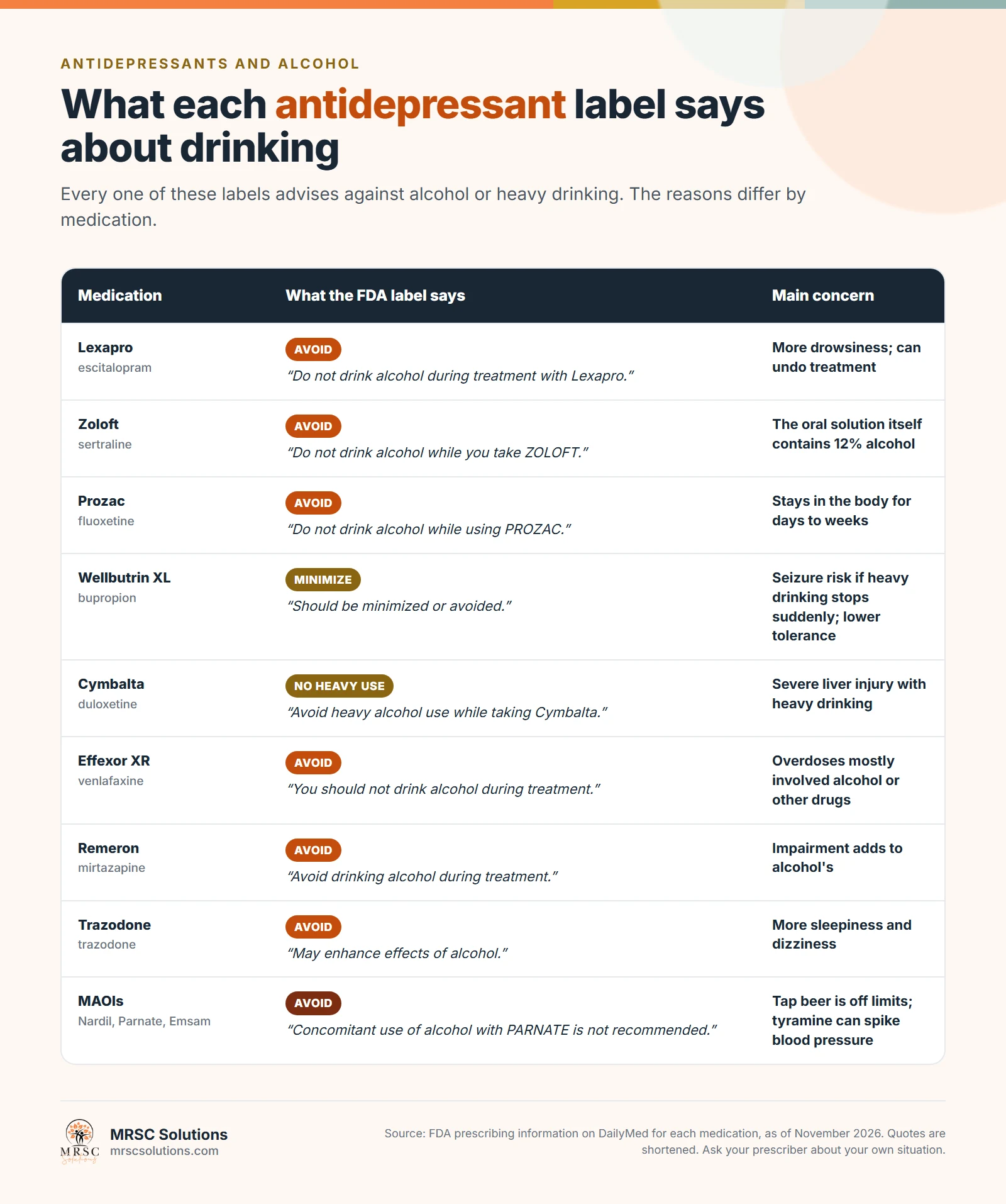
Each antidepressant's FDA label gives its own guidance on alcohol. Most say not to drink. Some focus on specific dangers: seizures with Wellbutrin, liver injury with Cymbalta, added sedation with Remeron and trazodone, and dangerous blood pressure spikes from certain drinks with MAOIs.
Lexapro (escitalopram)
The Lexapro label tells patients: "Do not drink alcohol during treatment with Lexapro." MedlinePlus, the National Library of Medicine's drug information service, adds that alcohol can make the side effects of escitalopram worse. Drowsiness is the effect people notice most. If you are new to Lexapro, our article on SSRI side effects in the first two weeks explains what is normal early on.
Zoloft (sertraline)
The Zoloft label says: "Do not drink alcohol while you take ZOLOFT." In healthy volunteers, sertraline did not increase alcohol's effects on thinking and coordination, but the advice stands. One detail many people do not know: Zoloft oral solution, the liquid form, itself contains 12% alcohol. The UK's NHS adds that it is best not to drink while taking sertraline because it can stop the medicine working properly. Our comparison of Celexa vs Zoloft covers how these two SSRIs differ.
Prozac (fluoxetine)
The Prozac label says: "Do not drink alcohol while using PROZAC." Fluoxetine stays in the body longer than most antidepressants, which matters for anyone hoping to time a drink around a dose. We cover half-lives below.
Wellbutrin (bupropion)
Bupropion works differently from SSRIs, and its alcohol warnings are different too. The Wellbutrin XL label says alcohol "should be minimized or avoided" and notes rare reports of adverse neuropsychiatric events or reduced alcohol tolerance in people who were drinking. In plain terms, some people find they feel drunk much faster than expected.
The more serious warning is about seizures. Bupropion lowers the seizure threshold, and the label lists abrupt discontinuation of alcohol as a situation in which the medication should not be used. It warns: "If you suddenly stop drinking alcohol, you may increase your chance of having seizures." That means anyone who drinks heavily should tell their prescriber before starting bupropion, and should not stop drinking abruptly while taking it without medical guidance. Our articles on whether Wellbutrin helps with anxiety and how to tell if Wellbutrin is working cover more about this medication.
Cymbalta (duloxetine)
The Cymbalta label focuses on the liver: "Use of Cymbalta concomitantly with heavy alcohol intake may be associated with severe liver injury. Avoid heavy alcohol use while taking Cymbalta." It also says the medication should not be prescribed to people with substantial alcohol use or evidence of chronic liver disease.
Effexor XR (venlafaxine) and Pristiq (desvenlafaxine)
The Effexor XR label says: "You should not drink alcohol during treatment with EFFEXOR XR." It also notes that overdose with venlafaxine has occurred predominantly in combination with alcohol and/or other drugs. The Pristiq label advises patients to avoid alcohol, as with all medications that act on the central nervous system.
Remeron (mirtazapine)
Mirtazapine is often prescribed partly because it helps with sleep, and that sedation adds up with alcohol. The Remeron label says the impairment of thinking and motor skills from mirtazapine was shown to be additive with that from alcohol, and tells patients to avoid drinking during treatment.
Trazodone
Trazodone is widely used at low doses as a sleep aid. Its label warns that trazodone may enhance the effects of alcohol and other central nervous system depressants, and that it may make sleepiness or dizziness worse when taken with alcohol. Mixing a sleep medication with alcohol at bedtime is a combination to avoid. Our guide to sleep medication for insomnia has more on trazodone.
MAOIs (Nardil, Parnate, Emsam)
MAOIs are less commonly prescribed today, but their alcohol rules are the strictest and the most specific. Certain drinks contain tyramine, which can trigger a dangerous rise in blood pressure in people taking an MAOI. The Parnate label lists all varieties of tap beer and unpasteurized beers among foods and drinks to avoid, and says concomitant use of alcohol is not recommended. It notes that bottled and canned beers and wines contain little or no tyramine, but the Nardil label lists beer and wine, and even alcohol-free and reduced-alcohol beer and wine products, as things to avoid while taking it and for two weeks after stopping. If you take an MAOI, follow your own label and your prescriber's list exactly.
Why Alcohol Works Against Your Antidepressant
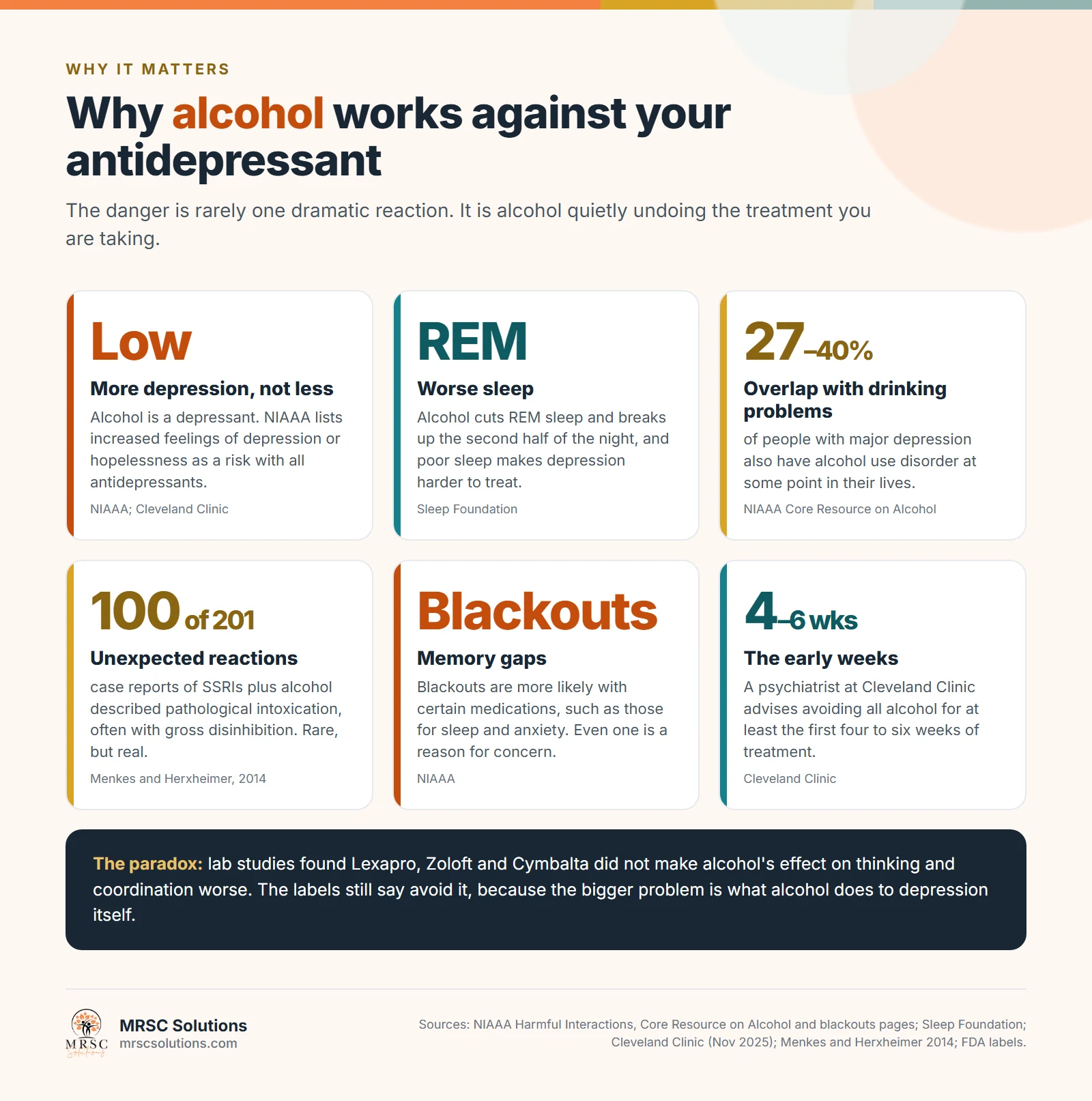
Alcohol works against antidepressants because it is a depressant that can worsen mood and anxiety, disrupt sleep, lower inhibitions and make side effects like drowsiness worse. Over time, regular drinking can make depression harder to treat and make it harder to tell whether your medication is working at all.
It can deepen depression and anxiety
The NIAAA's Harmful Interactions guide lists increased feelings of depression or hopelessness as a risk of combining alcohol with any antidepressant. A drink may feel relaxing for an hour, but the rebound afterward, often the next day, can be lower mood and more anxiety. People on Reddit and other forums frequently describe hangovers that seem to last for days, with anxiety or low mood far beyond what they experienced before starting medication.
It wrecks sleep
Many people use a drink to fall asleep. According to the Sleep Foundation, alcohol reduces REM sleep, the stage linked to memory and emotional processing, and breaks up sleep with frequent awakenings, especially during the second half of the night. Poor sleep is one of the strongest drivers of depression and anxiety. Our article on insomnia and depression explains that two-way link.
It overlaps with depression more than people realize
The NIAAA's Core Resource on Alcohol notes that among people with major depressive disorder, the lifetime co-occurrence of alcohol use disorder ranges from 27% to 40%. It also notes that depression screening scores often rise and fall in tandem with alcohol screening scores. If drinking has been creeping up as a way to cope, that is important information for your prescriber, and our article on trauma and addiction recovery explores how the two can feed each other.
Unexpected reactions do happen
Laboratory studies generally show little or no interaction between SSRIs and alcohol. But a 2014 review of case reports by Menkes and Herxheimer found that pathological intoxication, characterized by unexpected and often gross disinhibition, was described in 100 of 201 reports involving SSRIs and alcohol. Case reports cannot tell us how common these reactions are, only that they occur. It matches a theme many people share online: "I only had two drinks and I don't remember the end of the night."
Blackouts and impaired judgment
The NIAAA notes that blackouts are more likely when someone takes certain medications, such as those for sleep and anxiety, and that experiencing even one is a reason for concern. Combining sedating medications with alcohol also raises the risk of falls, accidents and impaired driving.
Alcohol and suicide risk
This is a hard topic, but an important one. Alcohol lowers inhibitions and increases impulsivity. A 2019 review in Alcohol Research: Current Reviews reported that about 36% of male and 29% of female suicide decedents ages 18 and older had alcohol in their blood, and that acute alcohol use is associated with a rapid transition from a suicidal impulse to action. If you are living with depression, alcohol can turn a dark moment into a dangerous one. If you are having thoughts of suicide, call or text 988 any time.
How Long Do Antidepressants Stay in Your System?
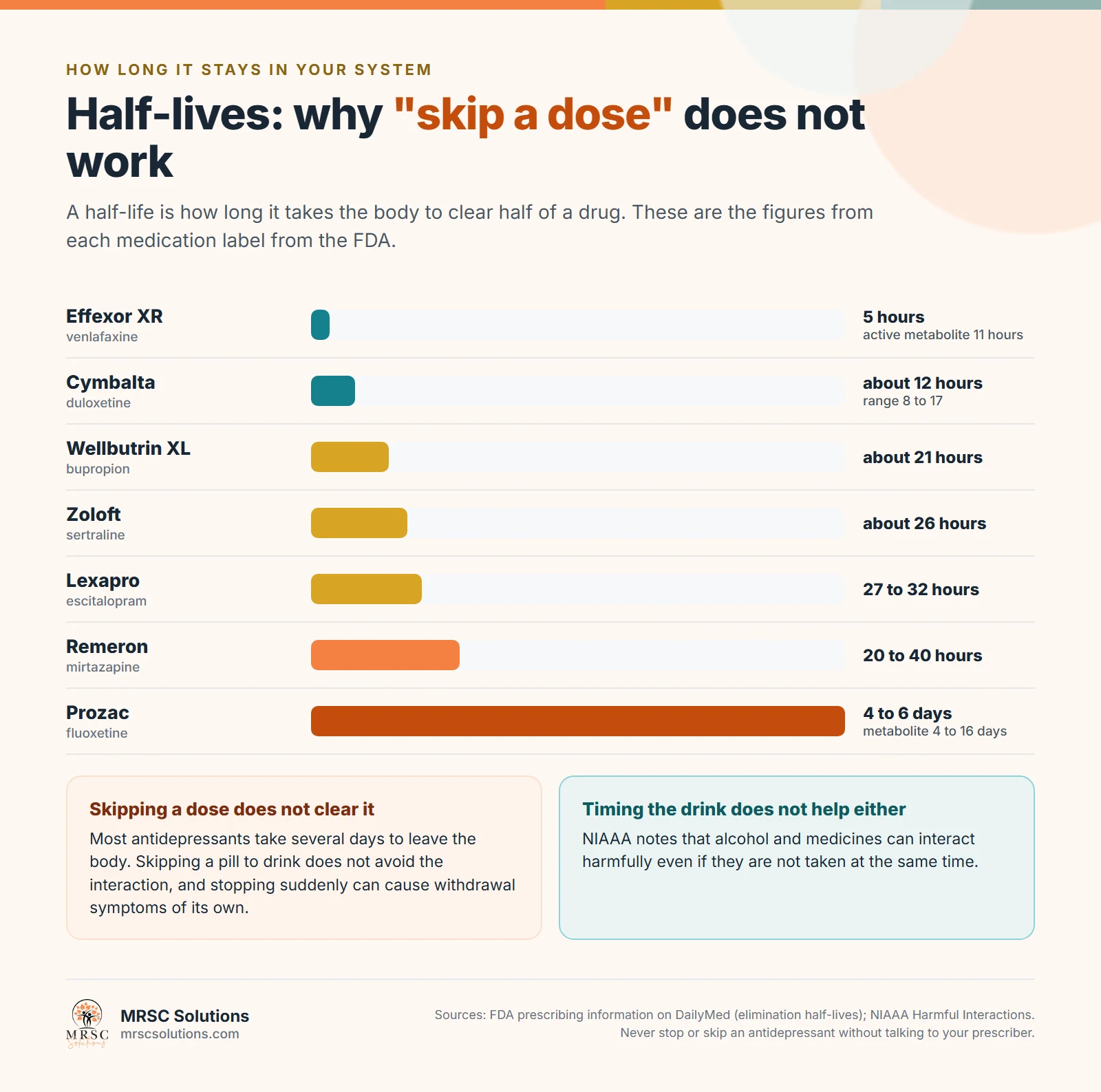
Most antidepressants take several days to leave your body after the last dose. A half-life is the time it takes for half of the drug to be cleared, and it ranges from about 5 hours for venlafaxine to about 4 to 6 days for fluoxetine after regular use, with its active metabolite lasting longer still.
| Medication | Half-life on the FDA label | What it means for drinking |
|---|---|---|
| Effexor XR (venlafaxine) | About 5 hours; active metabolite about 11 hours | Still present the next day |
| Cymbalta (duloxetine) | About 12 hours (8 to 17) | Still present for days after stopping |
| Wellbutrin XL (bupropion) | About 21 hours | Several days to clear |
| Zoloft (sertraline) | About 26 hours | Several days to clear |
| Lexapro (escitalopram) | 27 to 32 hours | Several days to clear |
| Remeron (mirtazapine) | 20 to 40 hours | Several days to clear |
| Prozac (fluoxetine) | 4 to 6 days; metabolite 4 to 16 days | Weeks to clear |
Can you skip a dose to drink?
No. This is one of the most common questions online, and one of the most important misconceptions to correct. Because these medications stay in your body for days, skipping one dose does not remove the drug before you drink. GoodRx, for example, notes that it takes about 5 to 6 days for the average adult to clear Zoloft. Skipping doses also makes your treatment less effective and can cause discontinuation symptoms such as dizziness, irritability and flu-like feelings.
Does it help to drink at night and take the pill in the morning?
Not really. The NIAAA points out that alcohol and medicines can interact harmfully even if they are not taken at the same time. With a medication that lasts a day or more in your body, there is no time of day when it is truly absent.
How long after stopping should you wait to drink?
No FDA label gives a single waiting period for SSRIs or SNRIs, and it depends on the medication and why you stopped. MAOIs are the exception with a clear rule: the Parnate and Nardil labels say to keep avoiding high-tyramine foods and drinks for two weeks after stopping. If you are coming off any antidepressant, ask your prescriber when drinking is reasonable for you, and remember that the weeks after stopping are when depression is most likely to return.
Is One Drink OK on Antidepressants?
For some people, an occasional single drink may be acceptable, but it depends on the medication, your dose, how long you have been on it, your health and your drinking history. The safest approach is to ask your prescriber before you drink, avoid alcohol entirely in the first weeks of treatment, and never combine alcohol with a sedating medication before driving.
Real-world guidance from clinicians reflects this nuance. Writing for Cleveland Clinic, psychiatrist David Streem advises avoiding all alcohol and other habit-forming substances for at least the first four to six weeks of treatment, and notes that one heavy drinking episode a month is not going to have a significant impact on most modern antidepressants. That is not permission to binge. It is a recognition that the occasional mistake is not a catastrophe, while regular drinking is a real problem for treatment.
Situations where even one drink is a bad idea:
- In the first four to six weeks of starting or changing a medication
- If you take an MAOI, or a sedating medication such as mirtazapine or trazodone
- If you have a seizure history or drink heavily and take bupropion
- If you have liver disease, or take duloxetine and drink heavily
- If you will be driving, operating machinery or caring for children
- If you have a history of alcohol misuse, or drinking has been increasing
- If your depression is not yet well controlled, or you have had thoughts of suicide
- If you are an older adult; the NIAAA notes older people are at particularly high risk of harmful alcohol and medication interactions
What counts as one drink?
Holiday drinks are often much bigger than people think. The NIAAA defines one US standard drink as about 14 grams of pure alcohol: 12 ounces of beer at about 5% alcohol, 5 ounces of wine at about 12%, or 1.5 ounces of spirits at about 40%. A generous pour of wine, a craft IPA or a mixed holiday cocktail can easily equal two or more standard drinks.
What People Describe When They Drink on Antidepressants
Search for any antidepressant and the word "alcohol", and you will find thousands of forum posts from people describing what happened when they drank. These stories are not research, but the same themes come up again and again, and most of them line up with what the labels and studies warn about.
- "I got drunk so much faster." Many people on Lexapro, Zoloft or Wellbutrin say one or two drinks hit like four. The Wellbutrin label specifically mentions reduced alcohol tolerance. With sedating medications, the drowsiness adds up.
- "I blacked out after a couple of drinks." Memory gaps are one of the most common and most frightening reports. The NIAAA says even one blackout is a reason for concern.
- "The hangover lasted for days." People often describe next-day anxiety, low mood and exhaustion far worse than before they started medication. Alcohol's effect on mood and sleep explains much of this.
- "My doctor said one or two is fine, but the pharmacist said none." Both can be right. The label gives the general rule; your prescriber can tailor advice to your medication, dose, health and history.
- "I skipped my dose for the weekend." This is common, and it does not work: the medication is still in your body, and skipping can bring on discontinuation symptoms that feel like a hangover on top of a hangover.
- "I stopped drinking when I started my SSRI, and it changed everything." Some of the most encouraging posts come from people who took a break from alcohol while starting treatment and found their mood improved far more than they expected.
- "My cravings changed." Some people notice they want alcohol less on certain medications. That can be a welcome side effect, but any big change in drinking is worth telling your prescriber about.
If any of these sound familiar, you are not alone, and your prescriber has heard all of them before. Honest answers about what really happens when you drink lead to better treatment.
What to Do If You Already Drank on Your Antidepressant
If you had a drink before you knew about the warnings, or more than you planned at a party, do not panic, and do not skip your next dose to "make up for it". For most people, a single drink on an SSRI does not cause a medical emergency. What matters is how you feel and what you do next.
- Stop drinking for the rest of the night and switch to water.
- Do not drive, and do not take extra sleep aids, anxiety medications or other sedating substances.
- Take your next dose as scheduled unless your prescriber tells you otherwise.
- Stay with someone if you feel unusually drunk, confused or sleepy.
- Know the warning signs. Seek emergency care by calling 911 for confusion, extreme drowsiness, trouble breathing, fainting, a seizure, chest pain, a severe headache or a racing heart. These are especially important on bupropion, which carries a seizure risk, and on an MAOI, which can cause dangerous spikes in blood pressure.
- Tell your prescriber at your next visit, or sooner if you had a strong reaction. It is useful information, not a confession.
Can You Drink on Two Antidepressants, Like Lexapro and Wellbutrin?
Many people take more than one antidepressant, for example an SSRI such as Lexapro or Zoloft together with bupropion. When you combine medications, the alcohol warnings for each one still apply, so the most cautious label sets the rule. With bupropion in the mix, that means keeping alcohol minimal or avoiding it, and never stopping heavy drinking abruptly without medical guidance. People taking a combination, or an antidepressant together with a sleep medication, benzodiazepine or opioid, should talk to their prescriber before drinking at all, because several sedating effects can stack on top of each other.
Alcohol Advice Is Changing for Everyone
It is not only people on antidepressants who are being told to drink less. In January 2025, the US Surgeon General issued an advisory on alcohol and cancer risk, calling alcohol the third leading preventable cause of cancer in the country, after tobacco and obesity. In January 2026, the new 2025 to 2030 Dietary Guidelines for Americans dropped the old numeric daily limits and, as AARP summarized, now simply advise people to consume less alcohol for better health.
Americans are already shifting. In 2025, Gallup found that the share of US adults who drink had fallen to 54%, a record low, and a record 53% said they believe moderate drinking is bad for your health. Choosing not to drink at a holiday party is more common than it has ever been.
Is This You? A Quick Self-Check
Be honest with yourself:
- Have you skipped or delayed a dose of your antidepressant so you could drink?
- Have you felt much more drunk than expected from a small amount since starting your medication?
- Have you had a blackout or memory gap while drinking on your medication?
- Do you feel low, anxious or irritable for a day or more after drinking?
- Have you been drinking more to manage stress, sleep or loneliness?
- Has anyone close to you mentioned your drinking?
- Have you not told your prescriber how much you really drink?
If you answered yes to any of these, it is worth a conversation with your prescriber. None of these make you a bad patient. They are exactly the kind of information that helps your clinician choose the right medication and dose for you.
A Holiday Party Plan If You Take an Antidepressant
The best holiday plan is the one you make before the party, not with a drink already in your hand. Talk to your prescriber, keep taking your medication, decide your limit and your ride in advance, and have a drink you enjoy that you can hold all night.
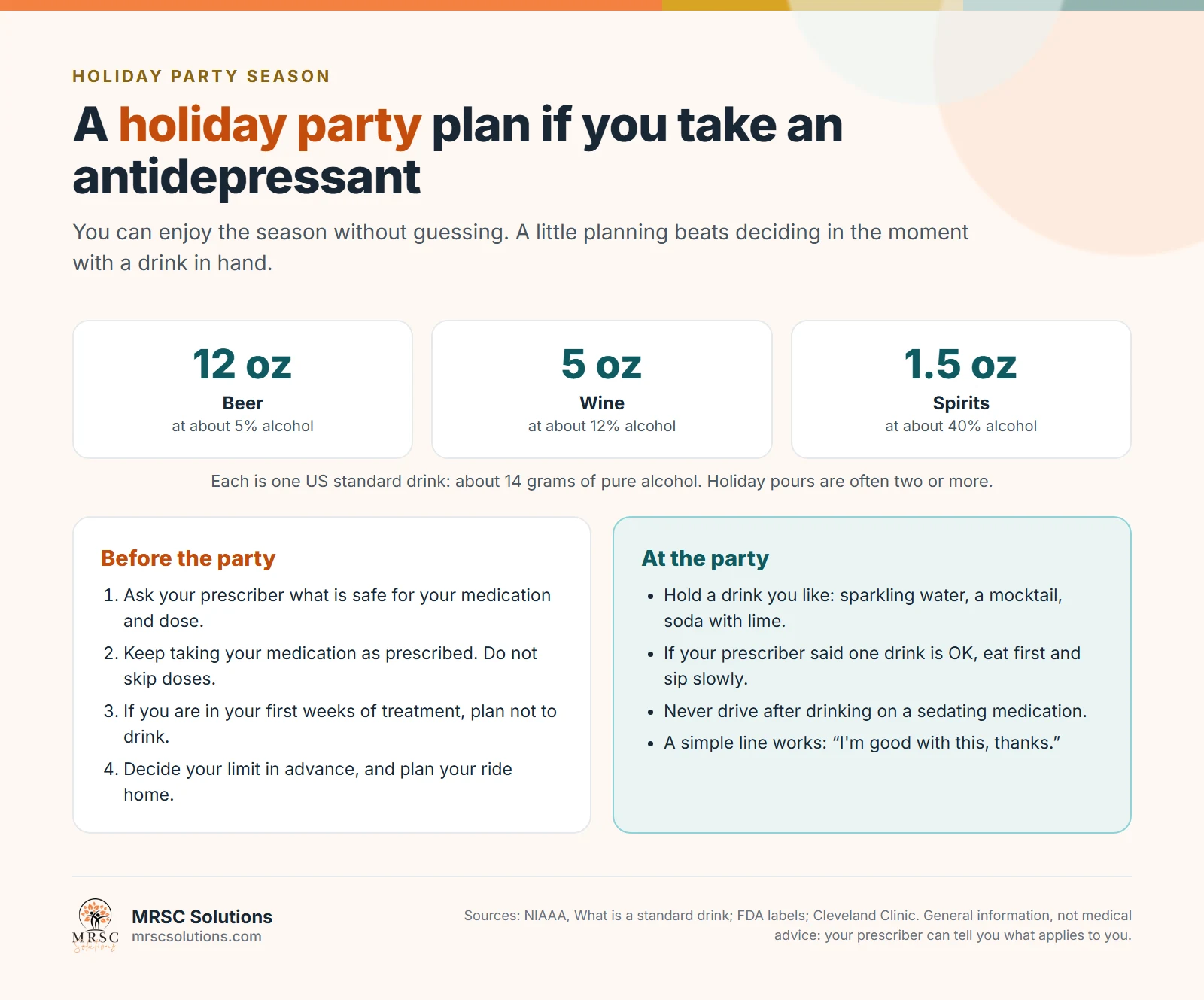
- Ask before the season starts. Ask your prescriber directly: "Is it safe for me to have a drink on this medication and dose? How much, and how often?"
- Keep taking your medication. Do not skip, delay or double up around events.
- If you are new to treatment, sit this one out. The first four to six weeks are the most important.
- Decide your limit in advance, and count standard drinks, not glasses.
- Eat first, and alternate with water if your prescriber has said an occasional drink is acceptable.
- Plan your ride home before you leave the house. Never drive after drinking on a sedating medication.
- Bring or order a drink you enjoy. Sparkling water with lime, a mocktail, non-alcoholic beer (unless you take an MAOI) or a festive soda.
- Have a line ready. "I'm good with this, thanks." You do not owe anyone an explanation about your health.
- Check in with yourself the next day. If your mood dips noticeably after drinking, that is useful information to share with your prescriber.
The holidays can be hard on mood in other ways too. If you notice the season itself weighing on you, our guides to seasonal depression and holiday depression may help.
When to Talk to Your Prescriber
Talk to your prescriber before you drink if you are new to your medication, take bupropion, duloxetine, mirtazapine, trazodone or an MAOI, or have any history of heavy drinking or seizures. Contact them soon if drinking makes your mood worse, causes blackouts, or if you find yourself skipping doses to drink.
Reach out promptly if:
- You have had a blackout, a fall or an unexpectedly strong reaction to alcohol on your medication.
- You drink heavily and want to cut down or stop, especially if you take bupropion. Stopping heavy drinking suddenly can be dangerous on its own and needs medical guidance.
- Your depression or anxiety has worsened, or your medication no longer seems to work.
- You are using alcohol to get through the day or to fall asleep.
The NIAAA's Core Resource notes that clinicians do not need to wait until patients become sober to start antidepressants if there is evidence of need. In other words, you do not have to have your drinking figured out before you ask for help with depression. Honesty about both is what leads to the right plan.
If you are having thoughts of suicide or self-harm, call or text 988, the Suicide and Crisis Lifeline, or call 911 in an emergency.
What Getting Help Looks Like
At an appointment about medication and alcohol, your prescriber will ask how much and how often you drink, without judgment, and look at your medication, dose, other prescriptions, sleep and mood. Together you decide whether your current medication is right, whether a different one would suit your life better, and what a safe plan for drinking looks like for you.
At MRSC Solutions, Rachel Christian, PMHNP-BC, a board-certified psychiatric nurse practitioner, provides depression treatment and anxiety treatment, including medication management, by secure video across Florida, New York, Arizona, Massachusetts, Oregon and California, and in person in West Palm Beach. Most new patients are seen within a week, and many major insurance plans are accepted; our FAQ explains how benefits are checked. If you are wondering how long a new medication takes to help, our article on how long antidepressants take to work is a good place to start.
If you have questions about your medication and the holidays, or about drinking more than you would like, request an appointment online or call (561) 849-4565. It is one of the most common conversations we have, and there is no judgment in it.
Conclusion
Can you drink on antidepressants? For most medications, the label says no, and the reason is less about a dramatic reaction and more about alcohol quietly working against your treatment: deepening low mood, disrupting sleep and lowering your guard. Some medications, like Wellbutrin, Cymbalta and the MAOIs, carry specific risks that make caution essential. Skipping a dose does not make drinking safer, and the first weeks of treatment are the most important time to avoid alcohol. The best plan is a simple one made in advance with your prescriber. If you would like help making that plan before the holidays, book an appointment or call (561) 849-4565 today.
Frequently Asked Questions
Can you drink alcohol on Lexapro?
The Lexapro label says not to drink alcohol during treatment. Although a clinical trial found Lexapro did not increase alcohol's effects on thinking and coordination, alcohol can worsen depression, increase drowsiness and disrupt sleep. Ask your prescriber whether any amount is acceptable for you.
Is it safe to drink on Zoloft?
The Zoloft label says not to drink alcohol while taking it. Alcohol can worsen side effects and depression and may stop the medicine working properly. Zoloft oral solution also contains 12% alcohol. Talk to your prescriber before drinking, especially in the first weeks of treatment.
What happens if you drink on Wellbutrin?
Wellbutrin can lower your tolerance, so you may feel drunk faster than expected, and rare neuropsychiatric reactions have been reported. Stopping heavy drinking suddenly while on bupropion raises the risk of seizures. Tell your prescriber how much you drink before starting it.
Can I skip my antidepressant to drink?
No. Most antidepressants take several days to leave your body, so skipping one dose does not prevent an interaction. Skipping doses can also make treatment less effective and cause discontinuation symptoms like dizziness and irritability. Keep taking your medication as prescribed.
Can alcohol make my depression worse?
Yes. Alcohol is a depressant. The NIAAA lists increased feelings of depression or hopelessness as a risk with all antidepressants, and alcohol disrupts sleep, which affects mood. Many people notice lower mood or more anxiety the day after drinking.
How much alcohol is one drink?
One US standard drink contains about 14 grams of pure alcohol: 12 ounces of regular beer, 5 ounces of wine, or 1.5 ounces of spirits. Many holiday pours and cocktails contain two or more standard drinks, so count carefully.