depression treatment
Seasonal Depression (SAD): Why Winter Hits So Hard and What Actually Helps
The clocks went back on November 1, and overnight the sun started setting before you leave work. You get up in the dark, sit at a desk all day, and drive home in the dark again. You are sleeping nine or ten hours and still waking up exhausted. You want carbs, not people. Things you normally enjoy feel like chores, and some part of you is already counting the weeks until March. If any of that sounds familiar, you are not being dramatic and you are not imagining it. You may be dealing with seasonal depression, and it is one of the most treatable conditions in psychiatry.
The short answer: seasonal depression, known clinically as seasonal affective disorder (SAD), is a type of major depression that comes back at the same time each year, most often in late fall and winter, and lifts in spring. It affects about 5% of adults in the United States. It is more than the winter blues: it changes your mood, sleep, appetite and energy for months at a time. Light therapy, a specific form of talk therapy, and medication all work, and it can often be prevented before it starts.
Key takeaways
- Seasonal depression affects about 5% of US adults and typically lasts about 40% of the year, according to the American Psychiatric Association.
- It is a real diagnosis: major depressive disorder with seasonal pattern, which requires seasonal episodes for at least two years in a row.
- The switch back to standard time is linked to a measurable rise in depression diagnoses, and the hardest months for most people are January and February.
- Light therapy, cognitive behavioral therapy for SAD (CBT-SAD) and medication all have strong evidence. CBT-SAD protected people better two winters later.
- Because seasonal depression is predictable, the best time to plan treatment is before symptoms start.
What Is Seasonal Depression?
Seasonal depression is a form of major depression that follows the seasons. Symptoms start at roughly the same time each year, usually in late fall or early winter, and ease in spring or summer. Doctors call it seasonal affective disorder, or SAD. It is not a mood or a personality trait. It is a recognized medical condition that responds well to treatment.
In the current diagnostic manual, the American Psychiatric Association explains that SAD is classified as "major depressive disorder with seasonal pattern". That wording matters. It means seasonal depression is not a separate, milder illness. It is depression, with the same symptoms and the same risks, that happens to arrive on a schedule.
To be diagnosed, the National Institute of Mental Health (NIMH) says a person must meet the criteria for major depression, and their depressive episodes must occur during specific seasons for at least two consecutive years. One rough winter after a hard year does not make it SAD. A pattern does.
Most people with seasonal depression have the winter pattern. A smaller group has the reverse: depression that starts in late spring or summer and lifts in fall. We cover both below, because the summer version is easier to miss, especially in warm states.
Is Seasonal Depression Real?
Yes. Seasonal depression is a recognized diagnosis with decades of research behind it. Studies show measurable differences in brain chemistry and sleep timing in people with SAD, and treatments built specifically for it work in controlled trials. Feeling down every winter is common; feeling unable to function every winter is a medical problem worth treating.
This question comes up constantly online, usually from people who have been told by a partner, parent or boss that "everyone gets down in winter" or that it is a choice. That framing is wrong, and it keeps people from getting help.
Here is what the research actually shows:
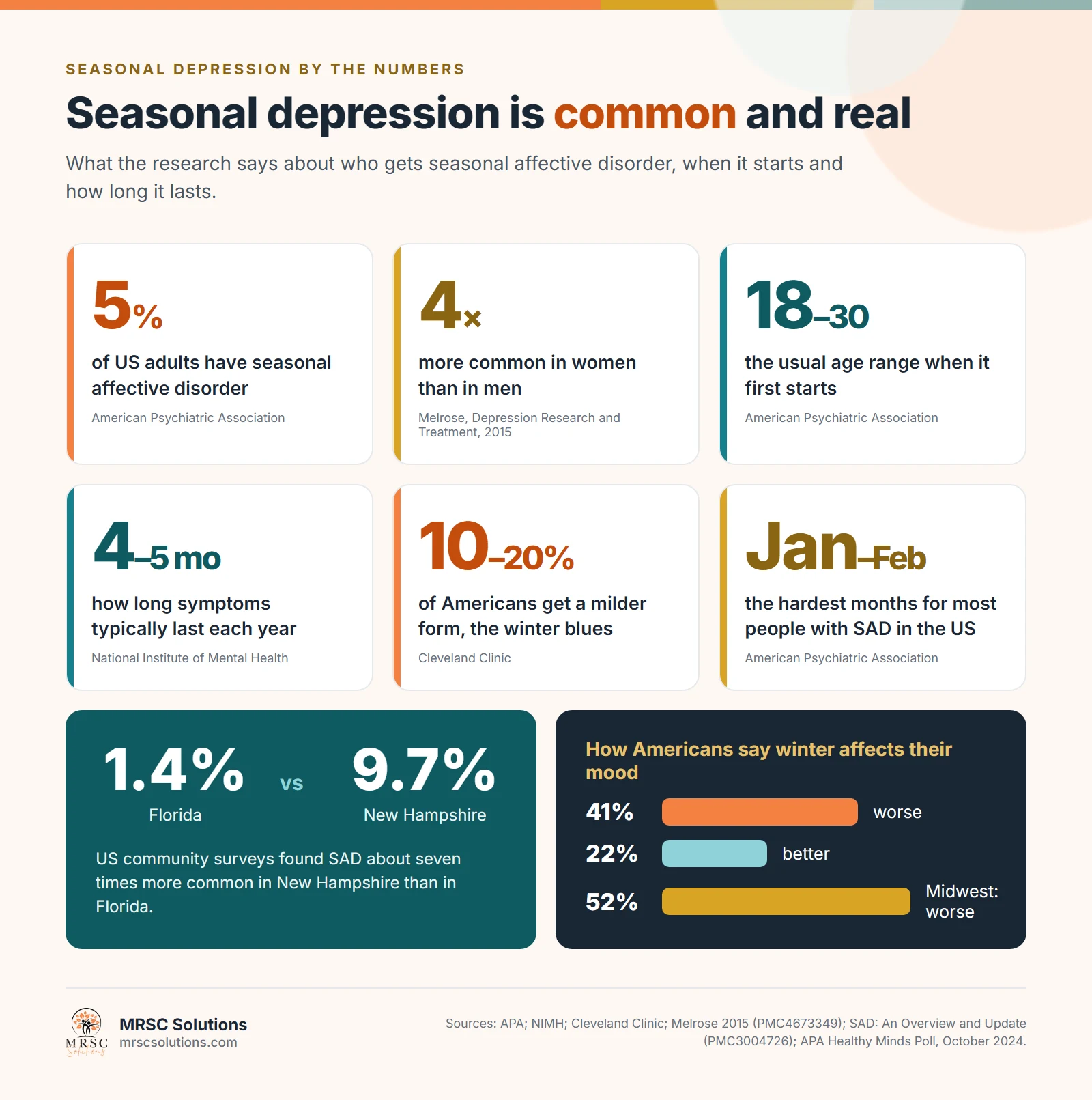
- It is common. About 5% of US adults experience SAD, according to the APA. A 2025 meta-analysis of 24 studies and nearly 33,000 people found a pooled prevalence of 5.01%, with higher rates farther from the equator.
- Most people notice something. Researchers at Yale's winter depression program report that about 90% of people notice some change in energy, mood, sleep, appetite or weight in winter. SAD is the far end of that range.
- The pattern holds up. In a 2024 study that followed adults diagnosed with winter SAD, 79% experienced complete remission the following summer, which is exactly what the diagnosis predicts.
- Plenty of Americans feel it. In the APA's 2024 Healthy Minds poll, Americans were twice as likely to say their mood declines in winter (41%) as to say it improves (22%).
What Are the Symptoms of Seasonal Depression?
Seasonal depression symptoms include the core signs of major depression: a low mood most of the day, nearly every day, and losing interest in things you used to enjoy. The winter pattern adds a cluster of "hibernation" symptoms: oversleeping, heavy fatigue, craving carbohydrates, weight gain and pulling away from people. Symptoms last weeks, not days.
Winter-pattern seasonal depression
Winter is by far the most common pattern. NIMH lists these symptoms, and they match what people describe in their own words:
- Low mood most of the day, nearly every day. Not a bad afternoon. A gray filter over everything.
- Losing interest in things you normally enjoy. Hobbies, friends and even favorite shows feel like effort.
- Oversleeping. Sleeping much longer than usual and still waking up tired. Many people describe feeling like a hibernating animal.
- Heavy fatigue. Arms and legs that feel weighted, and an energy tank that never refills.
- Craving carbohydrates and gaining weight. Bread, pasta and sugar become hard to resist.
- Social withdrawal. Canceling plans, ignoring texts, and wanting to stay home under a blanket.
- Trouble concentrating. Work takes longer, and small decisions feel heavy.
- Feeling hopeless, worthless or guilty, including guilt about being tired all the time.
- Thoughts of death or suicide. If this applies to you, call or text 988 now. It is a sign to get help today, not to wait for spring.
Summer-pattern seasonal depression
Summer-pattern SAD is less common, and its symptoms tend to look different. According to NIMH, they include trouble sleeping (insomnia), poor appetite with weight loss, and restlessness, agitation or anxiety. Some people describe feeling trapped indoors by heat and humidity, which is a real complaint in Florida, Arizona and Southern California.
What seasonal depression is not
Seasonal depression is not the same as disliking cold weather, being busy over the holidays, or feeling a bit sluggish for a few days after the clocks change. The difference is duration and impact. If symptoms last two weeks or more and start to affect work, school or relationships, it is worth taking seriously.
When Does Seasonal Depression Start, and How Long Does It Last?
Winter seasonal depression usually starts in late fall or early winter and lifts in spring. NIMH says symptoms typically last about four to five months of the year, and the APA notes that January and February tend to be the hardest months in the United States. For many people, the first clear sign comes right after the clocks fall back.
The timing is often remarkably consistent. Many people can name the week it starts: the first time they leave work in the dark, the first gray week of November, or the stretch after the holidays when the decorations come down and there is nothing to look forward to but more winter.
The APA says SAD typically begins between ages 18 and 30, and NIMH notes it most often starts in young adulthood. That is why college students and people in their first jobs are often the ones searching "why do I feel like this every winter?" for the first time.
How long seasonal depression lasts depends on where you live and whether you treat it. Untreated, an episode can stretch from October or November all the way into March or April. With treatment, many people notice improvement within one to two weeks.
Why Does the Time Change Make Seasonal Depression Worse?
When clocks fall back in November, sunset suddenly arrives an hour earlier, so most people lose their evening daylight overnight and spend more of their waking day in the dark. A large Danish study found the switch to standard time was linked to an 11% rise in depression diagnoses that lasted about ten weeks.
That study, published in Epidemiology in 2017, looked at more than 185,000 hospital contacts for depression. The rise appeared after the autumn change to standard time, not after the spring change, which suggests the sudden loss of evening light is what matters, not the clock change itself.
You can see the effect in real numbers. In Boston, sunset jumped from 5:39 pm on October 31, 2026 to 4:38 pm on November 1. By the shortest day of the year, December 21, Boston gets just over nine hours of daylight. Arizona does not observe daylight saving time, so Phoenix avoids the sudden jump, although its days still shorten.
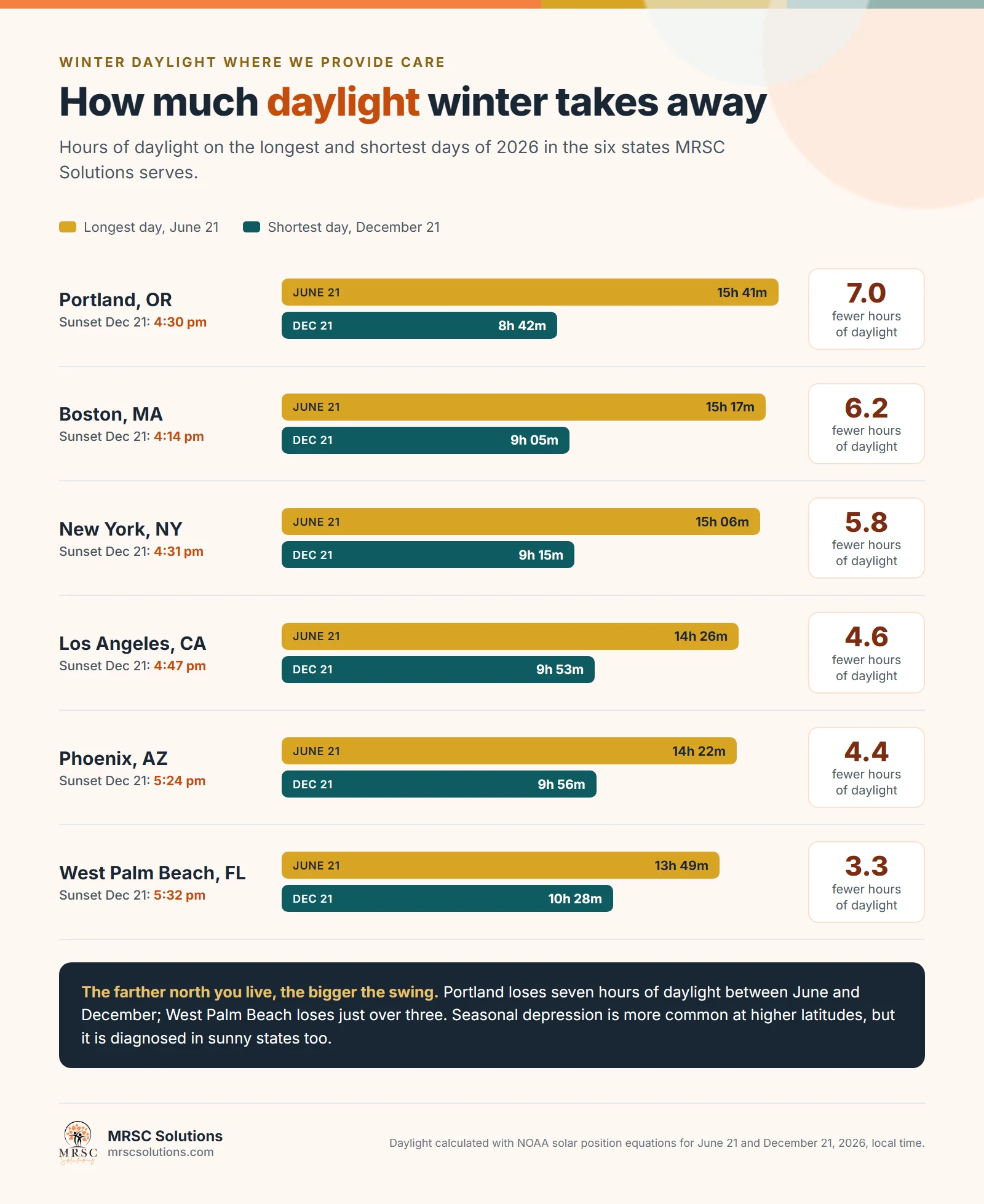
This is why the most common complaint every November is not about cold. It is about darkness at 4:30 in the afternoon. The American Academy of Sleep Medicine has called for an end to seasonal clock changes in favor of permanent standard time, because it fits the body clock better. Until that happens, the November switch is a predictable stress point, and it is a good time to put your winter plan in place.
What Causes Seasonal Depression?
Seasonal depression is caused mainly by reduced daylight disrupting the body's internal clock. Less morning light can shift your circadian rhythm, raise melatonin, the hormone that makes you sleepy, and change how the brain handles serotonin, a chemical that helps regulate mood. Vitamin D and genetics may also play a part.
Researchers do not think there is a single cause. These are the main explanations with the strongest evidence:
Your body clock drifts out of sync
Morning light is the main signal that sets your internal 24-hour clock, your circadian rhythm. When mornings are dark, that clock can drift later than your actual schedule. The Sleep Foundation explains one leading theory: when circadian rhythms become misaligned with a person's sleep schedule, they develop SAD. It is a bit like living with permanent jet lag from November to March.
Too much melatonin
Melatonin rises in darkness to prepare you for sleep. NIMH reports that people with winter-pattern SAD produce too much melatonin, which can increase sleepiness and lead to oversleeping. That helps explain why seasonal depression so often looks like hibernation.
Changes in serotonin
NIMH also notes that people with winter-pattern SAD have reduced serotonin activity. Brain imaging research published in Brain found that people with SAD had higher levels of the serotonin transporter, a protein that clears serotonin away, in winter. A review summarizing this work notes that people with SAD had about 5% more of this transporter in the winter months, leaving less serotonin available.
Vitamin D
Your skin makes vitamin D from sunlight, and levels often drop in winter. Low vitamin D has been linked with depression, but the evidence on treating SAD with vitamin D is mixed. We cover this in the treatment section below.
Genes and history
Seasonal depression tends to run in families, and it is more common in people who already have major depression or bipolar disorder. That is one reason a proper evaluation matters: the right treatment depends on the whole picture.
Who Is Most at Risk for Seasonal Depression?
Seasonal depression is most common in women, in young adults, in people who live far from the equator, and in people with a personal or family history of depression or bipolar disorder. Living in a cloudy northern city raises the risk, but seasonal depression also occurs in sunny states.
- Women. SAD occurs about four times more often in women than in men, according to a 2015 review in Depression Research and Treatment.
- Young adults. It usually starts between ages 18 and 30.
- People who live farther north. In US community surveys, SAD prevalence ranged from 9.7% in New Hampshire to 1.4% in Florida, according to SAD: An Overview and Update. NIMH notes that people in Alaska or New England are more likely to develop SAD than people in Texas or Florida.
- People with depression or bipolar disorder. Seasonal patterns are common in both, and the same review notes that 10% to 20% of recurrent depression cases follow a seasonal pattern.
- People with a family history of depression, SAD or other mental health conditions.
- People with little daylight exposure, such as shift workers, people in windowless offices, and anyone who commutes in the dark both ways.
The APA's 2024 poll also found regional and lifestyle differences: half (52%) of Midwesterners said their mood declines in winter, the highest of any region, and rural residents were more likely than city dwellers to say the same (46% vs 36%).
Can You Get Seasonal Depression in Florida?
Yes. Seasonal depression is less common in Florida than in the North, at roughly 1% to 1.4% of residents in US surveys, but it still happens. Some Floridians feel worse in summer, when heat and humidity keep them indoors, and people who move south from colder states may notice the pattern most.
Florida is where MRSC Solutions is based, so this is a question we hear often. A few situations come up again and again:
- People who moved to Florida from the North and found that their winter low eased but did not disappear entirely, or that it shifted to a different time of year.
- Floridians who moved north for school or work, and experienced their first real winter depression in New York, New Jersey or Massachusetts. If that is you, your symptoms are not a character flaw. You went from about ten and a half hours of December daylight to about nine.
- Summer-pattern seasonal depression. In South Florida, many people say they feel better when the temperature drops to the 70s, and that the long, hot, humid summer is the hard season. Summer-pattern SAD is rarer, but its symptoms (insomnia, poor appetite, restlessness and anxiety) are easy to dismiss as heat exhaustion.
- Indoor lifestyles. Living in a sunny place does not help much if you spend daylight hours in an office with the blinds down and drive home after dark.
The same logic applies in Arizona and Southern California. Sunshine lowers the risk, but it does not make seasonal depression impossible.
Winter Blues vs Seasonal Depression: What Is the Difference?
The winter blues are a mild, common dip in mood and energy that does not stop you from functioning. Seasonal depression is major depression with a seasonal pattern: symptoms are stronger, last for weeks, and affect work, school or relationships. If the winter blues make winter less pleasant, seasonal depression makes it hard to get through.
Cleveland Clinic estimates that 10% to 20% of people in America may get the milder winter blues. It is also possible to have year-round depression that simply gets worse in winter, which needs a different approach.
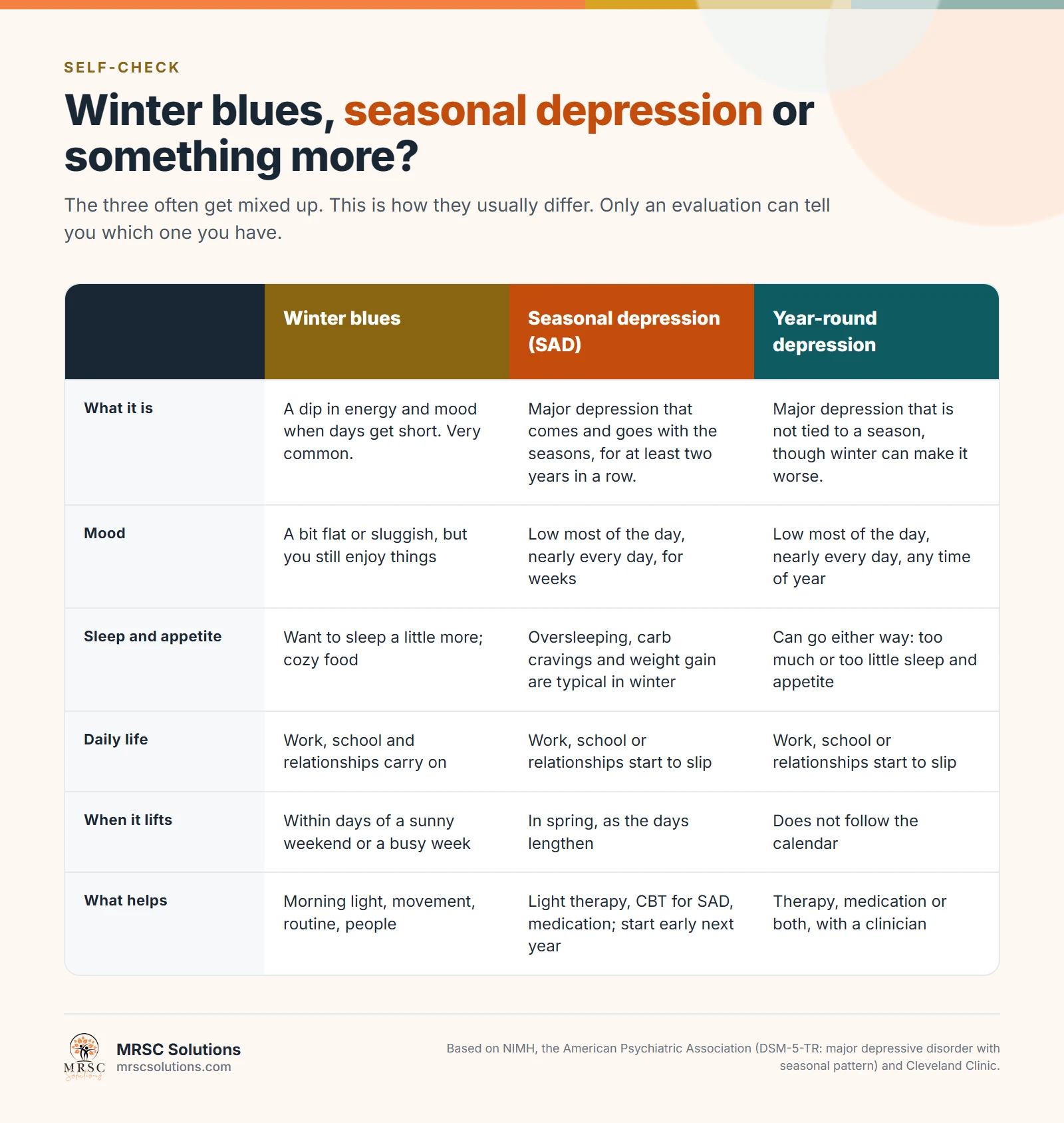
| Winter blues | Seasonal depression (SAD) | Year-round depression | |
|---|---|---|---|
| How common | Very common | About 5% of US adults | About 8% of US adults have a major depressive episode in a year |
| Mood | A bit flat, still enjoy things | Low most of the day, nearly every day | Low most of the day, nearly every day |
| Timing | Comes and goes with the weather | Starts in fall or winter, lifts in spring | Any time of year |
| Daily life | Carries on | Work, school or relationships slip | Work, school or relationships slip |
| Typical help | Light, movement, routine, people | Light therapy, CBT-SAD, medication | Therapy, medication or both |
The year-round figure comes from NIMH data on major depression. If you are not sure which column fits you, that is exactly what an evaluation is for. Our article on burnout vs depression can also help if work stress is part of the picture.
Is This You? A Quick Seasonal Depression Self-Check
Answer these honestly, thinking about the last two winters:
- Do your mood and energy drop at about the same time every year?
- Do you sleep much more than usual in fall and winter but still wake up tired?
- Do you crave carbohydrates and gain weight in the colder months?
- Do you pull away from friends and family, cancel plans, or stop answering messages in winter?
- Have work, school or relationships suffered during the darker months?
- Do you start dreading fall in August or September?
- Do you feel noticeably better, almost like a different person, by spring?
- Have you had thoughts that life is not worth living during the winter?
If you answered yes to several of these, especially the first, fifth and seventh, seasonal depression is a real possibility. If you answered yes to the last one, please do not wait. Call or text 988, or book a visit this week. A self-check cannot diagnose you, but it can tell you when it is time to talk to someone who can.
How Is Seasonal Depression Diagnosed?
Seasonal depression is diagnosed by a clinician through a psychiatric evaluation. They ask about your symptoms, when they start and stop each year, your sleep, appetite and energy, and your personal and family history. There is no blood test for SAD, but some tests may be used to rule out other conditions that look similar.
A good evaluation looks at the pattern over time, not just how you feel today. Expect questions like:
- When did you first notice this, and has it happened in previous years?
- What months are hardest, and when do you start feeling like yourself again?
- How much are you sleeping, and how do you feel when you wake up?
- Have you had periods of unusually high energy, little need for sleep, or racing thoughts?
- Is there a family history of depression, bipolar disorder or SAD?
That question about high energy matters. Seasonal patterns are common in bipolar disorder, and some treatments for seasonal depression, including bright light and antidepressants, can trigger mania in people with bipolar disorder. That is one of the most important reasons not to self-treat without an evaluation. If bipolar disorder is part of the picture, bipolar treatment looks different.
The APA also notes that SAD can be misdiagnosed when conditions such as hypothyroidism, low blood sugar, mononucleosis or other viral infections are present. A clinician may suggest blood work through your primary care provider to rule these out.
If you have never had a psychiatric evaluation, our guide on what to expect at your first psychiatric evaluation walks through it step by step.
Seasonal Depression Treatment: What Actually Works?
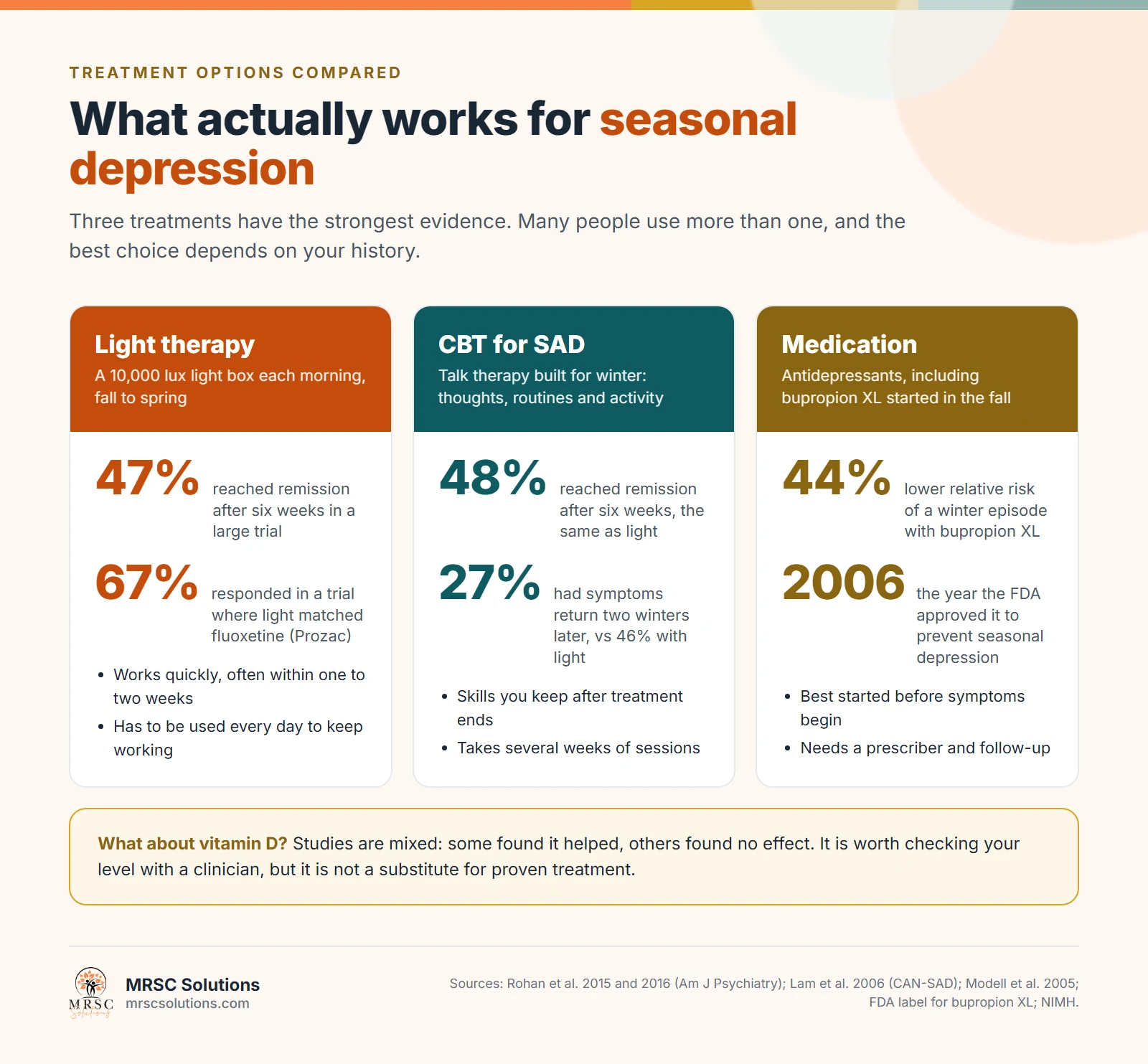
The three best-studied treatments for seasonal depression are bright light therapy, cognitive behavioral therapy designed for SAD (CBT-SAD), and antidepressant medication. Light therapy often works within one to two weeks, CBT-SAD gives the longest-lasting protection, and medication can prevent episodes when started early. Many people combine them.
Bright light therapy
Light therapy means sitting near a special light box for a set time each morning. NIMH describes the standard approach as a very bright light box (10,000 lux) used every day for about 30 to 45 minutes, usually first thing in the morning, from fall to spring. That light is about 20 times brighter than ordinary indoor light.
It works. A 2020 meta-analysis of 19 randomized trials found bright light therapy clearly better than placebo for seasonal depression. In the Canadian CAN-SAD trial, light therapy and the antidepressant fluoxetine (Prozac) worked equally well, with a 67% response rate in each group. The APA notes that most people see some improvement within one or two weeks.
The catch is that it has to be used daily, and symptoms tend to return when you stop. We cover how to use a lamp properly in the next section.
Cognitive behavioral therapy for SAD (CBT-SAD)
CBT-SAD is a version of cognitive behavioral therapy built specifically for winter depression. It focuses on two things: changing the thoughts that make winter feel unbearable ("I can't do anything until spring"), and scheduling activities that bring back energy and enjoyment, a technique called behavioral activation.
The best evidence comes from a large trial led by Kelly Rohan at the University of Vermont. In the first winter, CBT-SAD and light therapy worked equally well, with remission rates of 47.6% and 47.2%. The difference showed up later. Two winters after treatment, symptoms had returned in 27.3% of the CBT-SAD group compared with 45.6% of the light therapy group. CBT-SAD gives you skills you keep, while a lamp only works while you use it.
Medication
Antidepressants are an effective treatment for seasonal depression, especially when symptoms are moderate to severe. NIMH notes that SSRIs, such as fluoxetine, sertraline and escitalopram, are commonly used.
One medication has a specific approval. In 2006, the FDA approved bupropion XL (Wellbutrin XL) to prevent seasonal depressive episodes in people with a history of SAD, the first drug approved for the condition. Its FDA label says to start it in the autumn, before symptoms begin, and continue through winter. In three prevention trials, bupropion XL reduced the relative risk of a winter episode by 44%.
To keep that in perspective, a Cochrane review concluded that most people will not need preventive medication: about three out of four would not have had an episode anyway. That is why the decision is individual, and it depends on how severe your past winters have been. If you are already taking bupropion, our article on how to tell if Wellbutrin is working explains what to expect.
What about vitamin D?
Vitamin D is the supplement most people try first, often after reading about it online. NIMH says studies of vitamin D for SAD have produced mixed results: some found it worked as well as light therapy, and others found no effect. A small trial found no effect on SAD symptoms, although its authors noted it may have been too small to detect one.
The sensible approach is to have your level checked. If it is low, correcting it is good for your health anyway. Just do not let a vitamin D bottle replace treatments with stronger evidence, and do not take very high doses without medical advice.
| Treatment | How it works | How fast | Best for |
|---|---|---|---|
| Light therapy | 10,000 lux each morning resets your body clock | Often 1 to 2 weeks | Fast relief; people who can commit to daily use |
| CBT-SAD | Changes winter thinking and rebuilds activity | Several weeks of sessions | Longer-lasting protection in future winters |
| Bupropion XL | Started in fall to prevent episodes | Before symptoms begin | People with a history of severe winters |
| SSRIs | Antidepressant medication | Usually several weeks | Moderate to severe symptoms |
| Vitamin D | Corrects a deficiency | Varies | People with low measured levels |
How to Use a SAD Lamp the Right Way
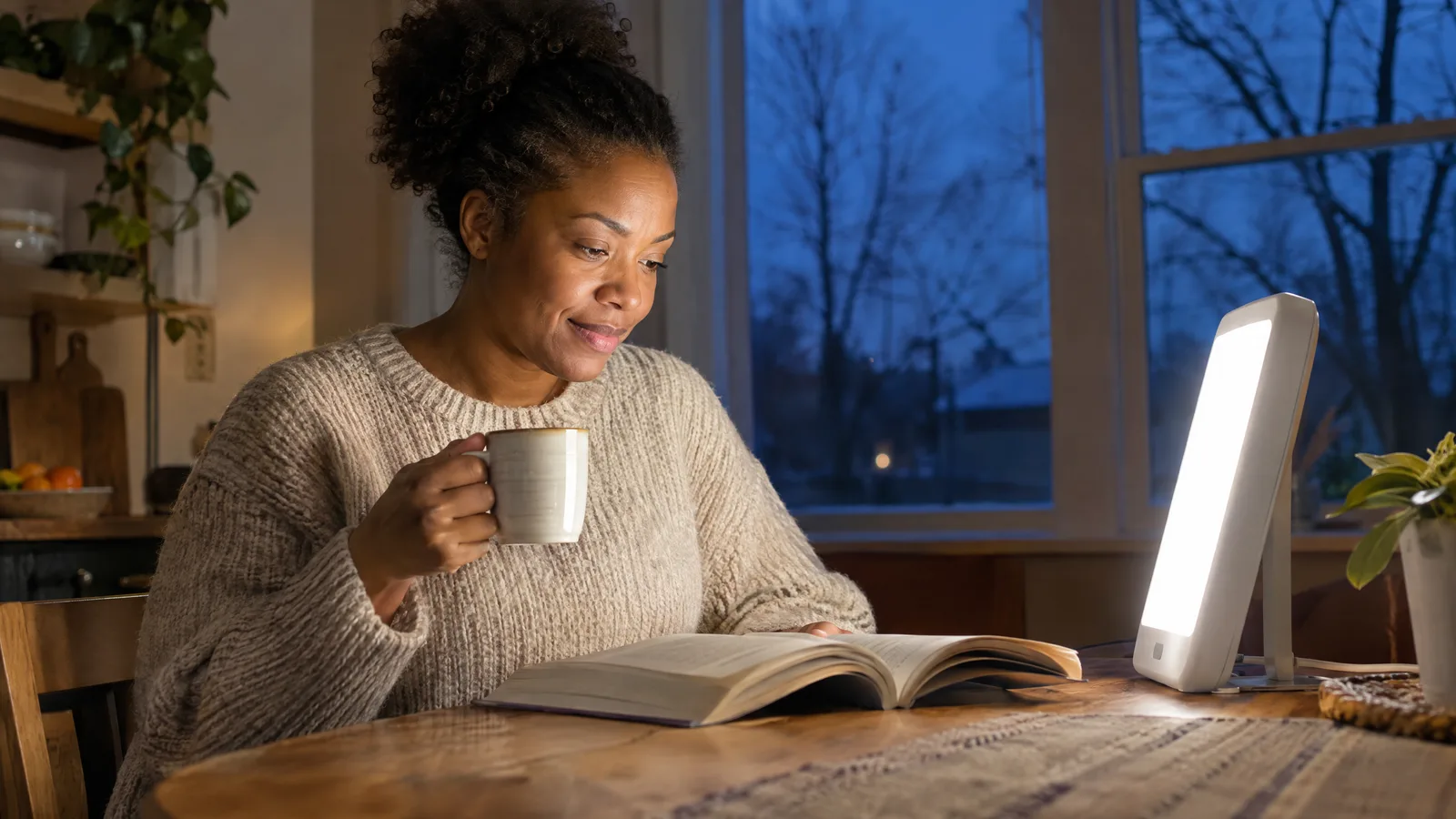
To use a SAD lamp, choose a white light box rated at 10,000 lux with a UV filter, sit at the distance its maker specifies with the light off to one side of your face, and use it for 20 to 30 minutes soon after waking. Use it every day from fall until spring, and expect improvement within one to two weeks.
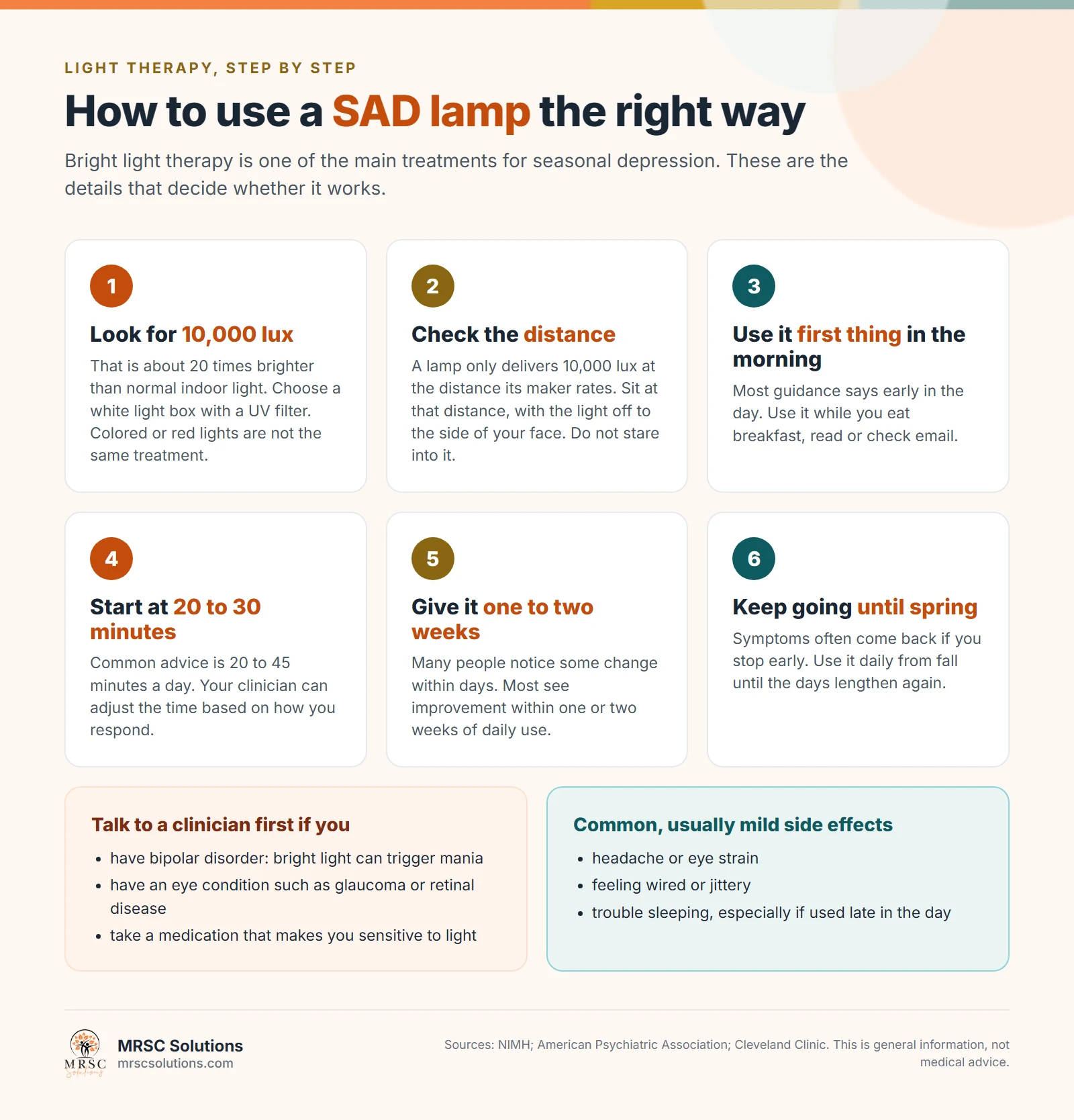
- Buy the right kind of lamp. Look for 10,000 lux, white light, and a UV filter. Small "happy lights" and colored or red lights are not the same treatment. Online listings are full of lamps that do not deliver the brightness they advertise, so check the specifications and the distance at which the lux rating applies.
- Sit at the right distance. The 10,000 lux rating only applies at a set distance, often around two feet or less. Cleveland Clinic suggests placing the lamp about two to three feet away for many models. Sitting farther back means a much weaker dose.
- Angle it, do not stare at it. Place the lamp slightly above eye level and off to the side. Your eyes need to receive the light, but you should not look directly into it.
- Use it early. Most guidance recommends using it shortly after waking. Use it during breakfast, while reading, or while answering email.
- Start with 20 to 30 minutes. The APA says it usually takes 20 minutes or more a day. NIMH describes sessions of 30 to 45 minutes. Your clinician can adjust the time.
- Be consistent. Daily use matters more than long sessions. Missing several days in a row often lets symptoms creep back.
- Keep going until spring. Stopping early, when you first feel better, is one of the most common reasons it seems to "stop working".
"I tried a SAD lamp and it didn't work"
This is one of the most common complaints online, and it usually has an explanation. The lamp was too weak or too far away. It was used for ten minutes instead of thirty. It was used at night, which can disrupt sleep. It was used for a week and then forgotten. Or the depression was more than seasonal and needed another treatment alongside the light.
People who stick with light therapy often share practical tips: keep the lamp where you already sit every morning so you do not have to remember it, and pair it with something you already do, like coffee or reading the news. If sitting still for 30 minutes is hard, which is common for people with ADHD, put the lamp beside your laptop and work in front of it.
Who should talk to a clinician first
Light therapy is safe for most people, but check with a clinician first if you have bipolar disorder (Cleveland Clinic notes that bright light and antidepressants can trigger mania or hypomania), an eye condition such as glaucoma or retinal disease, or take a medication that makes you sensitive to light. Common side effects are mild: headache, eye strain, feeling jittery, or trouble sleeping if you use it too late in the day.
How to Beat Seasonal Depression: 12 Things That Help at Home
These everyday steps can ease mild seasonal depression and make professional treatment work better. They are not a substitute for treatment when symptoms are moderate or severe, but almost everyone with seasonal depression benefits from them.
- Get outside in the morning. Even on a cloudy day, outdoor light is far brighter than indoor light. A 15 to 20 minute walk soon after sunrise is one of the simplest things you can do.
- Keep a fixed wake-up time. The same wake time every day, including weekends, anchors your body clock. Sleeping in feels good but can make the drift worse.
- Open the blinds first thing. Sit near a window for breakfast and at work if you can.
- Move every day. Exercise helps depression in general. Many people with seasonal depression say running, cycling or a brisk walk made the biggest difference for them.
- Plan things to look forward to. Put small, specific plans on the calendar for January and February, the hardest months. Behavioral activation works because action comes before motivation, not after.
- Protect social contact. Seasonal depression pushes you to withdraw. Schedule low-effort time with people: a weekly call, a standing coffee, a walk with a friend.
- Eat for steady energy. Carbohydrate cravings are part of SAD. Pair carbs with protein and fiber rather than fighting cravings with willpower alone.
- Watch the alcohol. It worsens sleep and mood, and it is easy to lean on during long dark evenings.
- Make evenings cozy, not dark. Warm lamps, a routine, and a fixed bedtime make long nights feel less endless. Avoid bright screens late at night.
- Name it to the people around you. Telling your partner or roommate "this is my seasonal depression, not you" can head off a lot of conflict, and a lot of guilt.
- Lower the bar, not the standard. Doing less in winter is not failure. Choose what matters most and let the rest wait until spring.
- Get help early. If these steps are not enough within a couple of weeks, that is the signal to book an evaluation, not to try harder.
If your low mood is worst at night specifically, our article on why you get sad at night explains why evenings can feel heavier and what helps.
Seasonal Depression and the Holidays
For many people, the hardest part of seasonal depression is that it lands in the same weeks as the holidays. Shorter days, the clock change, year-end deadlines, travel, money pressure and family expectations all arrive at once, often while you are already running on empty.
That combination can make it hard to tell what is causing what. Is it seasonal depression, holiday stress, grief that surfaces around family gatherings, or all three? It does not have to be one or the other, and you do not have to untangle it alone. Our guide to holiday depression covers the holiday side in more detail.
A few things help in this stretch: keep your morning light and wake time steady even during travel, say no to some invitations without guilt, and plan something for the first two weeks of January, when the holidays are over and winter still has months to go.
Can Seasonal Depression Be Prevented?
Yes, often. Because seasonal depression tends to return at the same time each year, you can plan ahead. Starting light therapy, CBT-SAD or, for some people, bupropion XL in early fall, before symptoms begin, can prevent an episode or make it much milder.
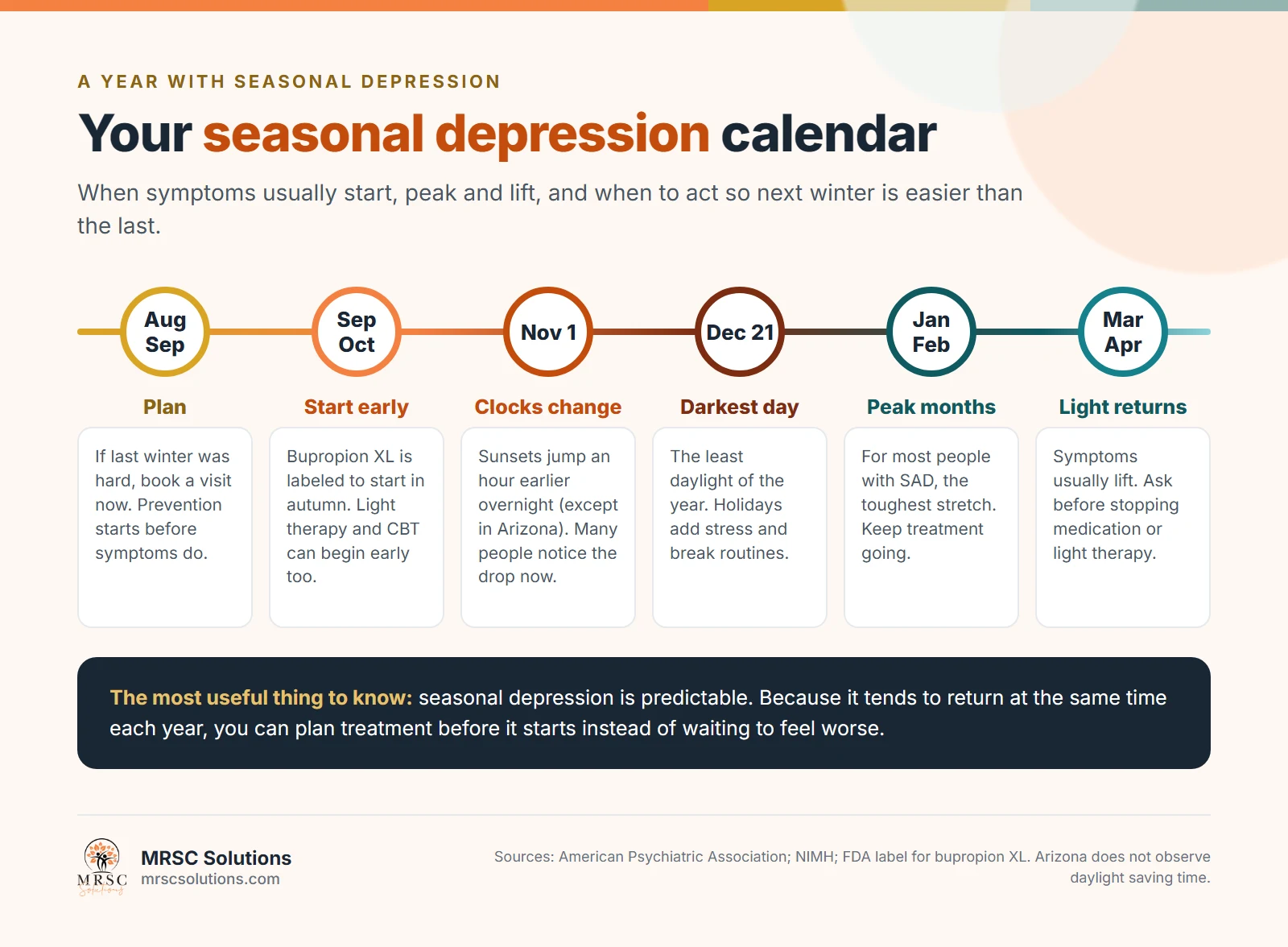
Prevention is the biggest gap in how most people handle seasonal depression. The usual pattern is to wait, feel worse, and finally seek help in January, after months of struggling. A better plan looks like this:
- Write down your pattern this winter. Note when symptoms start, when they peak and when they lift. That record makes your next evaluation far more useful.
- Treat this winter fully. If you are struggling now, start treatment now. It is not too late in November, December or even February.
- Book a visit in late summer. August or early September is the time to plan for next winter, before the days shorten.
- Start early. Depending on your history, that might mean starting light therapy in early fall, doing CBT-SAD before winter, or starting medication in autumn as the FDA label for bupropion XL describes.
- Taper in spring, with guidance. Stop light therapy or medication gradually and with your clinician, not abruptly on the first warm day.
When Should You Get Help for Seasonal Depression?
Get help if your symptoms last more than two weeks, if they affect work, school, relationships or self-care, if home strategies are not enough, or if this is the second or third winter in a row you have felt this way. Get help right away if you have thoughts of death or suicide.
Signs it is time to book an evaluation:
- You have felt low or lost interest in things for more than two weeks.
- You are sleeping much more than usual and still exhausted.
- You are missing work or school, or falling behind.
- You are withdrawing from people who matter to you.
- You are drinking more to get through the evenings.
- You tried a lamp, vitamin D and exercise, and it was not enough.
- Every winter for several years has felt like this.
If you are thinking about suicide or self-harm, call or text 988, the Suicide and Crisis Lifeline, any time, or call 911 if you are in immediate danger. Seasonal depression is still depression, and it deserves the same urgency.
What Getting Help Looks Like
Getting help for seasonal depression starts with a psychiatric evaluation. You talk through your symptoms, your yearly pattern, your sleep and energy, your health history, and anything you have already tried. Your clinician then explains what they think is going on and works out a plan with you, which may include light therapy guidance, a referral for CBT, medication, or a combination.
At MRSC Solutions, Rachel Christian, PMHNP-BC, a board-certified psychiatric nurse practitioner, provides depression treatment, including care for seasonal depression, by secure video across Florida, New York, Arizona, Massachusetts, Oregon and California, and in person in West Palm Beach. Video care is especially practical in winter, when getting to an appointment after dark is one more thing that feels impossible. Most new patients are seen within a week, and many major insurance plans are accepted; our FAQ explains how benefits are checked before your first visit. If you are new to telehealth, our guide on how online psychiatry works explains what to expect.
If this article described your winters, you do not need to be sure it is seasonal depression before reaching out. Request an appointment online or call (561) 849-4565, and we will help you work out what is going on and what will help.
Conclusion
Seasonal depression is not weakness, laziness or just disliking winter. It is a common, recognized form of depression that follows the light, and it tends to hit hardest right after the clocks change and through January and February. The good news is that it is one of the most predictable and treatable conditions in mental health. Light therapy, CBT-SAD and medication all work, and planning ahead can make next winter far easier than this one. If the dark months are taking more from you every year, book an evaluation or call (561) 849-4565 today.
Frequently Asked Questions
Is seasonal depression a real diagnosis?
Yes. Seasonal affective disorder is listed in the diagnostic manual as major depressive disorder with seasonal pattern. To be diagnosed, depressive episodes must follow a seasonal pattern for at least two years in a row. About 5% of US adults have it, and it responds well to treatment.
What is the difference between seasonal depression and regular depression?
Seasonal depression is major depression that starts and stops with the seasons, usually beginning in fall or winter and lifting in spring. Regular depression is not tied to a time of year. Winter seasonal depression also tends to cause oversleeping, carbohydrate cravings and weight gain.
Do SAD lamps actually work?
Yes, when used correctly. Research shows bright light therapy works better than placebo, and in one large trial it worked as well as the antidepressant fluoxetine. The lamp must deliver 10,000 lux at the distance you sit, and it needs to be used every morning from fall to spring.
Does vitamin D help seasonal depression?
The evidence is mixed. Some studies found vitamin D helped and others found no effect. It is worth having your level checked and correcting a deficiency, but vitamin D should not replace treatments with stronger evidence, such as light therapy, CBT-SAD or medication.
Can you get seasonal depression in the summer?
Yes. Summer-pattern seasonal depression is less common than the winter pattern. It tends to cause insomnia, poor appetite, weight loss, restlessness and anxiety rather than oversleeping. It is often missed in hot states such as Florida and Arizona, where summer heat keeps people indoors.
Can seasonal depression be treated online?
Yes. Evaluation, diagnosis, medication management and guidance on light therapy can all be done by secure video, which is often easier in winter. Anyone with thoughts of suicide, or who cannot stay safe, should call or text 988 or call 911 for urgent help.