
Anxiety Treatment
Emotional Flooding: What It Is, Why It Happens and How to Calm Down

The argument started over something small. A comment about the dishes, a late reply, a tone of voice. Then, in what feels like seconds, your heart is pounding, your face is hot, and your mind goes completely blank. Your partner is still talking, but you cannot take in a single word. You either say something you will regret, or you shut down and stare at the wall. Afterward, you feel embarrassed and confused: why did that happen again? If this sounds familiar, you have probably experienced emotional flooding, and there is a clear explanation for it.
The short answer: emotional flooding is a state in which your body's stress response takes over during an emotional moment, usually a conflict, so quickly and strongly that your ability to listen, think and respond calmly shuts down. Your heart rate rises, adrenaline surges, and the thinking part of your brain goes partly offline. It is not a character flaw or a lack of willpower. It is physiology, and it can be managed, especially once you know that the body needs at least 20 minutes to calm back down.
Key takeaways
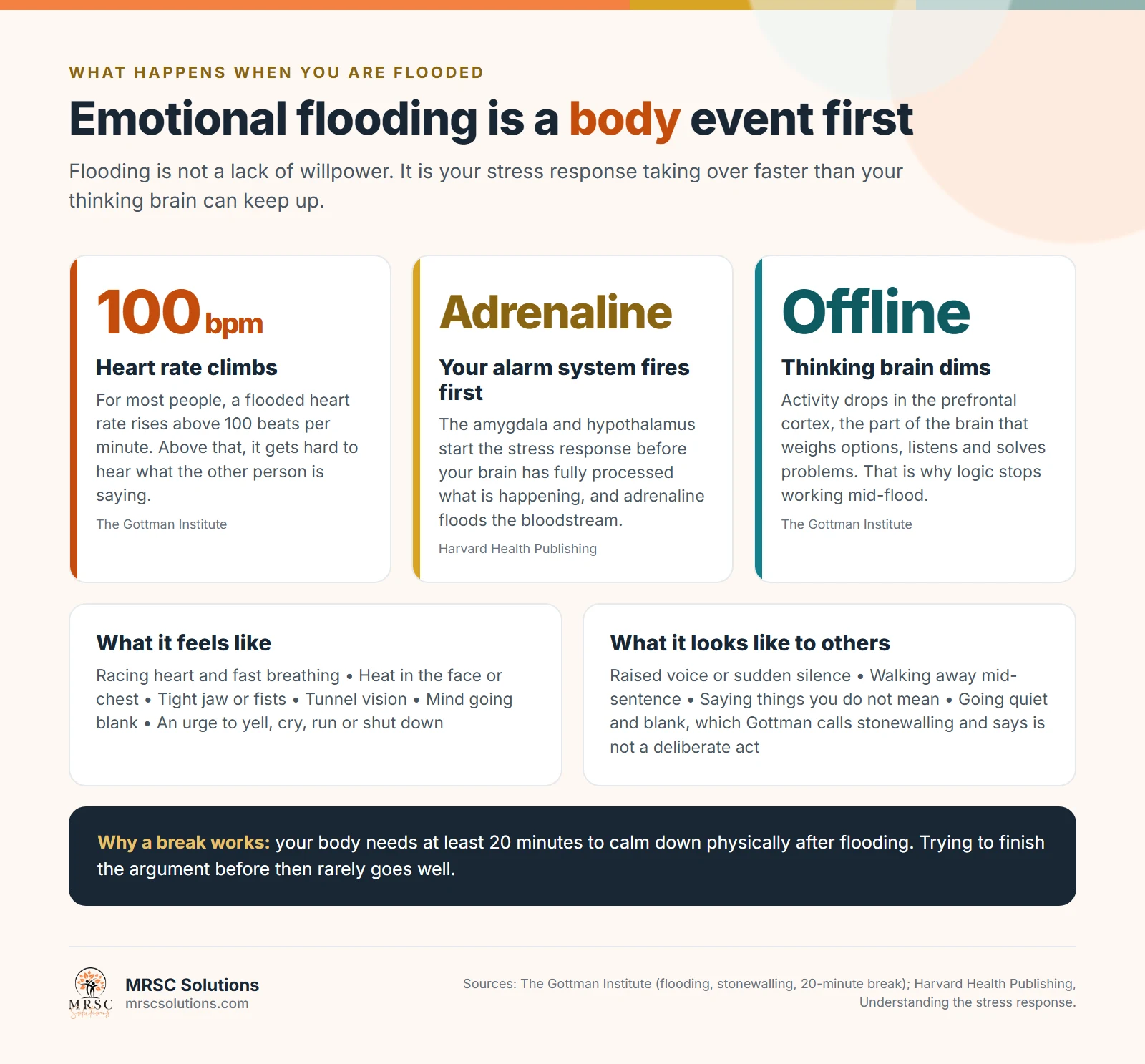
- Emotional flooding is a body event first: for most people, heart rate rises above 100 beats per minute, and listening becomes very hard.
- The Gottman Institute, which has studied couples for decades, recommends a break of at least 20 minutes, because that is about how long the body takes to settle.
- Flooding is different from ordinary anger and from a panic attack. The clearest sign is that you cannot hold a real conversation while it lasts.
- ADHD, anxiety, PTSD, borderline personality disorder and poor sleep can all lower the threshold for flooding.
- Frequent flooding, or flooding outside of arguments, is worth an evaluation, because an underlying condition is often treatable.
What Is Emotional Flooding?
Emotional flooding is a sudden surge of stress that overwhelms your ability to think clearly and stay in a conversation. It usually happens during conflict with someone close to you. Your heart races, adrenaline rises and your brain shifts into survival mode, so you fight, flee or shut down instead of listening and problem-solving.
The term comes from the relationship research of psychologist John Gottman and the Gottman Institute. In a 1993 paper, Gottman described the experience of being flooded by a partner's emotions as feeling "unexpected", "unprovoked, intense, overwhelming, and disorganizing", as summarized in a 2019 study in the Journal of Family Psychology. The Gottman Institute also calls it diffuse physiological arousal, or DPA.
Today the phrase is used far beyond couples therapy. People use it to describe being overwhelmed by a parent, a boss, a child's meltdown, or a news story. The core is the same: emotion arriving faster and harder than your mind can process it.
The term is having a moment. A widely shared April 2026 report from The Citizen, citing Google Trends, said search interest in "emotional flooding" had doubled in 2026, and TIME published an explainer the same month. Many people meet the phrase on social media and feel, for the first time, that someone has described exactly what happens to them.
One point of confusion: "flooding" is also the name of an exposure therapy technique for phobias, in which a person faces a feared situation all at once. That is a completely different thing. This article is about emotional flooding as an experience, not a therapy.
What Does Emotional Flooding Feel Like?
Emotional flooding feels like being swept away. Most people describe a racing heart, heat in the face or chest, shallow breathing, tunnel vision and a mind that goes blank or fills with noise. Words stop making sense. There is a powerful urge to yell, cry, run, or go completely silent.
Common signs in the body:
- A pounding or racing heart
- Fast, shallow breathing
- Heat, flushing or sweating
- A tight jaw, clenched fists or tense shoulders
- Tunnel vision, or feeling far away
- A blank mind, or racing thoughts you cannot organize
Common signs in behavior:
- Raising your voice, or suddenly going quiet
- Saying things you do not mean
- Interrupting, or not being able to follow what the other person says
- Walking out mid-sentence
- Crying and not being able to stop
- Going blank and still, sometimes called shutting down or freezing
Many people say their brain "goes dark" or that they "cannot hear anything". That description is close to what is actually happening in the body.
What Happens in Your Body When You Are Flooded?
When you flood, your brain's alarm system fires before your thinking brain catches up. The amygdala and hypothalamus trigger the release of adrenaline, your heart rate climbs, often above 100 beats per minute, and activity drops in the prefrontal cortex, the area that handles listening, judgment and problem-solving.
Harvard Health Publishing explains that the amygdala and hypothalamus start the stress cascade even before the brain's visual centers have had a chance to fully process what is happening. In other words, your body reacts to a threat before you have consciously decided anything is threatening.
The Gottman Institute links flooding to heart rate. In its research with couples, it reports that for most people, when they are flooded, their heart rate rises to over 100 beats per minute. John Gottman has written that once your heart rate goes above 100, you will not be able to hear what your partner is trying to tell you. The Institute also describes a decrease in activity in the prefrontal cortex, the center of higher thinking, during flooding.
One caution: 100 beats per minute is a rule of thumb, not a precise line. The Gottman Institute notes that a resting heart rate typically falls somewhere in the 60 to 100 range, so a very fit person may be flooded at a lower number, and someone with a naturally fast heart rate may not be flooded at a higher one. What matters more is a sudden, large jump from your usual baseline, together with the feeling of losing your ability to think.
You may have heard this called an "amygdala hijack". The phrase was coined by psychologist Daniel Goleman in his 1995 book Emotional Intelligence. It is a useful image, but Simply Psychology points out that it is a metaphor, not a clinical diagnosis. The brain is not literally taken over; the alarm system simply moves faster than reflection.
Why it takes at least 20 minutes to calm down
Here is the part that changes how people handle arguments. The Gottman Institute explains that one of the main stress chemicals involved, norepinephrine, does not have an enzyme to break it down quickly, so it has to be cleared through the blood. That takes time. Its guidance is that a break should last at least twenty minutes, because it will take that long before your body physiologically calms down.
The Institute describes a striking moment from its lab. When researchers interrupted couples after fifteen minutes, telling them the equipment needed adjusting, the couples came back with significantly lower heart rates, and their conversation was more positive and productive. Nothing about the disagreement had changed. Only their bodies had.
Emotional Flooding in Relationships
Emotional flooding in relationships usually shows up during conflict. One partner floods and either escalates or withdraws, the other feels attacked or ignored, and the argument spirals. Flooding is closely tied to stonewalling, when one person shuts down and stops responding, which the Gottman Institute says is a physiological reaction rather than a deliberate choice.
Couples often fall into a familiar pattern. One person wants to keep talking until the problem is solved. The other is flooded and needs space. The more one pursues, the more the other withdraws, and both end up feeling unheard.
Flooding and stonewalling
Stonewalling, going silent, turning away and refusing to engage, is one of the patterns the Gottman Institute calls the Four Horsemen, because it predicts relationship trouble when it becomes a habit. But the Institute is clear that stonewalling usually happens because the person is flooded: it describes the stonewaller as being in diffuse physiological arousal, also known as being flooded. It also says stonewalling is not a stubborn, deliberate act.
That reframing matters. If your partner goes blank in an argument, they may not be punishing you or giving you the silent treatment. They may be overwhelmed. And if you are the one who shuts down, it does not mean you do not care.
Do men flood more than women?
It is often said that men flood more easily. In Gottman's own lab, 85% of stonewallers were men, and his early work suggested men flooded with less provocation. But a later study of 233 couples, published in 2019, did not replicate the finding that men report higher levels of flooding than women. What it did find is that couples in which at least one partner reported high levels of flooding were less effective at solving problems together. In other words, flooding affects everyone, and it matters for how couples work through conflict, whatever their gender.
Flooding outside romantic relationships
Flooding is not limited to couples. It is common with parents and adult children, especially around old family patterns, and with siblings at holiday gatherings. Parents can flood during a child's tantrum. People flood at work when criticized in front of others. The common thread is a situation that feels threatening and personal, often with someone whose opinion matters to you.
Emotional Flooding Examples From Everyday Life
Emotional flooding can happen anywhere strong feelings meet a sense of threat. Recognizing what it looks like in real situations makes it easier to spot in yourself, and easier to forgive in others.
In a relationship. Maya and her partner are talking about money. He mentions, a little sharply, that the credit card bill is higher than usual. Within seconds Maya's face is hot, her chest is tight, and every sentence he says sounds like an accusation. She hears herself say something cutting about his spending last year. Later, she cannot even remember what started it. That is emotional flooding: the conversation stopped being about the bill the moment her body decided she was under attack.
As a parent. A father has asked his eight-year-old to put on shoes five times. The sixth time, something snaps. He is yelling before he knows it, and his son is crying. Afterward, he feels ashamed. Flooding as a parent is extremely common, especially when you are tired, hungry or stressed about being late. Children flood too, and a flooded parent cannot calm a flooded child.
At work. A manager criticizes a project in front of the whole team. An employee feels her heart pound and her mind go blank. She wants to defend herself but cannot find the words, so she says nothing, then replays the meeting all night. That shutdown is flooding, not weakness.
With family at the holidays. A comment about weight, a question about why you are still single, a political jab at dinner: family gatherings combine old wounds, an audience and very little privacy. Many people flood during the holidays and then wonder why they reacted so strongly to something so small. Our guide to holiday anxiety covers how to plan for these moments.
After a betrayal. People recovering from infidelity often describe emotional flooding that arrives out of nowhere, triggered by a song, a name or a phone notification. This is common in the aftermath of trauma of any kind, and it usually eases with time and good support, often including couples therapy and individual care.
Does emotional flooding look different in men and women?
Emotional flooding feels similar for everyone, but people often show it differently. Some people get loud, others go quiet. Some cry, others leave. Gendered expectations can shape how flooding comes out: someone who learned that anger is unacceptable may shut down, and someone who learned that tears are unacceptable may get angry instead. What matters is noticing your own pattern, not fitting a stereotype.
Emotional flooding and autism
Many autistic adults describe emotional overwhelm that can look like flooding, sometimes called a meltdown or a shutdown, especially when sensory overload, unexpected change and social stress pile up together. Research on flooding in autism specifically is limited, so the best approach is an individual one. If you are autistic, or wonder whether you might be, it can help to work with a clinician who understands how sensory and emotional overload interact.
Upset, Flooded or Having a Panic Attack?
Being upset means you are emotional but can still listen and respond. Being flooded means your stress response has taken over and you cannot take in what is being said. A panic attack is a sudden wave of intense fear with strong physical symptoms, which often comes without a clear trigger.
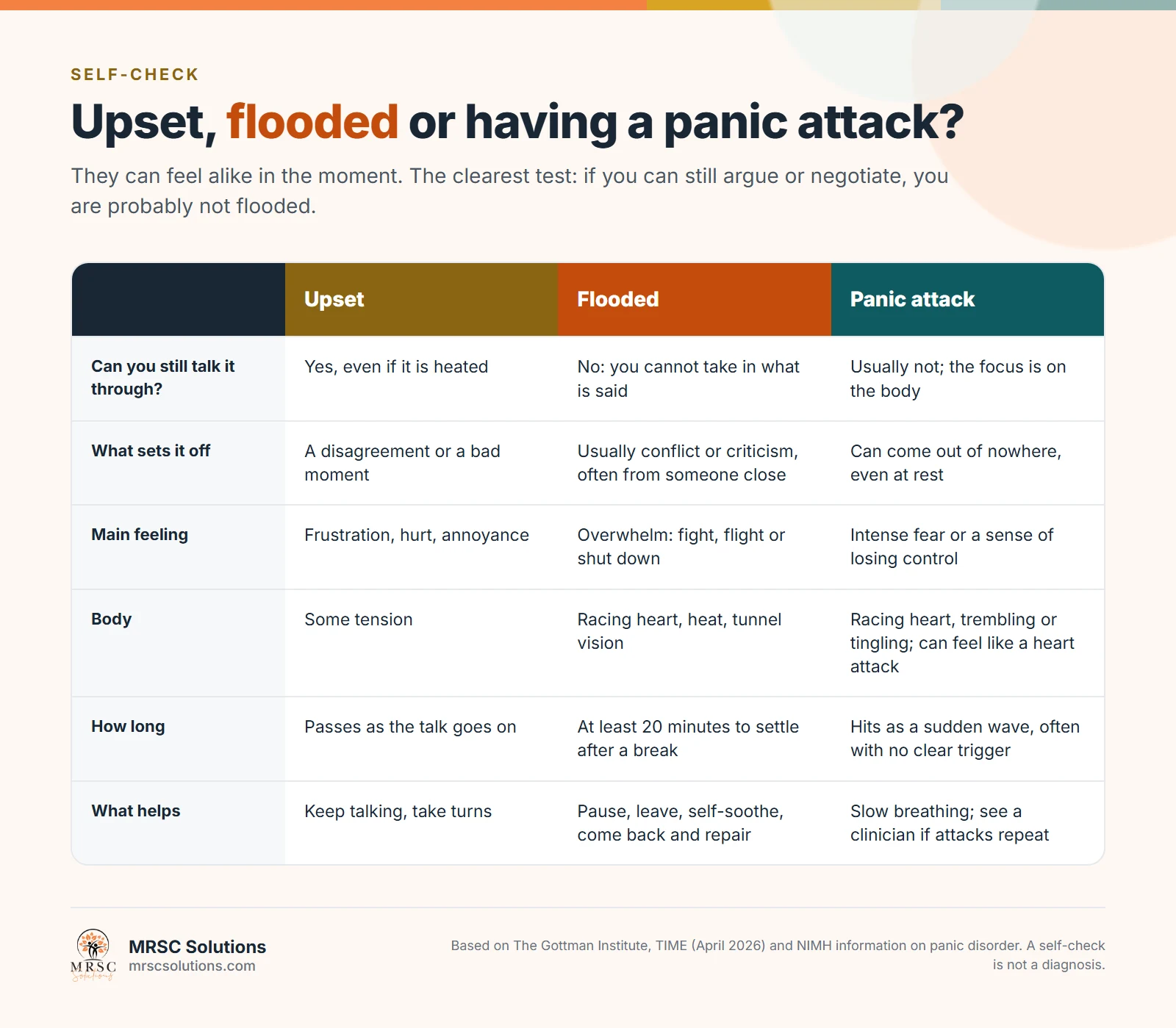
TIME's 2026 explainer offers a simple test: if you can still argue, negotiate a boundary, or hold a conversation, you are likely not flooded. Flooding is not simply strong emotion. It is the point where strong emotion makes thinking impossible.
| Upset | Flooded | Panic attack | |
|---|---|---|---|
| Can you still talk it through? | Yes | No, you cannot take in what is said | Usually not; the focus is on the body |
| Typical trigger | A disagreement | Conflict or criticism, often from someone close | Can come out of nowhere |
| Main feeling | Frustration or hurt | Overwhelm: fight, flight or shut down | Intense fear or a sense of losing control |
| Recovery | Passes as the talk goes on | At least 20 minutes after a break | Varies; see a clinician if attacks repeat |
According to the National Institute of Mental Health, panic attacks are characterized by a sudden wave of fear or discomfort, or a sense of losing control, even when there is no clear danger or trigger, and can include symptoms that feel like a heart attack. If you are not sure which you are experiencing, our article on panic attacks vs anxiety attacks explains the difference in more detail. Any chest pain you are unsure about deserves medical attention.
Emotional flooding vs emotional dysregulation
Emotional flooding and emotional dysregulation are related but not the same. Flooding is a moment: a surge that overwhelms you during a specific situation. Cleveland Clinic describes emotional dysregulation as having difficulty managing your emotions and the way you react to them, a broader, ongoing pattern. Someone with emotional dysregulation is likely to flood more often, but a person with generally steady emotions can still flood in a high-stakes argument. Flooding is the moment; dysregulation is the pattern.
Emotional flooding vs dissociation
Sometimes flooding tips into dissociation: feeling detached, numb, unreal, or as if you are watching yourself from outside. This is the freeze or shutdown end of the stress response. It can look calm from the outside, which is why a partner may misread it as indifference. If you often lose time, feel unreal, or cannot remember parts of arguments, mention it to a clinician, because dissociation is common after trauma and responds well to the right treatment.
Why Do Some People Flood More Easily?
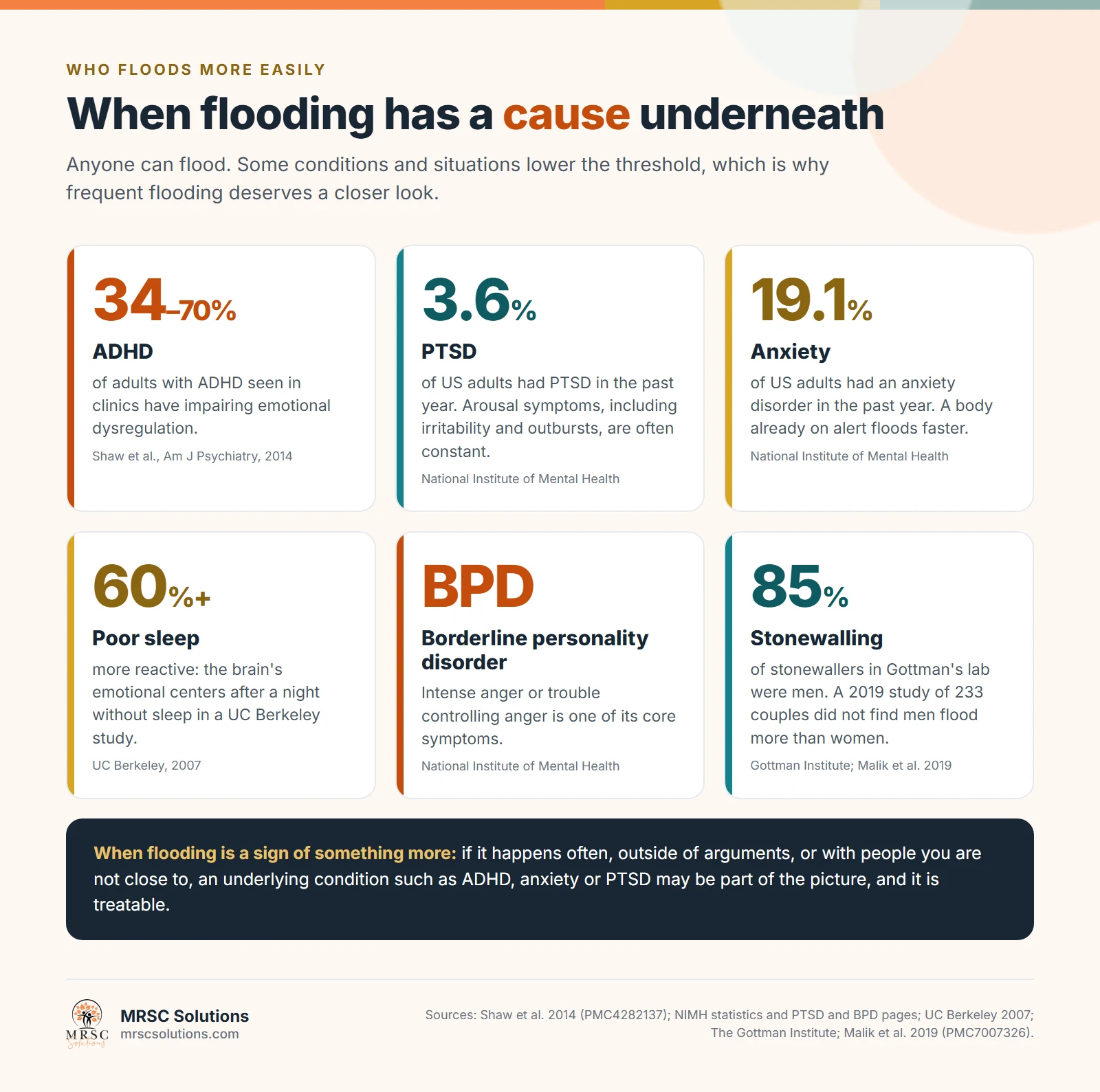
Some people flood more easily because their stress system is already on alert or their brain has a harder time regulating emotion. ADHD, anxiety disorders, PTSD, borderline personality disorder, chronic stress and poor sleep all lower the threshold. Past trauma, especially in childhood, can teach the body to treat conflict as danger.
ADHD
ADHD is not just about attention. Emotional regulation is often affected too. A 2014 review in the American Journal of Psychiatry reported that clinic-based studies found impairing emotional dysregulation in between 34% and 70% of adults with ADHD. Many adults with ADHD describe going from zero to overwhelmed in seconds, then feeling ashamed afterward. Rejection can hit especially hard, a pattern sometimes called rejection sensitive dysphoria. If you suspect ADHD, our guide on how to get tested for ADHD as an adult explains the process.
Trauma and PTSD
After trauma, the body can stay on high alert. The NIMH lists feeling irritable and having angry or aggressive outbursts among the arousal symptoms of PTSD, and notes that arousal symptoms are often constant. An estimated 3.6% of US adults had PTSD in the past year. For someone with a trauma history, a raised voice in an argument can register as genuine danger. Our article on complex PTSD vs PTSD covers how long-term trauma shapes these reactions.
Anxiety
An estimated 19.1% of US adults had an anxiety disorder in the past year, according to NIMH survey data. When your baseline is already tense, it takes less to tip over into flooding. People with high-functioning anxiety often hold it together all day and then flood at home, where they feel safe enough to fall apart.
Borderline personality disorder
The NIMH lists inappropriate, intense anger or problems controlling anger among the symptoms of borderline personality disorder. TIME's 2026 explainer also notes that people with panic disorder, PTSD or borderline personality disorder may find they enter a flooded state more easily.
Sleep loss and stress
Never underestimate a bad night. In a UC Berkeley study, the emotional centers of the brain were over 60% more reactive after sleep deprivation. Chronic stress, hunger, alcohol and illness all have a similar effect: they leave less room before the alarm goes off. If sleep is a struggle, our article on why you can't sleep even though you're tired may help.
Is This You? A Quick Self-Check
Think about the last few months and answer honestly:
- During arguments, does your heart pound so hard you cannot follow what the other person is saying?
- Do you say things in conflict that you later regret, and that do not reflect how you really feel?
- Do you shut down, go silent or leave the room because you cannot cope?
- Does it take you a long time, an hour or more, to calm down after a disagreement?
- Do you flood outside of relationships, at work, with strangers or with your children?
- Have people close to you said they feel like they are walking on eggshells?
- Do you feel ashamed or confused afterward about how strongly you reacted?
- Do you also notice ongoing restlessness, distraction, worry or trouble sleeping?
If you answered yes to several, flooding is likely part of your life, and it is worth addressing. If you answered yes to the last two in particular, an underlying condition such as ADHD, anxiety or trauma may be involved. A self-check cannot diagnose anything, but it can point you toward the right next step.
How to Stop Emotional Flooding in the Moment
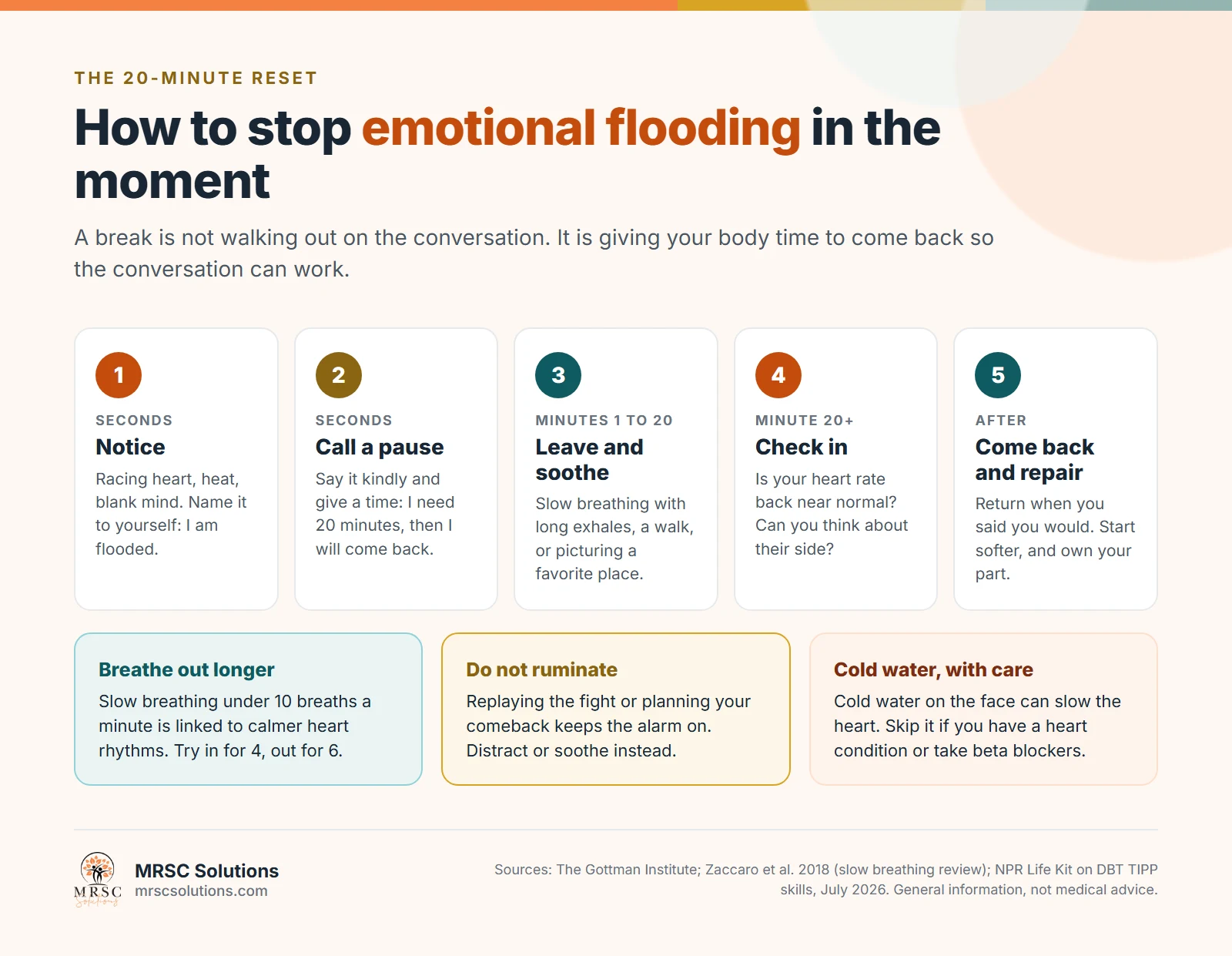
To stop emotional flooding, notice the signs early, ask for a break with a clear time to return, spend at least 20 minutes doing something calming that is not about the argument, then come back and reconnect. Slow breathing with long exhales is one of the fastest ways to help your body settle.
Step by step: the 20-minute reset
- Notice it early. Learn your personal warning signs: a hot face, a tight chest, a clenched jaw, the urge to interrupt. Saying to yourself "I am flooded" activates the thinking brain a little.
- Call a pause, kindly. Say something like: "I'm getting overwhelmed and I want to hear you properly. Can we take 20 minutes and come back to this at 8:30?" Giving a time matters. Without one, a break can feel like abandonment to the other person.
- Leave and soothe. Go to another room or step outside. Breathe slowly, walk, listen to music, or picture a favorite place, which is one of the Gottman Institute's own suggestions for self-soothing. Its guidance is to take 20 to 30 minutes and then come back.
- Do not rehearse the fight. Replaying what was said, or planning your comeback, keeps your body on alert. Distract yourself on purpose.
- Check in with your body. Has your heart rate slowed? Can you think about the other person's point of view again? If not, take a little more time.
- Come back and repair. Return when you said you would. Start gently, acknowledge your part, and ask to try again. Coming back is what turns a break into a healthy skill rather than avoidance.
Breathing techniques that help
Slow breathing works because it engages the body's calming system. A 2018 systematic review of slow breathing techniques, under 10 breaths a minute, found links to increased parasympathetic activity, the "rest and digest" side of the nervous system. A 2023 randomized trial found that five minutes a day of cyclic sighing, a breathing pattern with a long exhale, showed promise as a stress management exercise.
Try these:
- Long exhale breathing: breathe in for a count of four, out for a count of six.
- Cyclic sighing: two short breaths in through the nose, then one long, slow breath out through the mouth. Repeat for a few minutes.
- Box breathing: in for four, hold for four, out for four, hold for four. Our guide to box breathing walks through it.
Cold water and other fast resets
Dialectical behavior therapy (DBT) teaches a set of crisis skills known as TIPP: temperature, intense exercise, paced breathing and paired muscle relaxation. Splashing cold water on your face, or holding something cold, can slow the heart rate. An NPR Life Kit report on these skills notes an important caution: this is not recommended for people with a heart condition or those taking beta blockers. A brisk walk or a few minutes of hard exercise can also burn off some of the adrenaline.
What not to do while flooded
- Do not try to win the argument or make a decision.
- Do not send texts or emails you would not want read aloud tomorrow.
- Do not drive if you are very agitated.
- Do not use alcohol to calm down; it lowers your guard and makes conflict worse.
- Do not follow a partner who has asked for a break. Let them go and trust the agreed time.
If your thoughts are spinning long after the moment has passed, our guide on how to stop spiraling offers more tools.
How to Prevent Emotional Flooding Over Time
You can reduce how often and how intensely you flood by lowering your baseline stress, getting enough sleep, agreeing on a break plan with the people you argue with, learning emotion regulation skills in therapy, and treating any underlying condition such as ADHD, anxiety or PTSD.
- Agree on a break signal in calm moments. Couples and families who agree in advance, "If either of us says 'pause', we take 20 minutes and come back", argue much more safely.
- Protect your sleep. It is one of the strongest buffers you have.
- Bring up hard topics gently. Start with how you feel and what you need, not with blame. Starting softly lowers the chance that either of you floods.
- Notice your patterns. Keep a short note of when you flood: the time, the topic, how much you slept, whether you had eaten. Patterns often appear quickly.
- Practice calming skills when you are calm. Breathing and grounding work far better in a crisis if you have rehearsed them beforehand.
- Set healthy boundaries. Repeated flooding around the same person or topic may mean a boundary is needed. Our guide to setting healthy boundaries can help.
- Get help with the underlying cause. Therapies such as cognitive behavioral therapy (CBT) and DBT teach emotion regulation directly, and treating ADHD, anxiety, depression or PTSD often makes flooding less frequent and less intense.
How to Help Someone Who Is Flooded
To help someone who is flooded, stay calm, lower your voice, and stop trying to resolve the issue. Offer a break rather than insisting they keep talking, agree on a time to come back, and give them space. Pushing a flooded person to keep going almost always makes things worse.
- Recognize the signs: a blank stare, a sudden silence, a raised voice, or saying "I can't do this right now".
- Do not take shutdown personally. It is usually overwhelm, not contempt.
- Name it gently: "It feels like this is getting too much. Do you want to take a break?"
- Agree on a return time, then honor it.
- Soothe yourself too. You may be closer to flooding than you realize.
- Talk about it later, when you are both calm, and plan how to handle the next disagreement differently.
When Is Emotional Flooding a Sign of Something More?
Emotional flooding is worth a professional evaluation when it happens often, lasts a long time, happens outside of conflict, damages relationships or work, or comes with other symptoms such as ongoing worry, low mood, distraction, nightmares or trouble sleeping. These patterns can point to ADHD, anxiety, depression, PTSD or another treatable condition.
Signs it is time to get help:
- You flood several times a week, or with many different people.
- It takes hours to calm down afterward.
- You have said or done things while flooded that frightened you or someone else.
- Your relationships, parenting or work are suffering.
- You also have symptoms like constant worry, restlessness, low mood, trouble focusing, flashbacks or nightmares.
- You are using alcohol or other substances to cope.
If you ever feel unable to keep yourself or someone else safe, call or text 988, the Suicide and Crisis Lifeline, or call 911 in an emergency. If you are in a relationship where conflict involves threats, intimidation or violence, that is not flooding to be managed with breathing skills; reach out to the National Domestic Violence Hotline at 1-800-799-7233.
What Getting Help Looks Like
Getting help starts with an evaluation that looks beyond the flooding itself. A clinician asks how often it happens, what sets it off, how long it lasts, and what else is going on: sleep, mood, attention, anxiety, trauma history and substance use. From there, the plan might include therapy focused on emotion regulation, treatment for an underlying condition, or both.
At MRSC Solutions, Rachel Christian, PMHNP-BC, a board-certified psychiatric nurse practitioner, evaluates and treats the conditions that often sit underneath emotional flooding, including anxiety, ADHD, depression and PTSD. Care is available by secure video across Florida, New York, Arizona, Massachusetts, Oregon and California, and in person in West Palm Beach. Most new patients are seen within a week, and many major insurance plans are accepted; our FAQ explains how benefits are checked. If you have never had a psychiatric evaluation, our guide on what to expect at your first psychiatric evaluation walks through it.
If flooding keeps costing you peace at home or at work, you do not have to keep white-knuckling it. Request an appointment online or call (561) 849-4565, and we will help you understand what is driving it.
Conclusion
Emotional flooding is your body's alarm system moving faster than your thinking brain can follow. Your heart races, adrenaline surges, and listening becomes almost impossible. That is why willpower alone rarely works, and why a well-timed break of at least 20 minutes so often does. Learning your warning signs, agreeing on a pause with the people you love, and practicing calming skills can make a real difference. When flooding happens often, or comes with other symptoms, it may be a sign of ADHD, anxiety, trauma or another treatable condition. If that sounds like you, book an evaluation or call (561) 849-4565 today.
Frequently Asked Questions
What is emotional flooding?
Emotional flooding is a sudden surge of stress, usually during conflict, that overwhelms your ability to think and listen. Your heart rate rises, adrenaline floods your body and the thinking part of your brain becomes less active, so you fight, flee or shut down instead of responding calmly.
Is emotional flooding a symptom of something?
It can be. Anyone can flood under enough stress, but frequent or intense flooding is linked with ADHD, anxiety disorders, PTSD, borderline personality disorder, depression, chronic stress and poor sleep. If it happens often or affects your relationships or work, an evaluation can help identify the cause.
How long does emotional flooding last?
The flooded state itself can feel short, but the body takes time to settle. The Gottman Institute recommends a break of at least 20 minutes, because that is about how long it takes for your body to physiologically calm down. Some people need longer.
Is emotional flooding related to ADHD?
Often, yes. ADHD affects emotional regulation as well as attention. A 2014 review reported impairing emotional dysregulation in 34% to 70% of adults with ADHD seen in clinics. Treating ADHD can make emotional reactions less intense and easier to manage.
What is the difference between emotional flooding and stonewalling?
Emotional flooding is the overwhelmed state inside your body. Stonewalling is one way it can show on the outside: going silent, turning away and refusing to engage. The Gottman Institute describes stonewalling as a reaction to being flooded, not a deliberate act.
How do I stop emotional flooding in an argument?
Notice your warning signs, ask for a break and name a time to return, then spend at least 20 minutes doing something calming that is not about the argument, such as slow breathing or a walk. Come back when you said you would and reconnect before continuing.