Anxiety Treatment
Holiday Anxiety: How to Handle Thanksgiving, Family and the Questions You Dread
Thanksgiving is on November 26, and for a lot of people the dread started weeks ago. You are already rehearsing conversations in the shower. You know which relative will ask why you are still single, which one will comment on your plate, and which one will bring up the election before the turkey is carved. You love your family, mostly, and you feel guilty for dreading them. If that sounds familiar, you are dealing with holiday anxiety, and you are very far from alone. The good news is that it is one of the most plannable kinds of anxiety there is.
The short answer: holiday anxiety is the worry, tension and dread that build around the holiday season, especially around family gatherings, travel, money and grief. It is common, and in recent polling it is rising: 41% of US adults expected more holiday stress last year than the year before. Most holiday anxiety can be eased with planning, boundaries and a few ready-made answers. When it lasts beyond the season, or makes ordinary life hard, it may be an anxiety disorder, which is very treatable.
Key takeaways
- In the American Psychiatric Association's latest holiday poll, 41% of adults expected more holiday stress than the year before, up from 28% in 2024.
- The biggest holiday worries are grief or missing someone (48%), challenging family dynamics (32%) and loneliness (31%).
- Money stress is high this year: half of Americans say they are more worried about money this holiday season than last.
- Planning ahead, agreeing on an exit, and rehearsing short answers to the questions you dread are the most effective ways to feel less trapped.
- If holiday anxiety lingers after the season or affects your daily life, it is worth an evaluation. Many people wait until January, but there is no need to.
What Is Holiday Anxiety?
Holiday anxiety is the stress, worry and dread that build in the weeks around Thanksgiving and the winter holidays. It usually centers on family gatherings, travel, money, grief and the pressure to feel happy. It is not a diagnosis, but it can trigger or worsen anxiety disorders, depression and social anxiety.
Holiday anxiety tends to look like this:
- Anticipatory dread: worrying for weeks about a single day.
- Rehearsing conversations, arguments or awkward moments over and over.
- Physical tension: a tight chest, stomach upset, headaches, trouble sleeping.
- Irritability with the people you are about to spend time with.
- Guilt about dreading people you love.
- Avoidance: putting off travel plans, not answering family group chats, wanting to cancel.
Many people find the dread beforehand is worse than the day itself. That is a classic pattern of anxiety: the mind fills an uncertain future with worst-case scenarios.
How Common Is Holiday Anxiety?
Holiday anxiety is very common and appears to be rising. In a 2023 American Psychological Association survey, 89% of adults said concerns such as money, missing loved ones or family conflict caused them stress during the holidays, and in a 2025 American Psychiatric Association poll, 41% expected more holiday stress than the year before.
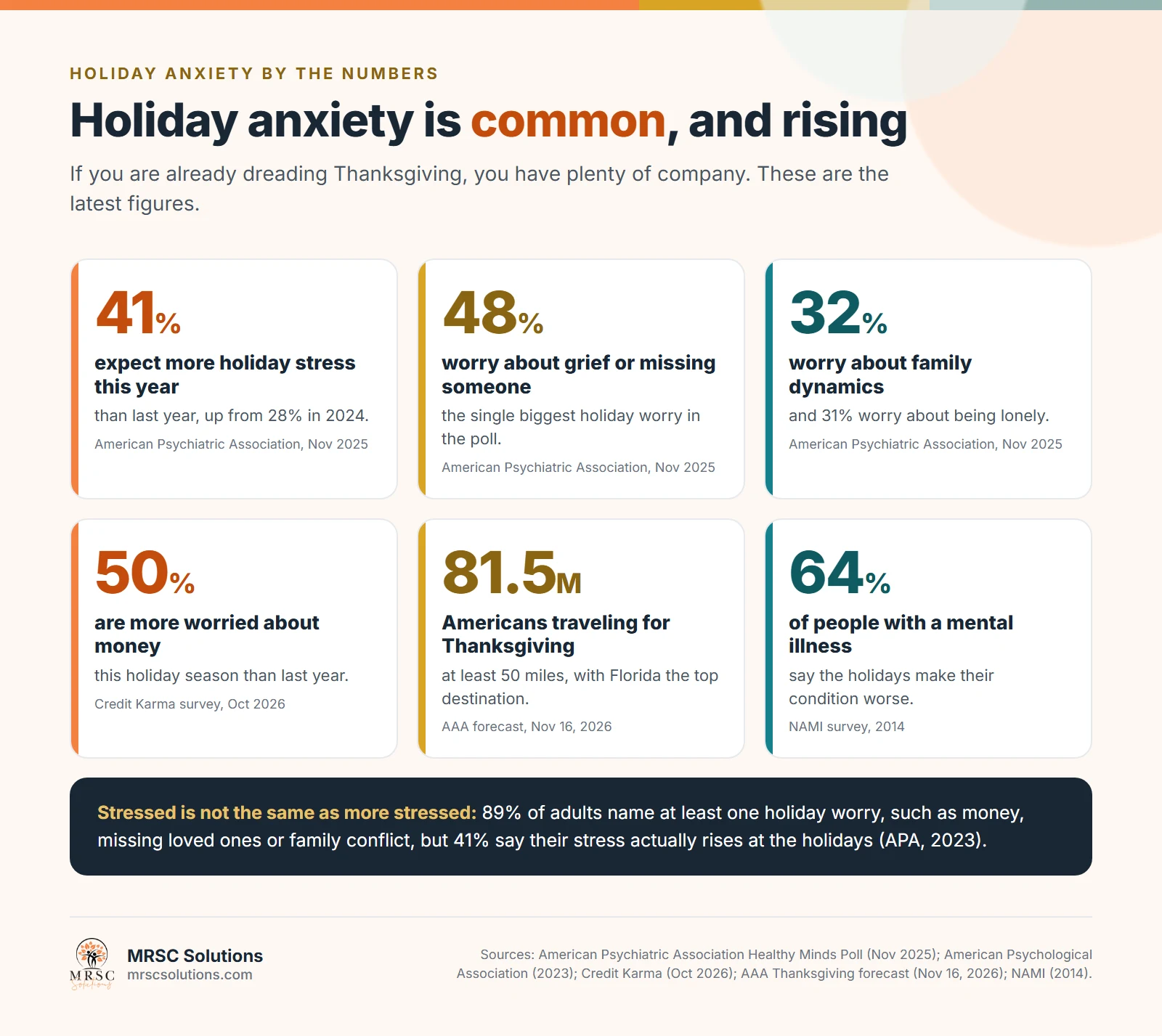
The numbers tell a clear story:
- Holiday stress is rising. In the American Psychiatric Association's Healthy Minds Poll from November 2025, 41% of adults said they anticipated more holiday stress than the year before, a notable jump from 28% in 2024 and 29% in 2023. Younger adults felt it most: 49% of 18 to 34 year olds, compared with 27% of those 65 and older.
- Grief is the top worry. In the same poll, 48% were worried about missing someone or grief, 32% about challenging family dynamics, and 31% about being lonely.
- Almost everyone has at least one worry. In the American Psychological Association's 2023 survey, nearly nine in 10 adults (89%) said concerns such as not having enough money, missing loved ones and anticipating family conflict caused them stress. But only around two in five (41%) said their stress increases at the holidays compared with the rest of the year. Both facts matter: almost everyone has holiday worries, but not everyone is more stressed.
- It gets in the way of enjoyment. The same survey found 43% said holiday stress interferes with their ability to enjoy the season, and 13% said they rely on substances such as alcohol or nicotine to feel better.
- People are tired of performing. A 2025 LifeStance Health survey found 69% feel at least a little pressure to appear happier than they actually are, 64% would prefer to skip at least a few holiday gatherings, and 51% feel lonely around the holidays even when they are with loved ones.
- Mental health conditions get harder. In a 2014 NAMI survey, 64% of people with a diagnosed mental illness said the holidays made their condition worse: 24% "a lot" and 40% "somewhat".
Why Do the Holidays Make Anxiety Worse?
The holidays make anxiety worse because they pile many stressors into a few weeks: family dynamics, travel, money, disrupted routines, grief, alcohol and the pressure to feel joyful. Old family roles and conflicts resurface, sleep and routines fall apart, and there is often no easy way to leave.
Family dynamics and old roles
Walking into your childhood home can feel like walking back into an old version of yourself. Siblings fall into old rivalries, parents fall into old habits, and you may find yourself reacting like you did at 15. Family relationships shape us deeply, as our article on how family influences mental and emotional health explores, and the holidays put all of that in one room.
The questions you dread
Few things raise anxiety like being asked about the parts of your life that feel uncertain: dating, marriage, children, jobs, money, weight, sobriety. These questions often come from love or curiosity, but they land on sore spots, in front of an audience, with no time to think.
Politics at the table
This Thanksgiving is the first since the November 3, 2026 midterm elections. In a LifeStance survey conducted in October 2026, 70% of Americans said they were experiencing at least some stress or anxiety about the midterms, and about 37% said they were dreading political conversations during the holiday season. After the 2024 election, the American Psychological Association found that 72% hoped to avoid discussing politics with family over the holidays, and 38% said they were avoiding family they disagreed with.
Money
Money stress is especially high this year. In a Credit Karma survey conducted in fall 2026, half of Americans (50%) said they were more worried about money this holiday season than last year, and 35% said they would skip some holiday traditions because of costs. In the American Psychological Association's 2023 survey, 58% said spending too much, or not having enough to spend, caused them stress.
Travel
Travel adds its own pressure: crowded airports, delays, long drives and sleeping in unfamiliar beds. AAA's Thanksgiving forecast, released on November 16, 2026, projects 81.5 million Americans will travel at least 50 miles from home between November 24 and 30. It notes that domestic round-trip flights are about 17% more expensive this year, and that Florida is the top domestic destination for AAA members who booked through AAA Travel.
Grief and the empty chair
For anyone who has lost someone, the holidays can make the absence feel sharper. It is no accident that grief topped the American Psychiatric Association's list of holiday worries. The first holidays after a loss, a divorce or an estrangement can be especially hard.
Disrupted routines, darker days and alcohol
The holidays scramble sleep, meals, exercise and medication schedules, all of which keep anxiety in check. They arrive as daylight shrinks, which can bring on seasonal depression. And there is often more alcohol around, which may ease nerves for an hour but disrupts sleep and can worsen anxiety. If you take an antidepressant, our guide on whether you can drink on antidepressants covers what you need to know.
Holiday Blues, Holiday Anxiety or an Anxiety Disorder?
Holiday blues and holiday anxiety are temporary reactions to the season that usually fade in January. An anxiety disorder lasts longer, happens outside the holidays too, and interferes with daily life. If worry or dread has lasted for weeks or months, or keeps you from functioning, it is worth an evaluation.
| Holiday blues | Holiday anxiety | Anxiety disorder | |
|---|---|---|---|
| Main feeling | Sadness, nostalgia, loneliness | Worry, dread, tension | Persistent worry or fear |
| Timing | Around the holidays | Builds before events, eases after | Lasts months, any time of year |
| Daily life | Mostly carries on | Some strain, but you cope | Work, sleep or relationships suffer |
| What helps | Connection, rest, realistic plans | Planning, boundaries, breaks | Therapy, medication or both |
Anxiety disorders are common. An estimated 19.1% of US adults had an anxiety disorder in the past year, and about 7.1% had social anxiety disorder, according to National Institute of Mental Health survey data. For people with social anxiety, a big family gathering can feel like a performance with no intermission. If sadness, rather than worry, is the main feeling, our article on holiday depression is a better fit.
Your Thanksgiving Anxiety Plan, Step by Step
The most effective way to reduce holiday anxiety is to plan ahead. Decide how long you will stay, how you will leave, who your ally is, and how you will answer the questions you dread. Keep your sleep, meals and medication on track, take breaks during the day, and plan a quiet day to recover afterward.
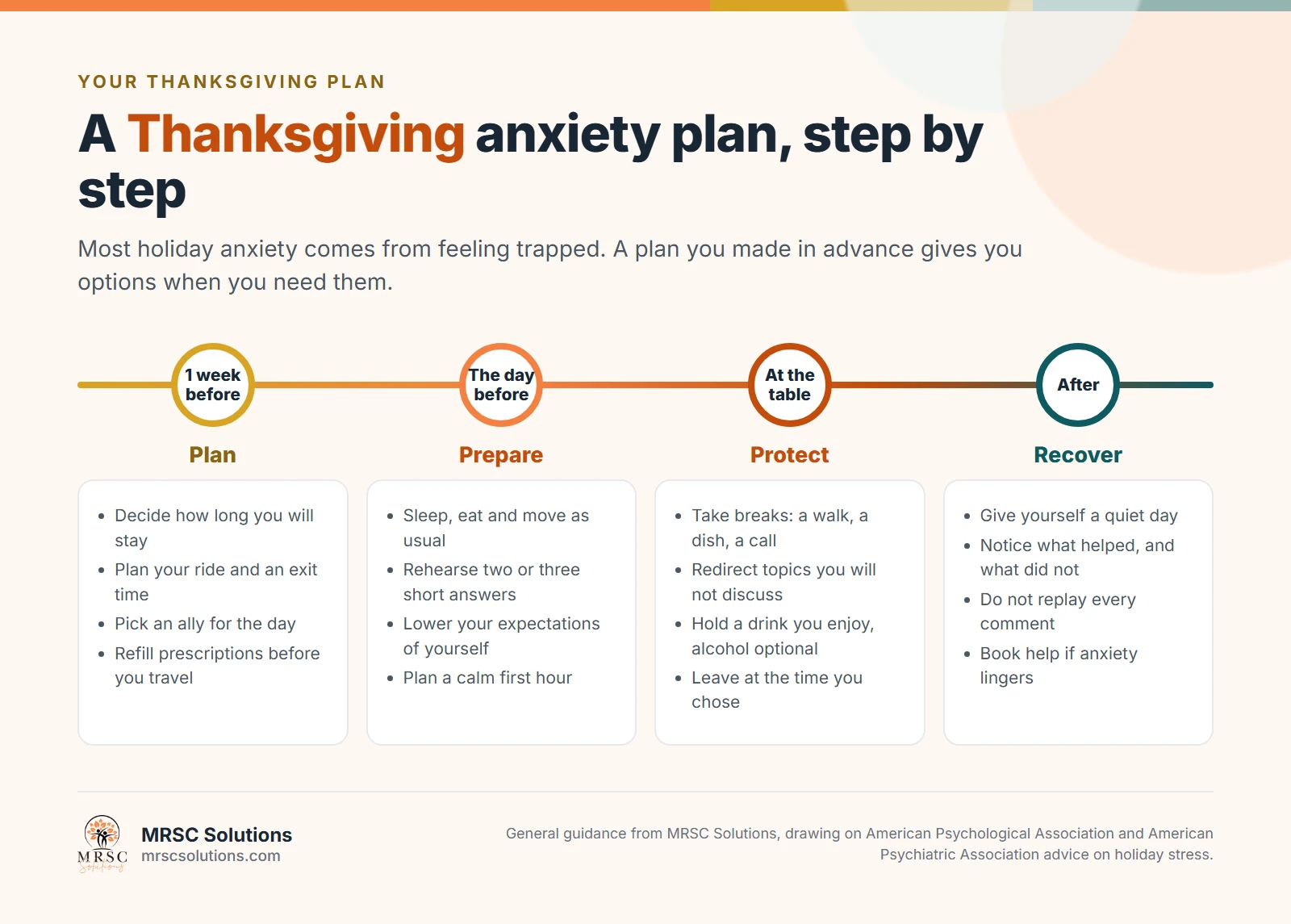
One week before
- Decide your time frame. "We'll come for dinner and leave by 7" is far easier to handle than an open-ended day. A clear end point makes the whole day feel survivable.
- Plan your exit. Drive yourself if you can, or know how you will get home. Feeling trapped is one of the biggest drivers of holiday anxiety.
- Choose an ally. A partner, sibling or cousin who knows your sore spots and will rescue you from a conversation with a simple signal.
- Refill prescriptions before you travel, and pack enough for delays.
- Decide what you will not discuss. Pick your topics in advance: politics, your weight, your relationship, your job, whatever is off limits for you this year.
The day before
- Protect your routine. Sleep, eat regular meals and move your body. Anxiety is much harder to manage when you are exhausted and hungry.
- Rehearse short answers to the questions you dread (see the scripts below).
- Lower the bar for yourself. The goal is not a perfect holiday. It is a manageable one.
- Plan your first hour. Arriving is often the hardest part. Plan something to do: helping in the kitchen, playing with the kids, taking the dog for a walk.
At the table
- Take breaks. Step outside, offer to wash dishes, take a short walk, or make a quick call. Leaving the room is allowed.
- Ground yourself. Try the 3-3-3 rule: name three things you can see, three things you can hear, and move three parts of your body. Slow breathing helps too; our guide to box breathing shows how.
- Redirect, do not debate. When a topic you have ruled out comes up, change the subject.
- Watch the alcohol. It can make conflict more likely and anxiety worse later.
- Leave when you said you would, even if things are going well. Ending on a good note is a win.
Afterward
- Give yourself a recovery day with as little on the schedule as possible.
- Notice what helped and what did not, and write it down for next year.
- Do not replay every comment. Rumination keeps the stress going. If your thoughts keep looping, our article on how to stop spiraling can help.
- Book help if the anxiety lingers.
What to Say: Short Answers for the Questions You Dread
The best way to handle intrusive questions is to have a short, friendly answer ready, then redirect the conversation. You do not owe anyone a detailed explanation. A calm sentence and a change of subject usually end the topic faster than a defense.
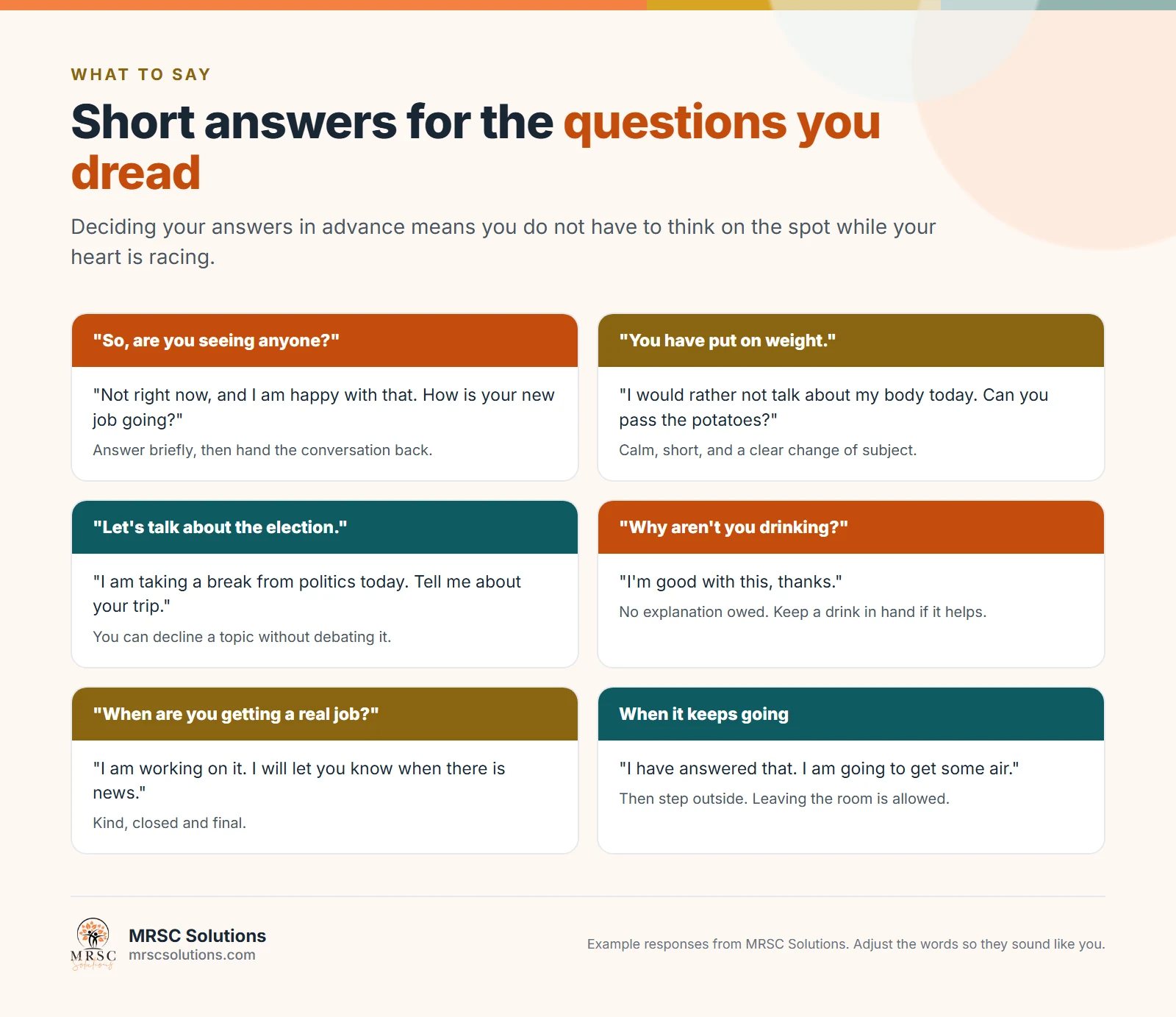
The formula is simple: acknowledge briefly, set the boundary, redirect.
- "So, are you seeing anyone?" "Not right now, and I'm happy with that. How's your new job going?"
- "When are you two having kids?" "That's between us. Did you ever finish the kitchen renovation?"
- "You've put on weight" or "Are you really eating that?" "I'd rather not talk about my body today. Can you pass the potatoes?"
- "Let's talk about the election." "I'm taking a break from politics today. Tell me about your trip."
- "Why aren't you drinking?" "I'm good with this, thanks." No explanation needed.
- "When are you going to get a real job?" "I'm working on it. I'll let you know when there's news."
- When someone will not let it go: "I've answered that. I'm going to get some air." Then step outside.
Food and body comments deserve a special mention, because they can be painful for anyone with a history of disordered eating or body image struggles. You are allowed to set that boundary firmly, and to ask your ally to back you up. Our guide to setting healthy boundaries offers more ways to say no without guilt.
How to Handle Politics at Thanksgiving
The simplest way to handle politics at Thanksgiving is to agree in advance, as a family or with your host, that it is off the table this year, and to have a short line ready to redirect when it comes up anyway. Avoiding the topic is fine, but it is not the same as managing your stress about it.
As American Psychological Association chief executive Arthur C. Evans Jr. put it after the 2024 election, "Avoiding conflict is not the same as coping with stress." It helps to do both: keep the dinner table politics-free, and find healthier outlets for your feelings about the news, such as a walk, a friend who shares your views, or time away from your phone.
A few practical tips:
- Ask the host to set the rule. "Let's keep politics off the table this year" lands better coming from the person whose house it is.
- Use your redirect line once, calmly. If it keeps going, excuse yourself.
- Do not try to change anyone's mind over pie. A heated debate at dessert rarely persuades anyone, and it can cost you the rest of the evening.
- Remember the reality. In a CBS News/YouGov poll after the 2024 election, a big majority planned to avoid political discussion at Thanksgiving, and just 1 in 10 said they had changed their plans to avoid people who voted differently. The blowup you fear is less likely than it feels.
When Thanksgiving Is Hard: Grief, Estrangement and Sobriety
If you are grieving
The first holiday after a loss is often the hardest. Some families find comfort in naming the person out loud, cooking their recipe or setting out a photo. Others need to change traditions completely. Both are valid. Let yourself step away when the empty chair becomes too much, and tell at least one person at the gathering that today is hard.
If you are estranged or no contact
For people who have chosen distance from a parent or relative, the holidays bring pressure from all sides. You do not have to justify your decision to anyone at the table. Plan where you will be and who you will be with, and consider building a day that is entirely yours.
If you are sober or cutting back
Holiday gatherings are full of drinks and drink offers. Bring your own favorite non-alcoholic drink, keep a glass in your hand, have your exit plan, and line up a sober friend or a meeting for that evening if you need one. The American Psychological Association's survey found 13% of adults rely on substances like alcohol or nicotine to get through the stress of the season, so you are protecting yourself from a very real trap.
Friendsgiving and chosen family
More people are reshaping the holiday entirely. In a 2025 Empower survey, nearly 2 in 5 said Friendsgiving is replacing traditional Thanksgiving, and more than 1 in 4 planned to pass on Thanksgiving because of costs. A smaller, kinder gathering with people who feel safe is a legitimate way to celebrate.
Social Anxiety at Family Gatherings
For people with social anxiety, a holiday gathering can feel like hours of being watched and judged. Small talk with relatives you rarely see, being the center of attention when you arrive, eating in front of others, and toasts or round-the-table "what are you thankful for" moments can all trigger intense anxiety.
A few strategies help:
- Arrive early. Walking into a quiet house as people trickle in is easier than walking into a full room.
- Give yourself a job. Setting the table, refilling drinks, or keeping the kids entertained gives your hands something to do and a reason to move around.
- Prepare two or three easy topics. A recent show, a trip, the food. Asking questions takes the spotlight off you.
- Know you are allowed to be quiet. You do not have to perform. Listening is a perfectly good way to take part.
- Plan small exits. A walk around the block, a bathroom break, a few minutes with the dog outside.
- Be kind to yourself afterward. Social anxiety loves a post-event replay. Notice it, and do not take the replay at face value.
If social anxiety is limiting your life well beyond the holidays, for example making work, dating or friendships hard, treatment can help a great deal.
Holiday Travel Anxiety
With tens of millions of people on the road and in the air over Thanksgiving week, travel is its own source of stress. Delays, crowds and tight connections are hard on anyone, and especially hard for people with anxiety or panic.
- Travel at off-peak times if you can, and leave buffer time so a delay does not become a crisis.
- Pack a calm kit: headphones, water, snacks, a phone charger, and anything that helps you ground yourself.
- Carry your medications in your hand luggage, with enough extra for a few days of delays.
- Expect some delays and decide in advance how you will handle them, rather than being surprised.
- Use slow breathing on the plane or in traffic. Long exhales help your body settle when you cannot leave.
- If you have panic attacks, remember that they pass, and that once a doctor has ruled out other causes, the feeling, though awful, is not dangerous in itself. Our article on panic attacks vs anxiety attacks explains what is happening.
Holiday Money Anxiety
With half of Americans more worried about money this season, financial stress is a big part of holiday anxiety. A few steps can lower the pressure:
- Set a total holiday budget before you start shopping, including travel and hosting.
- Suggest a family gift exchange, a spending limit, or gifts only for the children.
- Say no to some events. You are allowed to skip a dinner or a trip you cannot afford.
- Choose low-cost traditions: a potluck instead of hosting everything, a walk, a game night, a movie at home.
- Be honest with one person. Telling a partner or close friend that money is tight often eases the shame that makes money stress worse.
If You Are Hosting Thanksgiving
Hosting can turn ordinary holiday anxiety into a full-time job. The pressure to create a perfect meal and a perfect day is real, and it usually falls on one or two people.
- Delegate. Ask guests to bring dishes, drinks or dessert. Most people are glad to help.
- Simplify the menu. Make a few things well instead of everything from scratch.
- Set the tone early. As the host, you can say "This year, no politics at the table" and expect it to be respected.
- Build in a break for yourself, even 10 minutes alone in a quiet room.
- Let it be good enough. Guests rarely remember whether the rolls were homemade. They remember whether the day felt warm.
Holiday Anxiety: Myths Worth Letting Go
A few common beliefs make the season harder than it needs to be. Letting go of them can take real pressure off.
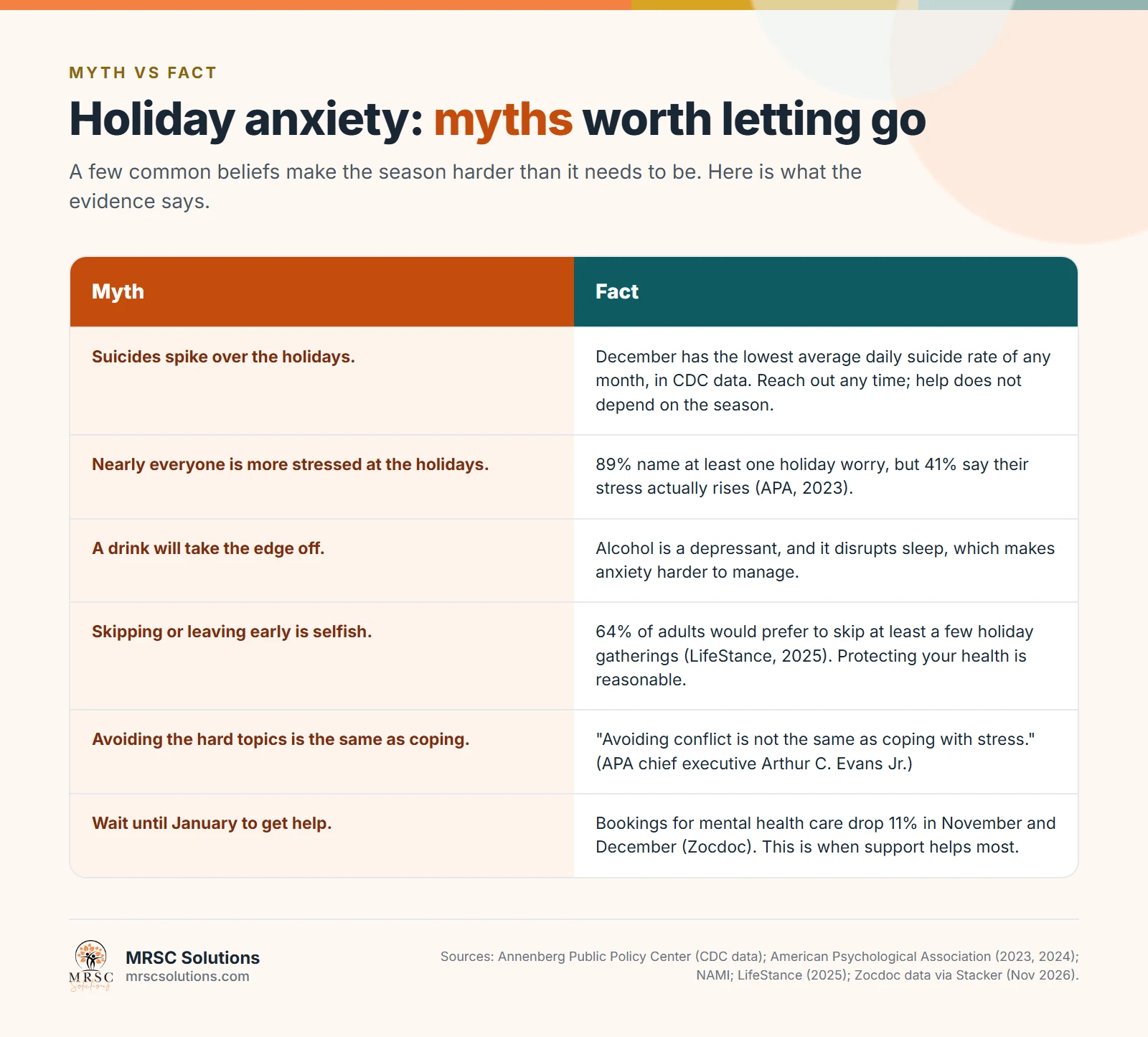
- Myth: suicides spike over the holidays. According to the University of Pennsylvania's Annenberg Public Policy Center, December had the lowest average daily suicide rate of any month in the most recent CDC data. That does not mean the holidays are easy, and help is always available through 988.
- Myth: everyone is more stressed at the holidays. Most people have at least one holiday worry, but around 41% say their stress actually rises.
- Myth: a drink takes the edge off. NAMI notes that alcohol is a depressant, and it disrupts sleep, which makes anxiety harder to manage.
- Myth: skipping a gathering or leaving early is selfish. Most adults would like to skip at least a few gatherings. Protecting your health is reasonable.
- Myth: you should wait until January to get help. Zocdoc data show that average daily bookings for mental health providers drop 11% in November and December compared with September and October. Many people put their mental health on hold during the season when support could help most.
Is This You? A Quick Self-Check
Answer honestly about the last few weeks:
- Have you been dreading Thanksgiving or the holidays for weeks?
- Are you losing sleep over upcoming gatherings, travel or money?
- Do you feel physically tense, nauseous or on edge when you think about family events?
- Are you planning to drink more than usual to get through it?
- Do you feel worried or tense most days, not only about the holidays?
- Did last year's holiday anxiety linger well into January or February?
- Is anxiety affecting your work, sleep or relationships right now?
If you answered yes to the first few, you are dealing with common holiday anxiety, and the planning steps above should help. If you answered yes to the last three, your anxiety may be more than seasonal, and it is worth talking to a professional.
When to Get Help for Holiday Anxiety
Get help if your anxiety lasts most days for several weeks, keeps you from sleeping, working or enjoying things, leads you to drink or use other substances to cope, or comes with panic attacks or low mood. You do not need to wait until after the holidays to ask for support.
Signs it is time to reach out:
- Worry or dread most days for two weeks or more
- Trouble sleeping, concentrating or eating
- Panic attacks, or physical symptoms like a racing heart or chest tightness
- Avoiding people, places or events because of anxiety
- Using alcohol, cannabis or other substances to cope
- Low mood, hopelessness or loss of interest in things you usually enjoy
If you are thinking about suicide or self-harm, call or text 988, the Suicide and Crisis Lifeline, which is available 24 hours a day, 7 days a week, or call 911 in an emergency.
What Getting Help Looks Like
Getting help for anxiety starts with an evaluation. You talk about what you are feeling, when it started, what makes it better or worse, how you are sleeping, and whether anxiety shows up outside the holidays too. Your clinician then explains what is going on and works out a plan with you, which may include therapy, medication, or both.
At MRSC Solutions, Rachel Christian, PMHNP-BC, a board-certified psychiatric nurse practitioner, provides anxiety treatment and depression treatment by secure video across Florida, New York, Arizona, Massachusetts, Oregon and California, and in person in West Palm Beach. Most new patients are seen within a week, and many major insurance plans are accepted; our FAQ explains how benefits are checked.
If you will be traveling over the holidays, keep in mind that a telehealth visit has to take place while you are physically in a state where your clinician is licensed. If you are visiting family in Florida, New York, Arizona, Massachusetts, Oregon or California, a video visit can still fit around your trip; our locations page lists where we can see you. Our guide on how online psychiatry works explains what to expect.
If holiday anxiety is already taking over your November, you do not have to wait for January. Request an appointment online or call (561) 849-4565, and we will help you get through the season, and the rest of the year, with more ease.
Conclusion
Holiday anxiety is common, it is rising, and it makes sense: the season packs family dynamics, travel, money, grief, politics and broken routines into a few short weeks. You cannot control what your relatives will say, but you can control a lot: how long you stay, how you leave, who has your back, and what you will say when the questions start. Plan ahead, keep your routines, take breaks, and give yourself permission to do the holidays your way. And if the anxiety is bigger than the season, help is available now. Book an appointment or call (561) 849-4565 today.
Frequently Asked Questions
Why do the holidays give me anxiety?
The holidays combine many stressors at once: family dynamics, travel, money, grief, disrupted routines, alcohol and pressure to feel happy. Family gatherings can also revive old roles and conflicts. In a 2025 poll, 41% of adults expected more holiday stress than the year before, so you are far from alone.
How do I deal with family during the holidays?
Plan ahead. Decide how long you will stay and how you will leave, choose an ally, and rehearse short answers to questions you dread. Take breaks during the day, keep your sleep and meals regular, limit alcohol, and redirect topics you do not want to discuss.
How do I avoid talking politics at Thanksgiving?
Ask the host to set a no-politics rule in advance, and have a short line ready, such as "I'm taking a break from politics today. Tell me about your trip." If the topic keeps coming up, excuse yourself for a few minutes. You do not have to win or join the debate.
Is it okay to skip Thanksgiving with family?
Yes. Choosing a smaller gathering, Friendsgiving or a quiet day can be a healthy decision, especially if family gatherings involve mistreatment, high conflict or costs you cannot manage. Many adults would prefer to skip at least some holiday gatherings, and protecting your health is reasonable.
What is the 3-3-3 rule for anxiety?
The 3-3-3 rule is a quick grounding technique. Name three things you can see, three things you can hear, and move three parts of your body. It pulls your attention back to the present moment and can ease rising anxiety in a crowded room or a tense conversation.
When is holiday anxiety a sign of an anxiety disorder?
Holiday anxiety usually eases after the season. If worry or dread lasts most days for weeks, appears outside the holidays, or affects your sleep, work or relationships, it may be an anxiety disorder. Anxiety disorders are common and very treatable with therapy, medication or both.